Satin bowerbird fact sheet | Field of Mars EEC
What are satin bowerbirds?
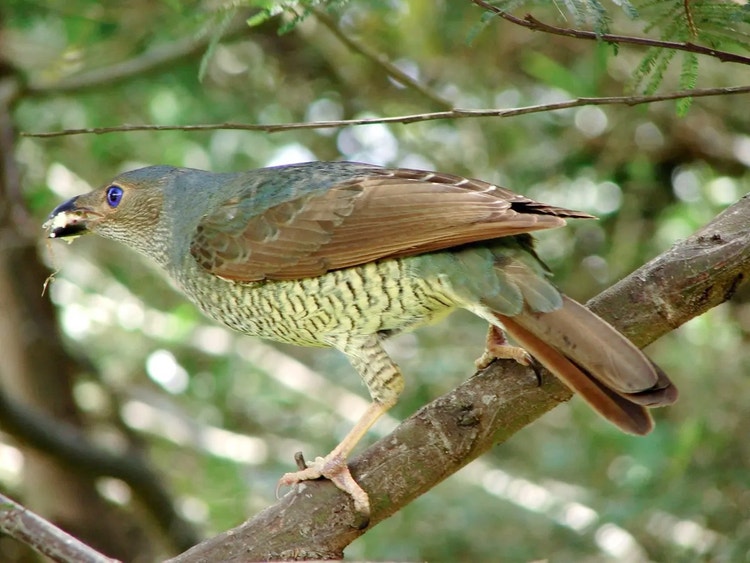
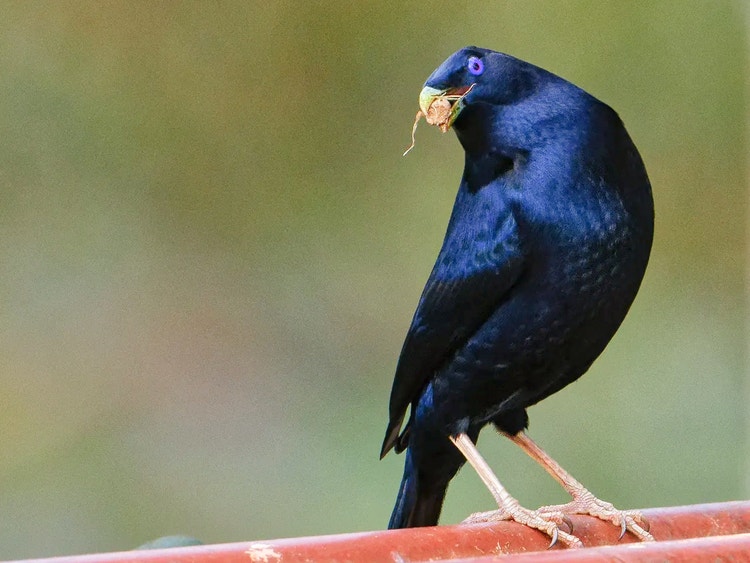
Satin bowerbirds are medium-sized native Australian birds best known for the elaborate bowers built by males during the breeding season. Adult males have glossy blue-black feathers that shine with a satin-like sheen in sunlight, while females and young birds are olive-brown with lighter markings underneath. Their scientific name is Ptilonorhynchus violaceus.
These birds live in forests, rainforest edges, wet sclerophyll woodland and leafy gardens along eastern Australia. In Sydney, satin bowerbirds are sometimes seen in larger bushland reserves, including Lane Cove National Park and nearby forested areas connected to the Field of Mars Reserve. Students may notice them feeding in fruiting trees, calling from dense vegetation or searching for bright blue objects to decorate their bowers.
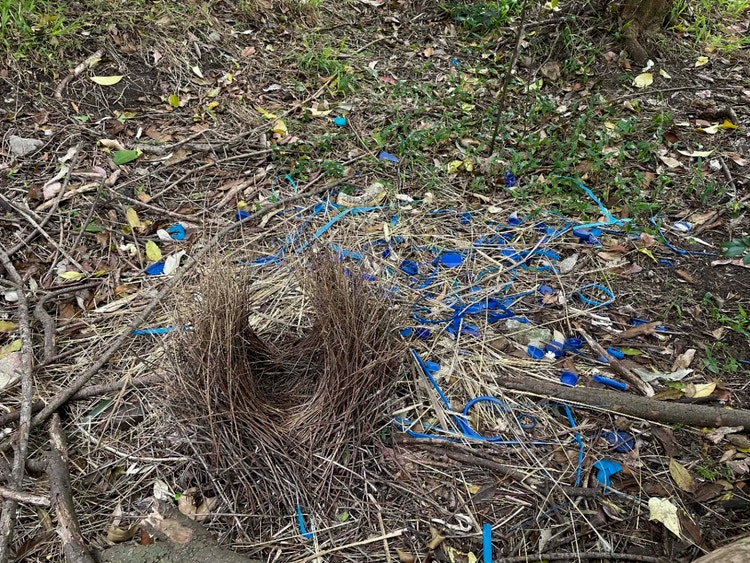
Satin bowerbirds are famous for their courtship behaviour. Males build and decorate special display structures called bowers to attract females. The bower is not a nest. Instead, it is used as a stage where the male performs dances and displays using colourful objects such as feathers, berries, flowers and even pieces of plastic.
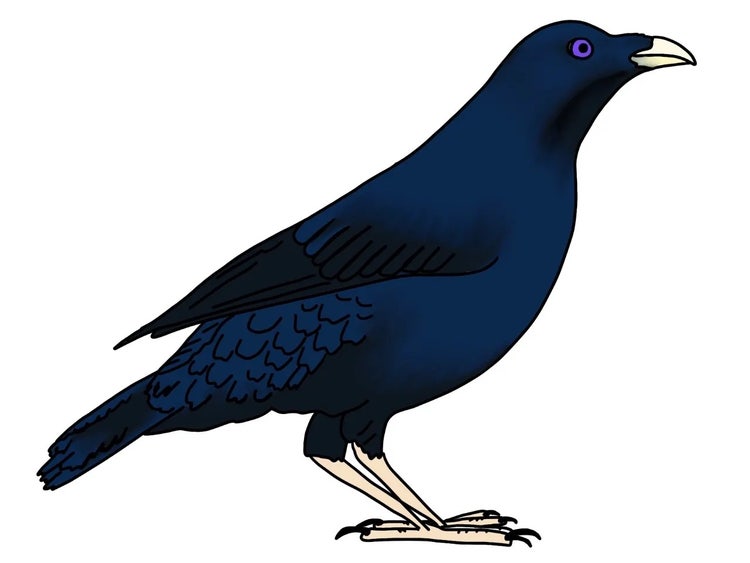
Fast facts – Satin bowerbird
Scientific name – Ptilonorhynchus violaceus
Scientific group – Satin bowerbirds are passerine birds in the bowerbird family.
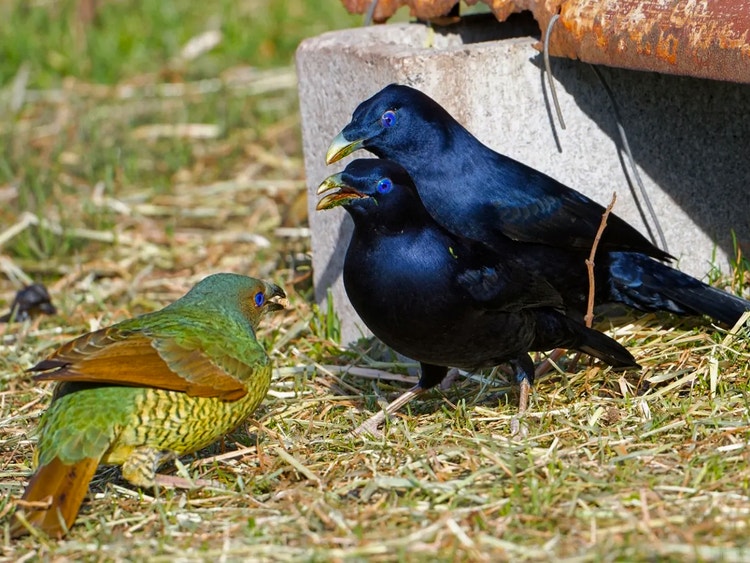
Appearance – Adult males have glossy blue-black feathers and bright blue eyes, while females and young birds are olive-brown with pale markings.
Size – Satin bowerbirds usually grow to about 25–32 centimetres long.
Diet – They eat fruit, insects, flowers, seeds and other plant material.
Habitat – Satin bowerbirds live in forests, rainforest edges, woodlands and large gardens in eastern Australia.
Life cycle – Females lay one to three eggs in a nest built in dense vegetation, and young birds may take several years to develop adult plumage.
Special behaviour – Male satin bowerbirds build and decorate bowers to attract females during courtship displays.
Where do satin bowerbirds live?
Satin bowerbirds live along the eastern coast of Australia from Queensland to Victoria. They are most common in rainforests, wet forests and tall eucalypt forests with dense shrubs and plenty of fruiting plants. They also adapt well to large gardens, orchards and parks where food and shelter are available.
In Sydney, satin bowerbirds are regularly recorded in bushland connected to Lane Cove National Park and other forested reserves. They prefer areas with thick vegetation where females can safely build nests and where males can gather decorations for their bowers. Students exploring bush tracks may notice a bower on the forest floor beneath shrubs or hear the harsh calls of these birds from the canopy.

What do satin bowerbirds eat?
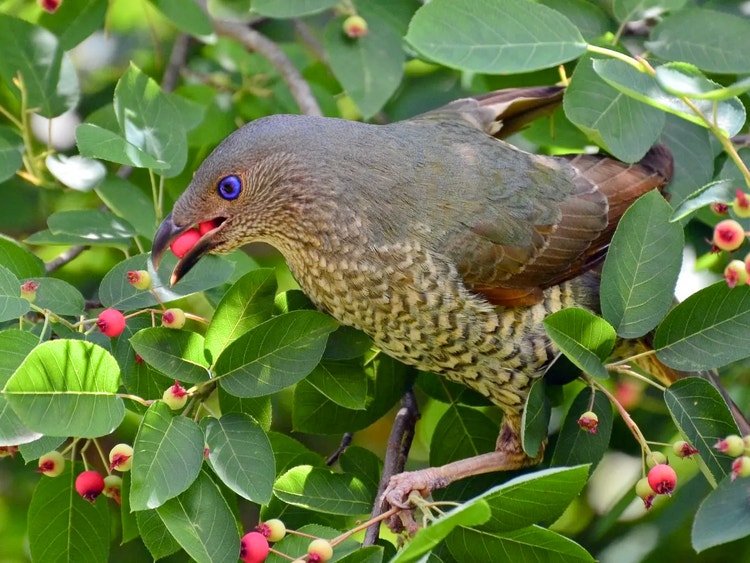
Satin bowerbirds are omnivores. Much of their diet includes fruit such as figs, lilly pilly berries and other soft native fruits. They also eat insects, spiders, nectar, seeds and flowers. Young birds need extra protein, so adults often feed them insects and other small animals.
These birds play an important role in forest ecosystems because they help spread seeds through their droppings. As they move through forests feeding on fruit, they help native plants grow in new places. Satin bowerbirds may also visit suburban gardens where flowering and fruiting plants provide food.
What do satin bowerbirds sound like?
Satin bowerbirds make a wide range of calls, whistles, hisses and harsh screeching sounds. Males often mimic the calls of other birds and even copy sounds from their environment. During courtship displays, males produce buzzing and rasping noises while dancing around the bower.
Their calls are most noticeable during spring and summer when breeding activity increases. Students walking in bushland may hear a loud raspy call before spotting the bird hidden among leaves and branches.
What is the life cycle of satin bowerbirds?
The breeding season usually begins in spring. Male satin bowerbirds build and carefully decorate bowers to attract females. Females visit several bowers before choosing a mate. After mating, the female builds a separate nest in dense shrubs or trees using sticks and leaves.
Females usually lay one to three eggs. The chicks hatch after about three weeks and remain in the nest while the female feeds and protects them. Young satin bowerbirds are brown like females and may take up to seven years to develop the glossy blue-black feathers of an adult male.

What adaptations do satin bowerbirds have to help them survive?
Male satin bowerbirds have strong legs and feet that help them gather sticks and build large bowers on the forest floor. Their excellent eyesight helps them find colourful decorations, especially blue objects that stand out during courtship displays. Bright blue eyes may also help communicate with other birds during breeding displays.
Females and young birds have brown patterned feathers that provide camouflage among branches and leaf litter. Satin bowerbirds are also intelligent and curious birds that learn from their environment. Their ability to mimic sounds and adapt to changing habitats helps them survive in forests as well as some urban areas.
Why are satin bowerbirds important?
Satin bowerbirds help maintain healthy forest ecosystems by spreading seeds from the fruits they eat. This helps native plants regenerate and supports forest biodiversity. They are also part of local food webs and provide food for larger predators.
These birds are important indicators of healthy forest habitat because they rely on dense vegetation, fruiting plants and suitable nesting areas. Their remarkable courtship behaviour also helps scientists study animal communication, learning and mate selection.

How can you help satin bowerbirds?
People can help satin bowerbirds by protecting native bushland and planting local native trees and shrubs that provide food and shelter. Fruit-producing native plants such as lilly pillies can support birds living in suburban gardens and bushland corridors.
Students can also help by staying on tracks when exploring bushland, keeping rubbish out of forests and avoiding disturbance to nests or bowers. Cats should be kept indoors or in enclosed outdoor spaces to reduce predation on native birds.

Related fact sheets
More bird fact sheets
- Birds fact sheet – Learn about bird features, life cycles, adaptations and ecological roles.
- Channel-billed cuckoo fact sheet – Explore another fruit-eating bird that helps spread seeds in forest ecosystems.
- Brush turkey fact sheet – Learn about another bird that uses forest floors and dense vegetation.
- Powerful owl fact sheet – Discover a forest predator that shares tall bushland habitats.
Habitats and ecosystems
- Eucalypt forest fact sheet – Explore the forest habitat where many native birds feed, shelter and nest.
- Tree habitats fact sheet – Learn how trees provide food, perches, nesting sites and shelter for birds.
- Shrub habitats fact sheet – Discover how dense shrubs help protect nesting and feeding birds.
Food webs and ecological relationships
- Noisy miner fact sheet – Compare another native bird that feeds on nectar, insects and fruit.
- Eastern spinebill fact sheet – Explore how birds connect with flowering plants and local food webs.
Field of Mars habitats and wildlife
- Field of Mars Reserve fact sheet – Learn about local bushland habitats and the wildlife they support.
Attributions
References
Australian Museum. Satin Bowerbird. [online] Available at: https://australian.museum/learn/animals/birds/satin-bowerbird/
BirdLife Australia. Satin Bowerbird. [online] Available at: https://birdlife.org.au/bird-profiles/satin-bowerbird/
NSW National Parks and Wildlife Service. Satin bowerbird. [online] Available at: https://www.nationalparks.nsw.gov.au/plants-and-animals/satin-bowerbird
Atlas of Living Australia. Satin Bowerbird – Ptilonorhynchus violaceus. [online] Available at: https://bie.ala.org.au/species/Satin%2BBowerbird
Booderee National Park. Satin bowerbird. [online] Available at: https://booderee.gov.au/discover/nature/birds/satin-bowerbird/
Hicks, B. and Elliott, D. The role of satin bowerbirds in seed dispersal. [online] Available at: https://www.botanicgardens.org.au/sites/default/files/2023-06/BGD0574_Cunninghamia-2020-Hicks-Elliott-Bowerbird-seeds_1.pdf
AnAge. Ptilonorhynchus violaceus – satin bowerbird. [online] Available at: https://genomics.senescence.info/species/entry.php?species=Ptilonorhynchus_violaceus
Image attributions
A satin bowerbird. – Field of Mars EEC (original image).
A male satin bowerbird’s bower at Field of Mars Reserve. – Field of Mars EEC (original image).
Satin bowerbirds may move to more open areas in winter to feed in flocks. – ‘Village gossip’ by audiodam. Creative Commons Attribution-NonCommercial-ShareAlike 2.0 Generic licence. Available at: https://www.flickr.com/photos/78063402@N00/52219661144/in/photostream/
Satin bowerbirds eat fruit, insects and other foods found in forest habitats. – ‘A Berry Xmas’ by Merryjack. Creative Commons Attribution 2.0 Generic licence. Available at: https://flic.kr/p/BmF2By
A male satin bowerbird’s bower is used for courtship, not nesting. – Field of Mars EEC (original image).
An immature male satin bowerbird practises courtship behaviour at another male’s bower. – ‘Satin Bowerbird’ by Leo. Creative Commons Attribution-NonCommercial-ShareAlike 2.0 Generic licence. Available at: https://flic.kr/p/cBpipd
Females and immature male satin bowerbirds have similar olive-green and brown plumage that helps them blend into leafy forest habitats. – ‘Satin Bowerbird - female’ by Tatters. Creative Commons Attribution 2.0 Generic licence. Available at: https://flic.kr/p/5QbEJf
An adult male satin bowerbird has glossy blue-black feathers that help attract females during courtship displays. – ‘A big flock of Satin Bowerbirds landed at the sheep trough’ by audiodam. Creative Commons Attribution-NonCommercial-ShareAlike 2.0 Generic licence. Available at: https://www.flickr.com/photos/78063402@N00/52218071664/
Satin bowerbirds are part of forest food webs where birds, plants and other animals depend on each other. – ‘Satin Bowerbird Ipswich Queensland Australia.jpg’ by Jesper Örtlund. Creative Commons Attribution-Share Alike 4.0 International licence. Available at: https://commons.wikimedia.org/wiki/File:Satin_Bowerbird_Ipswich_Queensland_Australia.jpg

Urban gardens with fruiting plants can provide food for satin bowerbirds. – ‘A Berry Xmas’ by Merryjack. Creative Commons Attribution 2.0 Generic licence. Available at: https://flic.kr/p/BmF2By
Learn with us

Book now
Book a birdwatching or Bowerbird builders program where students investigate bird behaviour, bowers, natural materials and animal-built structures.

Learning programs
Explore Field of Mars EEC programs that support learning about satin bowerbirds, bird behaviour, display structures, habitats and design in nature.

Learning resources
Use the satin bowerbird fact sheet to support classroom learning about bowers, courtship displays, blue objects, fruit, insects and forest habitats.

Flora and fauna fact sheets
Explore related fact sheets about birds, tree habitats, shrub habitats, native plants, eucalypt forests, rainforest ecosystems and animal structures.
Related programs
Junior birder HPGE enrichment program
Observe birds and their behaviours using binoculars, field notes and identification evidence before creating a digital bird artwork.
Photographer HPGE enrichment program
Develop nature photography skills through close observation, composition, perspective, lighting and digital editing in the bushland environment.