Powerful owl fact sheet | Field of Mars EEC
What are powerful owls?
Powerful owls are the largest owl species found in Australia. Their scientific name is Ninox strenua. These large forest owls have striking yellow eyes, heavy feathered legs and dark brown and white markings that help them blend into tree branches and shadows at night.
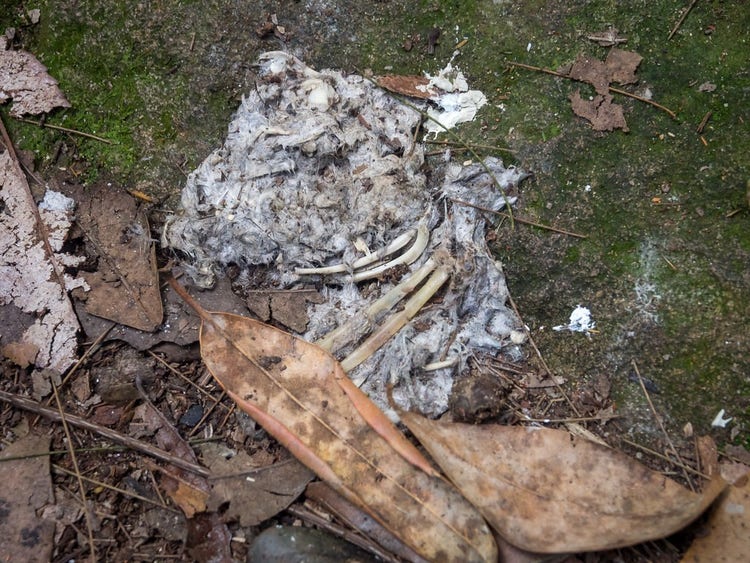
Powerful owls live in forests and woodlands along eastern Australia, including bushland around Sydney. They are difficult to spot during the day because they rest quietly in tall trees. Students exploring bushland in places such as Field of Mars Reserve or Lane Cove National Park may hear their deep calls at night or find signs of prey remains beneath large roost trees.
These powerful hunters feed mainly on possums and other mammals. They play an important role in forest food webs by helping control populations of nocturnal animals. Powerful owls need large areas of connected habitat with old trees for nesting and hunting, so they are sensitive to habitat loss and urban development.

Fast facts – Powerful owls
Scientific name – Ninox strenua
Scientific group – Powerful owls are large nocturnal birds of prey in the owl group.
Appearance – Powerful owls have yellow eyes, dark brown and white feathers, and heavily feathered legs with large talons.
Size – Adult powerful owls can grow to about 60 centimetres long with a wingspan of up to 140 centimetres.
Diet – Powerful owls mainly eat possums, gliders and other nocturnal animals.
Habitat – Powerful owls live in forests, woodlands and large areas of connected bushland with old hollow-bearing trees.
Life cycle – Powerful owls lay eggs in large tree hollows and raise one or two chicks each breeding season. Young owls may stay with their parents for many months while learning to hunt.
Special behaviour – Powerful owls silently hunt at night and can carry large prey in their strong talons.

Where do powerful owls live?
Powerful owls live along the east coast of Australia from Victoria to Queensland. They are most commonly found in forests, woodlands and large areas of connected bushland with tall trees. These owls need old trees with large hollows for nesting and sheltered areas where they can rest during the day.
In Sydney, powerful owls can still survive in bushland reserves, national parks and some urban areas where suitable habitat remains. Lane Cove National Park and nearby bushland corridors provide important habitat and movement pathways for powerful owls and their prey species. Students are unlikely to see a powerful owl during the day unless they know where a roost site is located, but pellets, white droppings and prey remains beneath trees can reveal that an owl is nearby.

What do powerful owls eat?
Powerful owls are carnivores and hunt mainly at night. Their diet includes possums, gliders, flying foxes, rats, rabbits and large birds. Ringtail possums are one of their most common prey animals in Sydney bushland.
These owls are ambush predators. They wait silently on branches before swooping down to catch prey with their powerful talons. Powerful owls often return to the same feeding sites and may leave feathers, fur or bones beneath favourite roost trees. By hunting medium-sized mammals, powerful owls help maintain balance in forest ecosystems.

What do powerful owls sound like?
Powerful owls make deep, slow double hoots that can travel long distances through the forest at night. Pairs often call to each other during the breeding season to communicate and defend their territory.
Young powerful owls also make high-pitched begging calls when waiting for food from their parents. Students camping or exploring bushland near suitable habitat at dusk may hear these distinctive owl calls echoing through the trees.
What is the life cycle of powerful owls?
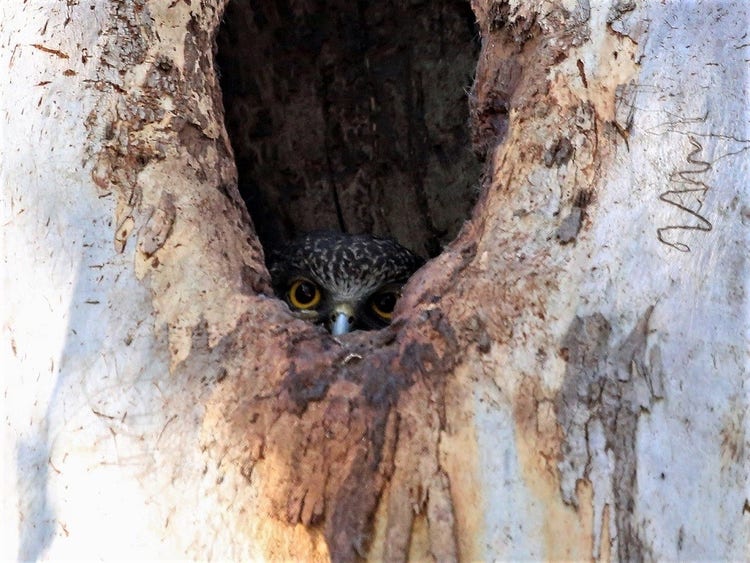
Powerful owls usually breed during autumn and winter. They nest in large hollows found in very old eucalyptus trees. The female lays one or two eggs and remains near the nest while the male brings food.
After hatching, chicks stay in the nest hollow for several weeks before learning to fly. Young powerful owls continue depending on their parents for food and protection for many months. Because these owls breed slowly and need old trees for nesting, habitat loss can strongly affect their populations.

What adaptations do powerful owls have to help them survive?
Powerful owls have many adaptations that help them hunt at night. Their large forward-facing eyes help them judge distance and see in low light. Soft feather edges allow them to fly almost silently so prey animals do not hear them approaching.
Their powerful talons and strong legs help them catch and carry heavy prey such as possums. Brown and white feathers provide camouflage among tree branches and bark during the day. Powerful owls also have excellent hearing, allowing them to locate animals moving through the forest at night.

Why are powerful owls important?
Powerful owls are important predators in Australian forest ecosystems. They help control populations of possums, rodents and other animals, which supports balanced food webs and healthy ecosystems.
These owls are also important indicators of forest health. Because they require large territories, old trees and healthy prey populations, the presence of powerful owls shows that bushland habitats are still functioning well. Protecting powerful owls also helps protect many other species that depend on mature forests.

How can you help powerful owls?
People can help powerful owls by protecting forests, preserving old hollow-bearing trees and supporting connected bushland corridors. Even small patches of native vegetation can help prey animals survive and provide movement pathways for wildlife.
Students can help by respecting bushland habitats, keeping cats indoors at night and learning about local wildlife. Planting native trees and supporting conservation programs can also help maintain healthy habitats for powerful owls and many other native species.

Related fact sheets
More bird fact sheets
- Birds fact sheet – Learn about bird features, life cycles, adaptations and roles in ecosystems.
- Laughing kookaburra fact sheet – Discover another native predator bird found in Sydney bushland.
- Australian raven fact sheet – Learn about an intelligent native bird that also lives in Sydney bushland.
Habitats and ecosystems
- Eucalypt forest fact sheet – Explore forest habitats with tall trees, hollows and food for many animals.
- Field of Mars Reserve fact sheet – Learn about local bushland that supports birds, possums and other native wildlife.
Animals that share this habitat
- Common ringtail possum fact sheet – Find out about a nocturnal tree-dwelling mammal found in forests and gardens.
- Common brushtail possum fact sheet – Learn about a possum species that uses tree hollows and urban bushland.
- Grey-headed flying-fox fact sheet – Discover another nocturnal mammal that moves through Sydney’s forests and urban areas.
Food webs and ecological relationships
- Mammals fact sheet – Explore mammal groups, habitats and their roles in Australian ecosystems.
- Red fox fact sheet – Learn about an introduced predator that affects native animals and food webs.
Attributions
References
Australian Museum. Powerful Owl. [online] Available at: https://australian.museum/learn/animals/birds/powerful-owl/
BirdLife Australia. Powerful Owl. [online] Available at: https://birdlife.org.au/bird-profiles/powerful-owl/
Birds in Backyards. Powerful Owl. [online] Available at: https://www.birdsinbackyards.net/species/Ninox-strenua
NSW Department of Climate Change, Energy, the Environment and Water. Powerful Owl – profile. [online] Available at: https://threatenedspecies.bionet.nsw.gov.au/profile?id=10562
NSW Scientific Committee. Powerful Owl Ninox strenua review report. [online] Available at: https://www.environment.nsw.gov.au/sites/default/files/2024-09/sc-powerful-owl-ninox-strenua-review-report.pdf
Queensland Government. Powerful owl. [online] Available at: https://www.qld.gov.au/environment/plants-animals/conservation/threatened-species/featured-projects/powerful-owl
Australian Museum. Powerful Owl Ninox strenua diet from two sites in the Australian Capital Territory. [online] Available at: https://publications.australian.museum/powerful-owl-ninox-strenua-diet-from-two-sites-in-the-australian-capital-territory/
Mo, M. and Waterhouse, D. Development of independence in Powerful Owl Ninox strenua fledglings in suburban Sydney. [online] Available at: https://www.oatleyflorafauna.org.au/wp-content/uploads/2021/08/MoWaterhouse-Powerful-Owl.pdf
Australian Museum. Save our owls. [online] Available at: https://australian.museum/blog-archive/science/save-our-owls/
Australian Geographic. Fact File: Powerful owl (Ninox strenua). [online] Available at: https://www.australiangeographic.com.au/fact-file/powerful-owl-ninox-strenua-2/
Image attributions
A powerful owl. – Field of Mars EEC (original illustration).
Powerful owls often rest quietly in large trees during the day. – ‘Powerful Owl - Sydney Olympic Park, New South Wales.jpg’ by JJ Harrison. Creative Commons Attribution-Share Alike 3.0 Unported licence. Available at: https://commons.wikimedia.org/wiki/File:Powerful_Owl_-_Sydney_Olympic_Park,_New_South_Wales.jpg

Tall forests with old hollow-bearing trees provide important habitat for powerful owls. – ‘Lane Cove River in Lane Cove National Park pano.jpg’ by Dicklyon. Creative Commons Attribution 4.0 International licence. Available at: https://commons.wikimedia.org/wiki/File:Lane_Cove_River_in_Lane_Cove_National_Park_pano.jpg

Powerful owls use strong talons to catch prey at night. – ‘Powerful Owl - April 6 2009 Chatswood West edited..JPG’ by Poyt448 Peter Woodard. Public domain. Available at: https://commons.wikimedia.org/wiki/File:Powerful_Owl_-_April_6_2009_Chatswood_West_edited..JPG

Powerful owl pellets can contain bones, fur and feathers from prey animals. – Field of Mars EEC (original image).
Powerful owls need large tree hollows for nesting. – Field of Mars EEC (original image).
Young powerful owls stay with their parents while learning to hunt. – ‘Ninox strenua - Lake Parramatta Reserve.jpg’ by JJ Harrison. Creative Commons Attribution-Share Alike 4.0 International licence. Available at: https://commons.wikimedia.org/wiki/File:Ninox_strenua_-_Lake_Parramatta_Reserve.jpg

Large talons help powerful owls catch and carry prey. – ‘Powerful Owl 0A2A8181.jpg’ by JJ Harrison. Creative Commons Attribution-Share Alike 4.0 International licence. Available at: https://commons.wikimedia.org/wiki/File:Powerful_Owl_0A2A8181.jpg

Powerful owls are important predators in Australian forest ecosystems. – ‘Powerful Owl in a Native Crabapple.jpg’ by Poyt448, Peter Woodard. Creative Commons Attribution-Share Alike 4.0 International licence. Available at: https://commons.wikimedia.org/wiki/File:Powerful_Owl_in_a_Native_Crabapple.jpg

Protecting connected bushland helps powerful owls survive in urban environments. – ‘Lane Cove River in Lane Cove National Park pano.jpg’ by Dicklyon. Creative Commons Attribution 4.0 International licence. Available at: https://commons.wikimedia.org/wiki/File:Lane_Cove_River_in_Lane_Cove_National_Park_pano.jpg
Learn with us

Book now
Book a science or ecosystem fieldwork program where students investigate powerful owls, forest habitats, possums, food webs and ecosystem health.

Learning programs
Explore Field of Mars EEC programs that support learning about powerful owls, predator-prey relationships, habitat trees, biodiversity and conservation.

Learning resources
Use the powerful owl fact sheet to support classroom learning about large owls, talons, night hunting, hollows, possums and forest food webs.

Flora and fauna fact sheets
Explore related fact sheets about birds of prey, possums, mammals, tree habitats, eucalypt forests, food webs and Field of Mars Reserve.
Related programs
Ecosystems excursion
Investigate habitat suitability for powerful owls by collecting ecosystem data and constructing food webs from field evidence.
Mystery HPGE enrichment program
Analyse wildlife clues, prey evidence, maps and field data to investigate predator-prey relationships and solve an environmental mystery.