Australian raven fact sheet – wugan | Field of Mars EEC
What are Australian ravens?
Australian ravens are large black birds that belong to the crow and raven family. Their scientific name is Corvus coronoides. They are called wugan by the Darug people of the Sydney basin. These intelligent birds are common across much of eastern and southern Australia and are often seen in bushland, parks, farmland and suburbs around Sydney. Many people recognise them by their loud, drawn-out calls and shaggy throat feathers.
Australian ravens have glossy black feathers, a strong black beak and pale white eyes as adults. When they call, the long throat feathers puff out and give the bird a shaggy or bearded appearance. Young birds have darker eyes that gradually become pale as they grow older.
Students may spot Australian ravens searching for food on sports fields, perched high in trees, or gliding over bushland in places such as Field of Mars Reserve and Lane Cove National Park. Ravens are curious, adaptable birds that can solve problems, remember food sources and work together to defend their territory.

An Australian raven.
Fast facts – Australian raven
Scientific name – Corvus coronoides
Scientific group – Australian ravens are large native birds in the corvid family, which also includes crows.
Appearance – Australian ravens have glossy black feathers, pale eyes and shaggy throat feathers that puff out when calling.
Size – Adult Australian ravens usually grow to about 46–53 centimetres long with a wingspan close to 1 metre.
Diet – Australian ravens are omnivores that eat insects, seeds, fruit, carrion, small animals and human food scraps.
Habitat – Australian ravens live in forests, woodlands, farms, coastal areas, parks and suburbs across much of Australia.
Life cycle – Australian ravens hatch from eggs laid in large stick nests and may live for more than 10 years in the wild.
Special behaviour – Australian ravens are highly intelligent birds that use problem-solving skills and defend their territory with loud calls and swooping flights.

Where do Australian ravens live?
Australian ravens live across eastern and southern Australia in many different habitats. They are common in open forests, woodlands, grasslands, coastal areas and farmland. Ravens have also adapted well to human environments and are often seen in parks, school grounds, sporting fields and suburban streets.
In Sydney, Australian ravens can be found in bushland areas such as Field of Mars Reserve and Lane Cove National Park. They usually perch high in tall trees where they can watch for food or warn other ravens about danger. Ravens build large stick nests high in trees and often return to the same territory year after year.

What do Australian ravens eat?
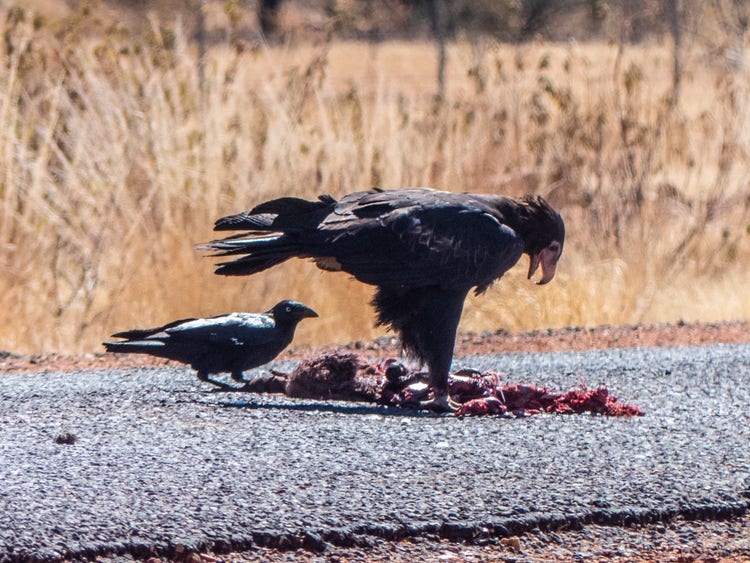
Australian ravens are omnivores, which means they eat both plants and animals. They feed on insects, spiders, seeds, fruit, eggs, reptiles and small mammals. Ravens are also scavengers and help clean the environment by eating dead animals.
These birds are very adaptable feeders and often search for food in rubbish bins, picnic areas and roadsides. Ravens walk confidently across the ground while looking for food and use their strong beaks to tear apart tough materials. Young ravens learn feeding skills by watching adult birds.
What do Australian ravens sound like?
Australian ravens are famous for their deep, slow “ah-ah-aaaah” calls that can carry across long distances. When calling, the bird stretches its neck and raises the long throat feathers beneath its beak. Their calls are often heard early in the morning or when defending territory.
Ravens use different calls to communicate with mates, warn about danger and keep track of family members. Their loud voices help pairs stay connected in large territories across bushland and urban environments.
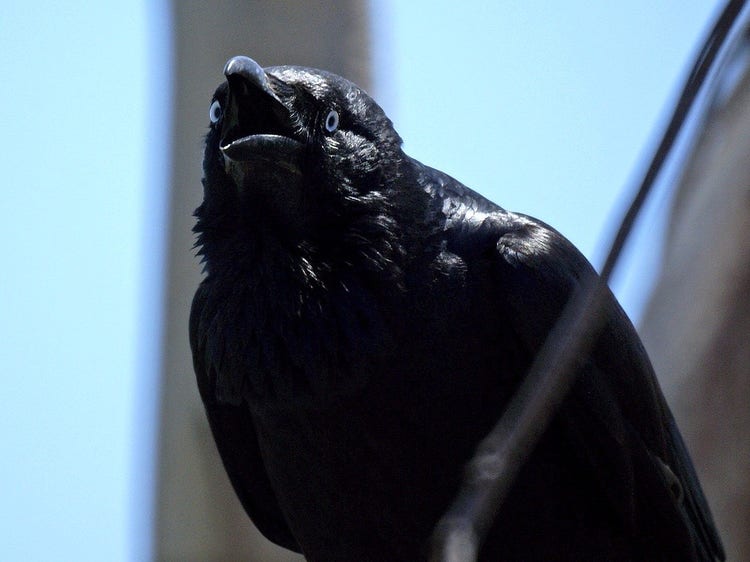
Australian ravens use loud calls to communicate across their territory.
What is the life cycle of Australian ravens?
Australian ravens usually breed from winter into spring. Pairs often stay together for life and defend nesting territories throughout the year. They build large stick nests lined with grass, bark and feathers high in tall trees.
The female lays several eggs and incubates them while the male brings food to the nest. Young chicks hatch blind and helpless before gradually growing feathers and learning to fly. Juvenile ravens often stay with their parents for a period before joining groups of younger birds. Adult ravens can live for more than a decade in the wild.

An Australian raven chick.
What adaptations do Australian ravens have to help them survive?
Australian ravens are highly intelligent birds with strong memories and problem-solving abilities. They can learn where reliable food sources are located and quickly adapt to changing environments. Their powerful beaks help them tear apart food, dig through leaf litter and scavenge carrion.
Their glossy black feathers absorb heat during cool mornings, while their strong wings allow them to soar long distances. Ravens also have excellent eyesight and communication skills that help them defend territories and warn each other about danger. Their adaptability is one reason they survive successfully in both natural and urban environments.

Australian ravens use intelligence and strong beaks to survive in many habitats.
Why are Australian ravens important?
Australian ravens play an important role in ecosystems as scavengers and predators. By eating carrion, they help clean the environment and recycle nutrients back into the ecosystem. They also help control insect populations and remove weak or sick animals from food webs.
Ravens are part of many Australian ecosystems and provide food for larger predators such as powerful owls and eagles. Their presence can also help scientists understand changes in urban wildlife and ecosystem health because ravens respond quickly to environmental change.

How can you help Australian ravens?
People can help Australian ravens by protecting native bushland habitats and keeping local environments healthy. Planting native trees provides nesting sites and shelter for ravens and many other native birds. Reducing litter also helps prevent birds from eating harmful rubbish.
Students can help by observing ravens respectfully without disturbing nests or feeding wildlife unhealthy food. Learning about native birds and protecting habitats such as Field of Mars Reserve supports healthy ecosystems for many different species.

Related fact sheets
More bird fact sheets
- Birds fact sheet – Learn about bird features, life cycles and adaptations.
- Australian magpie fact sheet – Compare another intelligent black-and-white bird found in open spaces.
- Butcherbird fact sheet – Learn about another bird with a strong hooked beak.
- Australian white ibis fact sheet – Explore another adaptable native bird that forages in parks and urban areas.
Habitats and ecosystems
- Field of Mars Reserve fact sheet – Discover local bushland habitats that support native birds.
- Eucalypt forest fact sheet – Explore forest layers where ravens perch, nest and search for food.
- Tree habitats fact sheet – Learn how trees provide nesting, shelter and lookout sites.
Food webs and ecological relationships
- Leaf litter habitats fact sheet – Explore how fallen leaves support insects, decomposers and food webs.
- Insects fact sheet – Learn about small animals that form part of many bird food webs.
- Red fox fact sheet – Find out about an introduced predator and scavenger that shares some food sources with ravens.
Attributions
References
Australian Museum. Australian Raven. [online] Available at: https://australian.museum/learn/animals/birds/australian-raven/
BirdLife Australia. Australian Raven. [online] Available at: https://birdlife.org.au/bird-profiles/australian-raven/
Birds in Backyards. Australian Raven. [online] Available at: https://www.birdsinbackyards.net/species/Corvus-coronoides
Atlas of Living Australia. Australian Raven Corvus coronoides. [online] Available at: https://bie.ala.org.au/species/Australian%2BRaven
Museums Victoria Collections. Corvus coronoides, Australian Raven. [online] Available at: https://collections.museumsvictoria.com.au/species/8155
BirdLife International. Australian Raven Corvus coronoides Species Factsheet. [online] Available at: https://datazone.birdlife.org/species/factsheet/australian-raven-corvus-coronoides
Image attributions
An Australian raven. – Field of Mars EEC (original illustration).
Ravens have a distinctive ‘beard’ called a hackle. – ‘Australian Raven.’ by Laurie R B. Creative Commons Attribution-ShareAlike 2.0. Available at: https://www.flickr.com/photos/12567713@N00/4147507155
Australian ravens are common in Sydney bushland and urban parks. – Field of Mars EEC (original image).
Australian ravens are opportunistic feeders that search for many different foods. This raven is sharing a meal with a wedge-tailed eagle. – ‘File:Wedge-tailed eagle and Australian raven Diamantina Developmental Road Boulia Shire Central Western Queensland P1080978.jpg’ by John Robert McPherson. Creative Commons Attribution-ShareAlike 4.0. Available at: https://commons.wikimedia.org/wiki/File:Wedge-tailed_eagle_and_Australian_raven_Diamantina_Developmental_Road_Boulia_Shire_Central_Western_Queensland_P1080978.jpg

Australian ravens use loud calls to communicate across their territory. – ‘Australian Raven (Corvus coronoides)’ by David Cook Wildlife Photography. Creative Commons Attribution-NonCommercial 2.0. Available at: https://www.flickr.com/photos/davidcookwildlifephotography/
An Australian raven chick. – ‘Juvenile Australian Raven’ by Derek A Young. Creative Commons Attribution-NonCommercial 2.0. Available at: https://www.flickr.com/photos/dereksnaturephotos/
Australian ravens use intelligence and strong beaks to survive in many habitats. – ‘Australian Raven’ by _Stickybeak. Creative Commons Attribution-NonCommercial 2.0. Available at: https://www.flickr.com/photos/31031835@N08/
Australian ravens are important predators in bushland and urban environments. – ‘Australian Raven (49764389421).jpg’ by Jean and Fred. Creative Commons Attribution 2.0. Available at: https://commons.wikimedia.org/wiki/File:Australian_Raven_(49764389421).jpg
.jpg)
Healthy gardens and bushland provide food and nesting sites for Australian ravens. – ‘Australian Raven Sydney University.jpg’ by Toby Hudson. Creative Commons Attribution-ShareAlike 3.0. Available at: https://commons.wikimedia.org/wiki/File:Australian_Raven_Sydney_University.jpg

Learn with us

Book now
Book a curriculum-aligned excursion or incursion where students investigate intelligent birds, scavengers, food webs, calls and urban wildlife.

Learning programs
Explore Field of Mars EEC programs that support learning about Australian ravens, bird behaviour, scavenging, adaptation and ecosystem roles.

Learning resources
Use the Australian raven fact sheet to support classroom learning about black birds, strong beaks, loud calls, problem-solving and varied diets.

Flora and fauna fact sheets
Explore related fact sheets about birds, urban environments, eucalypt forests, insects, reptiles, mammals and food webs.
Related programs
Mystery HPGE enrichment program
Analyse wildlife clues, predator and prey evidence, maps and field data to solve an environmental mystery.
Junior birder HPGE enrichment program
Investigate bird identification, calls, behaviour and habitat use through guided birdwatching and field observation.