Channel-billed cuckoo fact sheet | Field of Mars EEC
What are channel-billed cuckoos?
Channel-billed cuckoos (Scythrops novaehollandiae) are large migratory birds found in northern and eastern Australia. They are the largest cuckoos in the world and are well known for their loud calls, long tails and huge curved bills. These birds arrive in Sydney during spring and summer to breed before migrating north again in autumn.
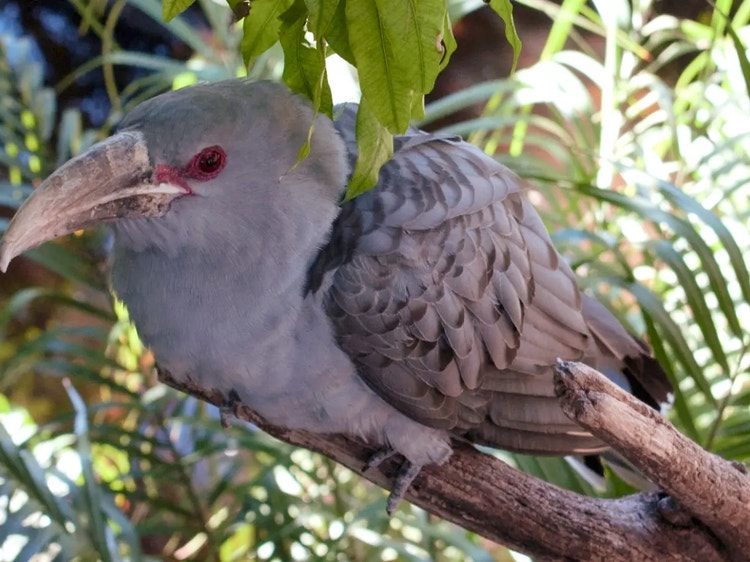
Channel-billed cuckoos are often noticed because of their noisy screeching calls and dramatic flying displays. They have grey-brown feathers, pale underparts, red eyes and broad wings. Their long tail helps them steer through the air as they move between tall trees in forests, parks and suburban areas.
Unlike most birds, channel-billed cuckoos do not build their own nests or raise their own chicks. Instead, they lay their eggs in the nests of other birds, especially Australian magpies, currawongs, ravens and pied currawongs. This behaviour is called brood parasitism. Students may hear or see channel-billed cuckoos in tall eucalypt forests around Sydney, including bushland near Field of Mars Reserve and Lane Cove National Park during the warmer months.
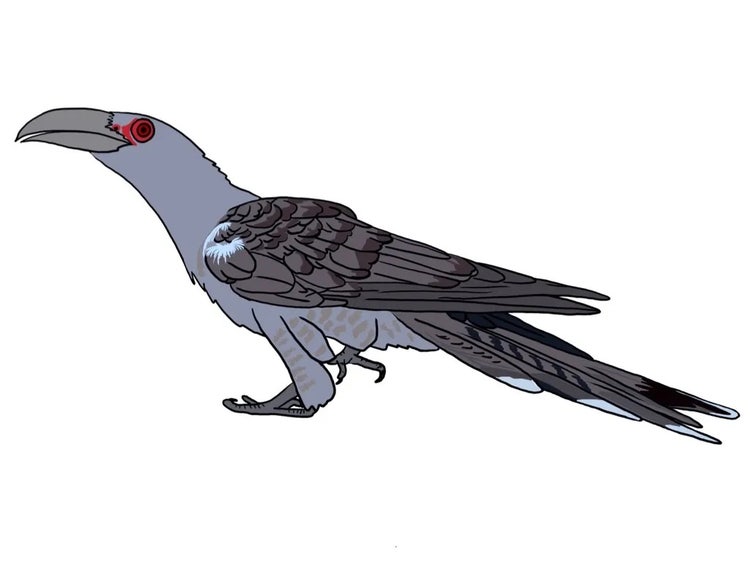
A channel-billed cuckoo.
Fast facts – Channel-billed cuckoo
Scientific name – Scythrops novaehollandiae
Scientific group – Channel-billed cuckoos are large migratory birds in the cuckoo family.
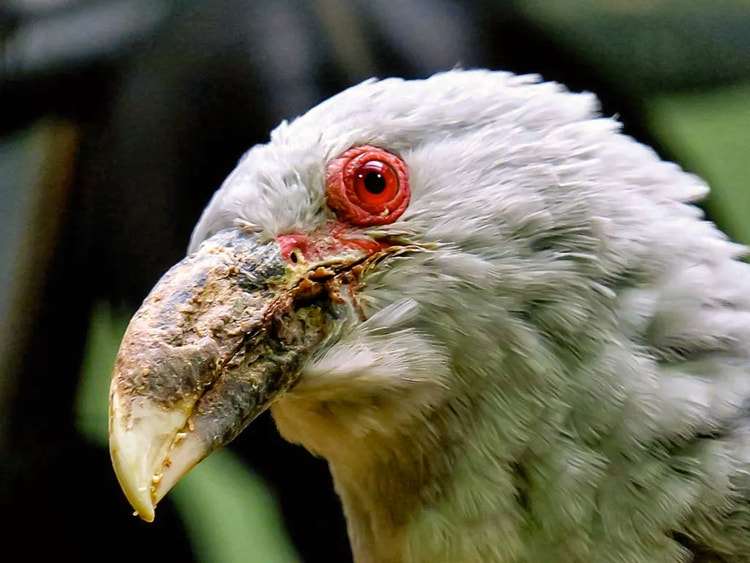
Appearance – They have grey-brown feathers, red eyes, a long tail and a large pale curved bill.
Size – Adults can grow to about 60 centimetres long with a wingspan over 90 centimetres.
Diet – They mainly eat figs and other fruits but also feed on insects, caterpillars and small animals.
Habitat – They live in forests, woodlands, rainforests, parks and suburbs with tall trees.
Life cycle – Females lay eggs in the nests of other birds during spring and summer, and chicks are raised by foster parents before the adults migrate north again.
Special behaviour – Channel-billed cuckoos are brood parasites that trick other birds into raising their chicks.
Where do channel-billed cuckoos live?
Channel-billed cuckoos live across northern and eastern Australia, as well as parts of Papua New Guinea and Indonesia. In Australia they migrate south during spring and summer to breed, then return north during autumn. They are commonly found in rainforests, open forests, woodlands, coastal bushland and suburban areas with tall trees.
In Sydney, channel-billed cuckoos are often seen or heard in parks, school grounds and bushland reserves during the warmer months. They are regularly noticed in areas with large fig trees and nesting birds that can act as foster parents. Students visiting bushland around Field of Mars Reserve or Lane Cove National Park may hear their loud screeching calls high in the tree canopy before spotting the birds themselves.
What do channel-billed cuckoos eat?
Channel-billed cuckoos mainly eat fruit, especially figs from native and introduced fig trees. They also feed on berries, seeds, insects, caterpillars, cicadas and occasionally small birds or eggs. Their strong curved bill helps them grab and swallow large fruits whole.
These birds help spread seeds through forests and urban bushland when they move between feeding areas. By dispersing seeds, they support the growth of native plants and rainforest species. Their feeding behaviour also connects them to seasonal food cycles in Australian ecosystems.
What do channel-billed cuckoos sound like?
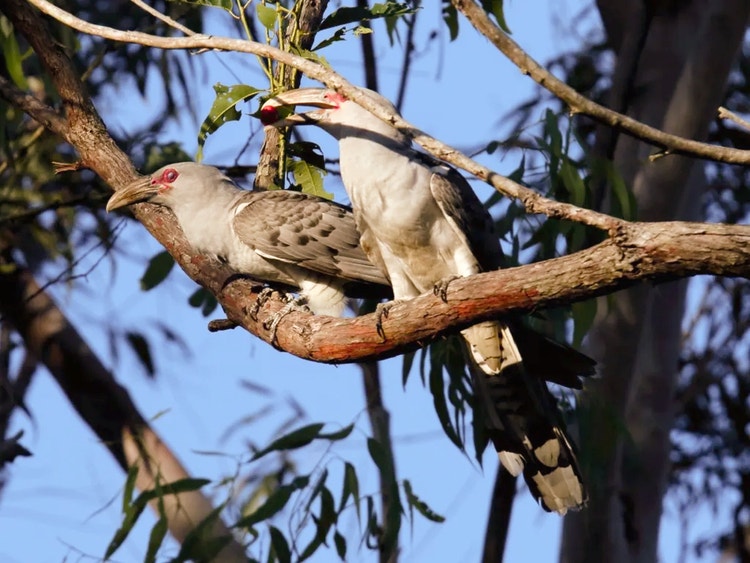
Channel-billed cuckoos are famous for their loud, harsh screeching calls. Their calls are often described as noisy, rising shrieks that echo across suburbs and bushland during spring and summer. Groups of birds may call together while flying over treetops.
These calls help birds communicate during migration and breeding. Many people first notice channel-billed cuckoos by sound before they ever see the birds. Their noisy behaviour is a strong sign that warmer weather has arrived in eastern Australia.
What is the life cycle of channel-billed cuckoos?
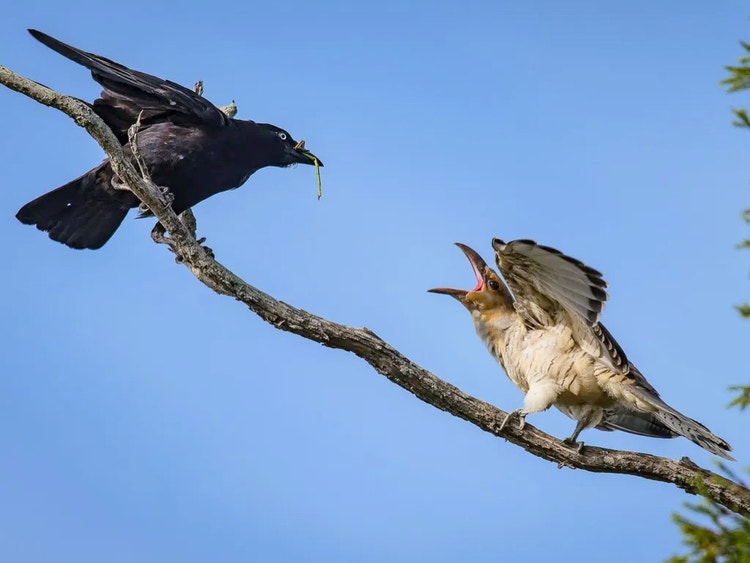
Channel-billed cuckoos migrate into southern Australia during spring to breed. Instead of building nests, females lay their eggs in the nests of other large birds such as currawongs, magpies or ravens. Foster parents incubate the eggs and raise the cuckoo chick after it hatches.
Young channel-billed cuckoos grow quickly and can become much larger than the foster parents feeding them. After the breeding season, adults and young birds migrate north again. Channel-billed cuckoos may live for more than 20 years in the wild.
What adaptations do channel-billed cuckoos have to help them survive?
Channel-billed cuckoos have several adaptations that help them survive across large distances and varied habitats. Their broad wings and long tail allow strong, efficient flight during migration. Their large curved bill helps them eat large fruits and capture prey in tree canopies.
Their most unusual adaptation is brood parasitism. By laying eggs in the nests of other birds, channel-billed cuckoos avoid the energy costs of building nests and raising chicks themselves. Their chicks hatch quickly and grow rapidly, increasing their chances of survival before migration season begins.
Why are channel-billed cuckoos important?
Channel-billed cuckoos play an important role in Australian ecosystems as seed dispersers and predators of insects and other small animals. By spreading seeds from fruits such as figs, they help regenerate forests and support plant diversity.
These birds are also part of complex food webs and seasonal migration patterns. Their arrival in spring connects Australian ecosystems with broader migratory systems across the Pacific region. Studying channel-billed cuckoos helps scientists understand bird migration, breeding behaviour and changing environments.
How can you help channel-billed cuckoos?
People can help channel-billed cuckoos by protecting forests, bushland and large native trees. Planting native trees that provide food and shelter can support migratory birds visiting suburban areas during spring and summer.
Students can also help by respecting wildlife habitats, keeping pets away from nesting birds and learning more about migratory species. Healthy urban bushland and connected habitats help channel-billed cuckoos complete their long seasonal journeys safely.

Related fact sheets
More bird fact sheets
- Birds – Learn about bird features, habitats and adaptations.
- Australian magpie – Discover a bird that may raise channel-billed cuckoo chicks.
- Pied currawong – Learn about another large bird linked to channel-billed cuckoo breeding.
- Australian raven – Explore another large, intelligent bird found in Sydney bushland.
Habitats and ecosystems
- Habitat – Learn what animals need from their habitats.
- Tree habitats – Discover how trees provide food, shelter and nesting places for birds.
Animals that share this habitat
- Laughing kookaburra – Find out about another bird that uses trees for perching and breeding.
- Noisy miner – Learn about a common Sydney bird that lives in open areas with trees.
Food webs and ecological relationships
Attributions
References
Australian Museum. Channel-billed Cuckoo. [online] Available at: https://australian.museum/learn/animals/birds/channel-billed-cuckoo/
Atlas of Living Australia. Australian Channel-Billed Cuckoo. [online] Available at: https://bie.ala.org.au/species/Australian%2BChannel-Billed%2BCuckoo
BirdLife Australia. Channel-billed Cuckoo. [online] Available at: https://birdlife.org.au/bird-profiles/channel-billed-cuckoo/
BirdLife International. Channel-billed Cuckoo Scythrops novaehollandiae. [online] Available at: https://datazone.birdlife.org/species/factsheet/channel-billed-cuckoo-scythrops-novaehollandiae
Birds in Backyards. Channel-billed Cuckoo. [online] Available at: https://www.birdsinbackyards.net/species/Scythrops-novaehollandiae
Museums Victoria. Scythrops novaehollandiae, Channel-billed Cuckoo. [online] Available at: https://collections.museumsvictoria.com.au/species/8160
Queensland Government. Taxon: Scythrops novaehollandiae, channel-billed cuckoo. [online] Available at: https://wildnet.science-data.qld.gov.au/taxon-detail?taxon_id=1740
NSW National Parks and Wildlife Service. Lane Cove National Park. [online] Available at: https://www.nationalparks.nsw.gov.au/visit-a-park/parks/lane-cove-national-park
Image attributions
A channel-billed cuckoo. – Field of Mars EEC (original illustration).
Channel-billed cuckoos are mostly grey with a red ring around their eyes. – ‘Channel-billed cuckoo at Adelaide Zoo’ by Bilby. Creative Commons Attribution 3.0 Unported licence. Available at: https://commons.wikimedia.org/wiki/File:Channel-billed_Cuckoo_at_Adelaide_Zoo.jpg

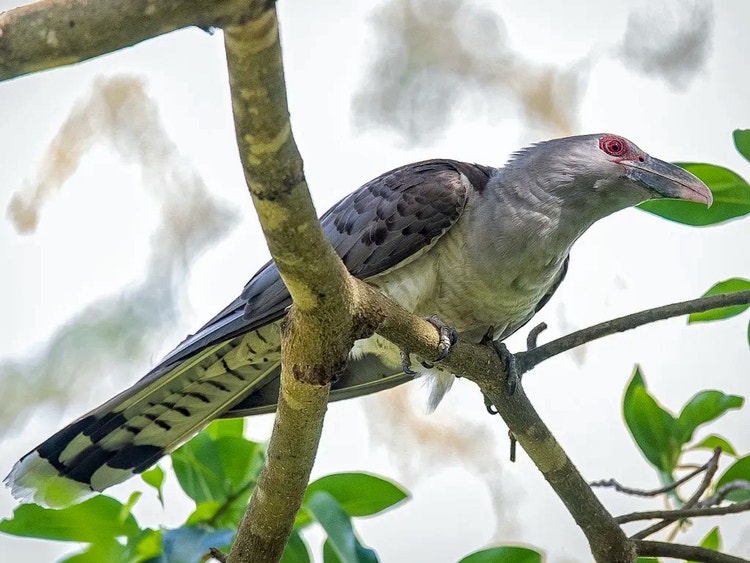
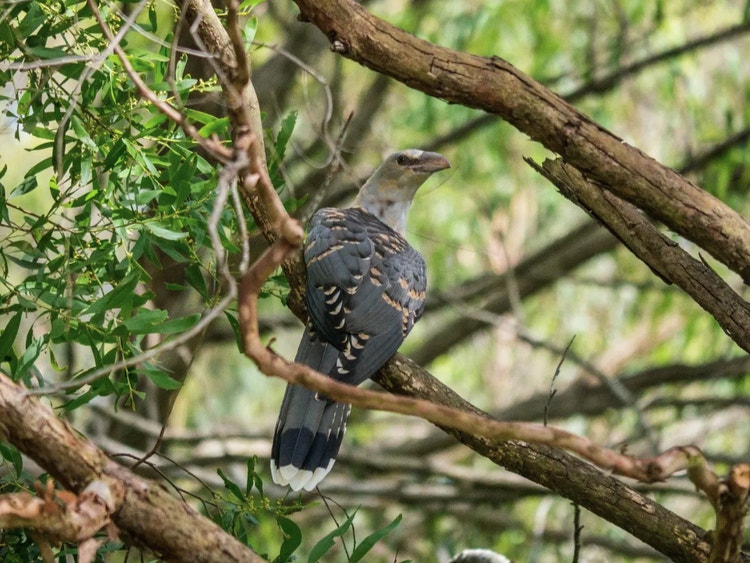
Channel-billed cuckoos spend much of their time high in tall forest trees. – ‘Channel-billed cuckoo juvenile 7th Brigade Park Chermside P1130778.jpg’ by John Robert McPherson. Creative Commons Attribution-Share Alike 4.0 International licence. Available at: https://commons.wikimedia.org/wiki/File:Channel-billed_cuckoo_juvenile_7th_Brigade_Park_Chermside_P1130778.jpg

Channel-billed cuckoos eating fruit in a forest canopy. – ‘Channel-billed Cuckoo (Scythrops novaehollandiae) (30556020533).jpg’ by Dominic Sherony. Creative Commons Attribution-Share Alike 2.0 Generic licence. Available at: https://commons.wikimedia.org/wiki/File:Channel-billed_Cuckoo_(Scythrops_novaehollandiae)_(30556020533).jpg
_(30556020533).jpg)
A young channel-billed cuckoo being fed by foster parent birds. – ‘Torresian Crow surrogate mother about to feed Juvenile Channel-billed Cuckoo - Flickr - PaulBalfe.jpg’ by Paul Balfe. Creative Commons Attribution 2.0 Generic licence. Available at: https://commons.wikimedia.org/wiki/File:Torresian_Crow_surrogate_mother_about_to_feed_Juvenile_Channel-billed_Cuckoo_-Flickr-_PaulBalfe.jpg

Channel-billed cuckoos have a beak that helps them collect fruit. – ‘Wieso Fratzenkuckuck? (24954735506).jpg’ by Rolf Dietrich Brecher. Creative Commons Attribution-Share Alike 2.0 Generic licence. Available at: https://commons.wikimedia.org/wiki/File:Wieso_Fratzenkuckuck%3F_(24954735506).jpg
.jpg)
Channel-billed cuckoos help spread seeds through forests and bushland. – ‘Channel-billed Cuckoo.jpg’ by Paul Balfe. Creative Commons Attribution 2.0 Generic licence. Available at: https://commons.wikimedia.org/wiki/File:Channel-billed_Cuckoo.jpg

Large native fig trees provide important food and shelter for channel-billed cuckoos. – ‘Port Jackson fig (3159667976).jpg’ by John Tann. Creative Commons Attribution 2.0 Generic licence. Available at: https://commons.wikimedia.org/wiki/File:Port_Jackson_fig_(3159667976).jpg
.jpg)
Learn with us

Book now
Book a curriculum-aligned excursion or incursion where students investigate migratory birds, fruit eating, breeding behaviour and food webs.

Learning programs
Explore Field of Mars EEC programs that support learning about channel-billed cuckoos, bird migration, brood parasitism, rainforest links and ecosystem relationships.

Learning resources
Use the channel-billed cuckoo fact sheet to support classroom learning about large cuckoos, migration, fruit, host nests and seasonal bird behaviour.

Flora and fauna fact sheets
Explore related fact sheets about birds, rainforest ecosystems, eucalypt forests, fruiting plants, pied currawongs and Australian ravens.
Related programs
The secret life of birds excursion
Observe local birds and investigate features, feeding, nesting and other behaviours that help birds survive.
Junior birder HPGE enrichment program
Observe bird behaviour and habitat use, record field evidence and identify species using features, movement and calls.