Scribbly gum fact sheet | Field of Mars EEC
What are scribbly gums?
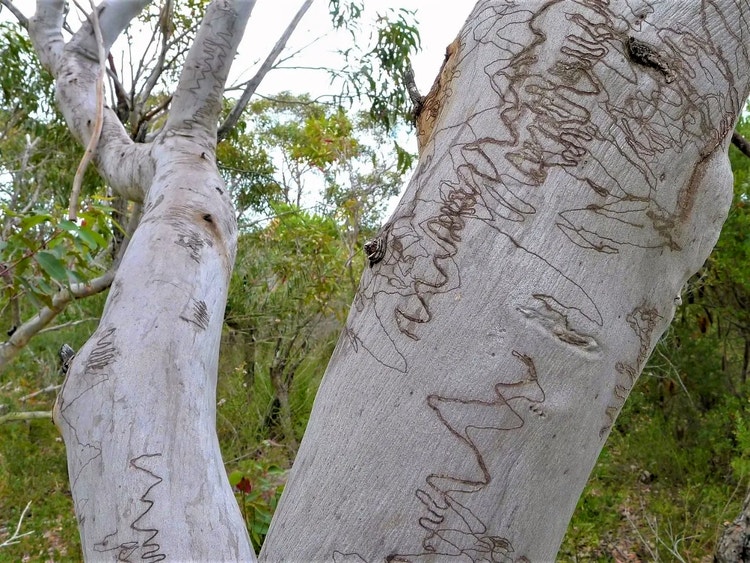
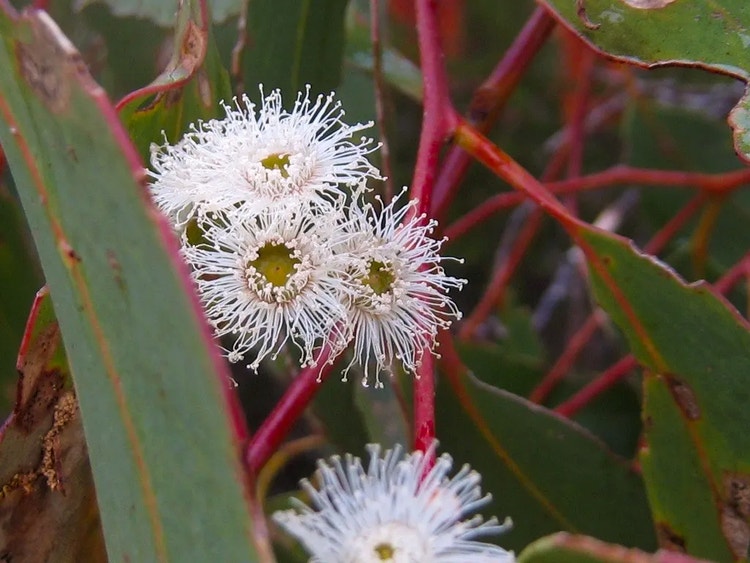
Scribbly gums are native eucalypt trees known for their pale smooth bark marked with winding lines called scribbles. Several eucalypt species are called scribbly gums, but the scribbly gum found around the Sydney region is Eucalyptus haemastoma. It is a low to medium tree that can grow up to about 15 metres high, often with spreading branches, more than one trunk, grey-green leaves and clusters of cream to white flowers.
The scribbles are made by the larvae of tiny scribbly gum moths as they tunnel between layers of bark. When the outer bark sheds, the larval feeding trails are revealed as dark lines. In Sydney sandstone bushland, including places such as Field of Mars Reserve and nearby Lane Cove National Park, scribbly gums help form dry eucalypt forest and woodland habitat for birds, mammals, insects and other small animals.

Fast facts – Scribbly gum
Scientific name – Eucalyptus haemastoma
Scientific group – Scribbly gums are flowering trees in the myrtle family, Myrtaceae.
Appearance – Scribbly gums have smooth white, grey or yellowish bark with dark scribble marks, grey-green leaves and cream to white flowers.
Size – They are usually low to medium trees and can grow up to about 15 metres high.
Habitat – They grow in dry eucalypt forest and woodland on shallow sandy soils over sandstone.
Flowers and fruit – Cream to white flowers attract nectar-feeding animals and develop into small woody fruit capsules.
Life cycle – Flowers are pollinated, woody capsules form, seeds are released, and new seedlings can grow in suitable sandy soil.
Adaptations – Tough waxy leaves, smooth shedding bark, woody seed capsules and epicormic buds help scribbly gums survive dry conditions, poor soils and fire.
Ecological role – Scribbly gums provide nectar, pollen, bark habitat, hollows, fallen logs, leaf litter and shelter for many animals.
Where do scribbly gums grow?
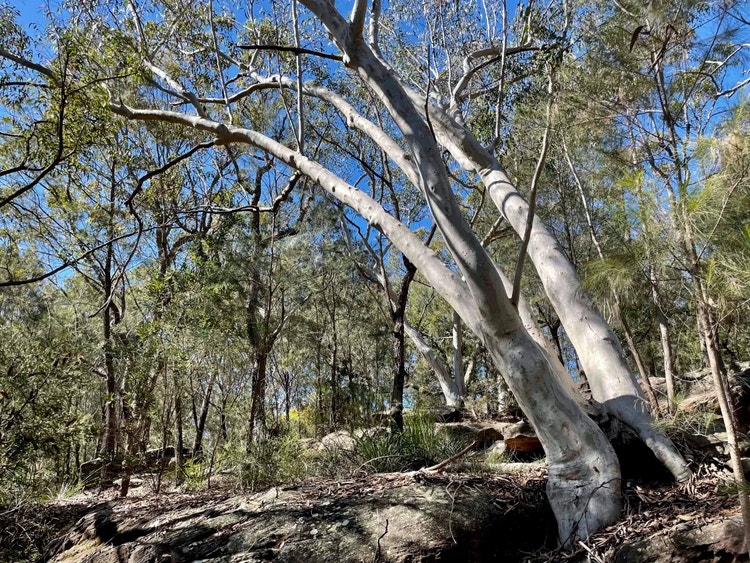
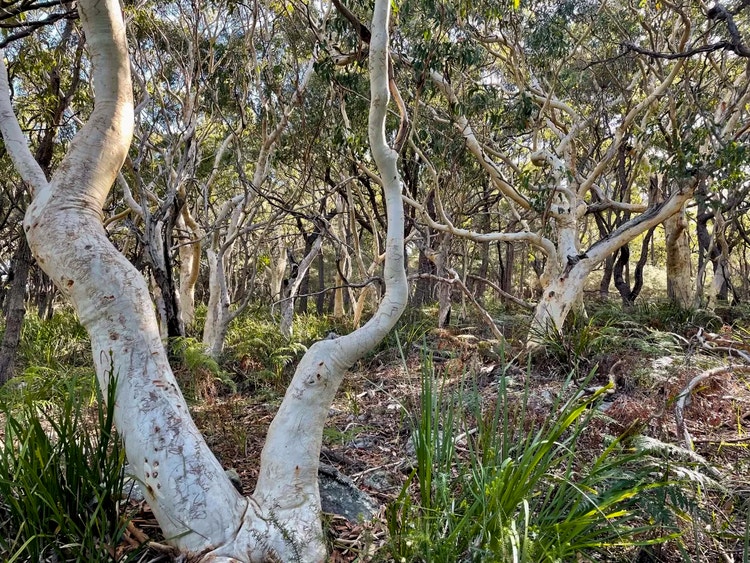
Scribbly gums grow in dry sclerophyll woodland and forest, especially on shallow, sandy and infertile soils formed from sandstone. Around Sydney they are often found on ridges, slopes and rocky sandstone areas where the soil is well drained and low in nutrients.
The Sydney scribbly gum, Eucalyptus haemastoma, is recorded from Royal National Park north to Lake Macquarie and west to the Blue Mountains. Scribbly gums are also found in several NSW national parks and reserves, including areas of Sydney sandstone bushland.
How are scribbly gums used by Aboriginal Peoples?
The Dharug word yarra is recorded for eucalyptus or gum tree. This can be included as a broad Sydney language word connected with eucalypts, rather than as a confirmed species name for scribbly gum.
Aboriginal Peoples used many eucalypt species in different ways depending on the species, place and community. Published sources describe eucalypt bark, timber, leaves and gum being used for purposes such as containers, shields, shelters, canoes and medicines. Some older eucalypt trees also show scars where bark or wood was carefully removed. These culturally modified trees are important evidence of Aboriginal knowledge, skill and connection to Country, and should never be touched, climbed on, carved into or damaged.
What animals use scribbly gums?
Scribbly gum flowers provide nectar and pollen for native bees, other insects, honeyeaters, lorikeets, possums and grey-headed flying foxes. The bark, leaves and branches also support many invertebrates. Scribbly gum moth larvae live inside the bark as they feed, and their trails become the scribbles that people notice on the trunk.
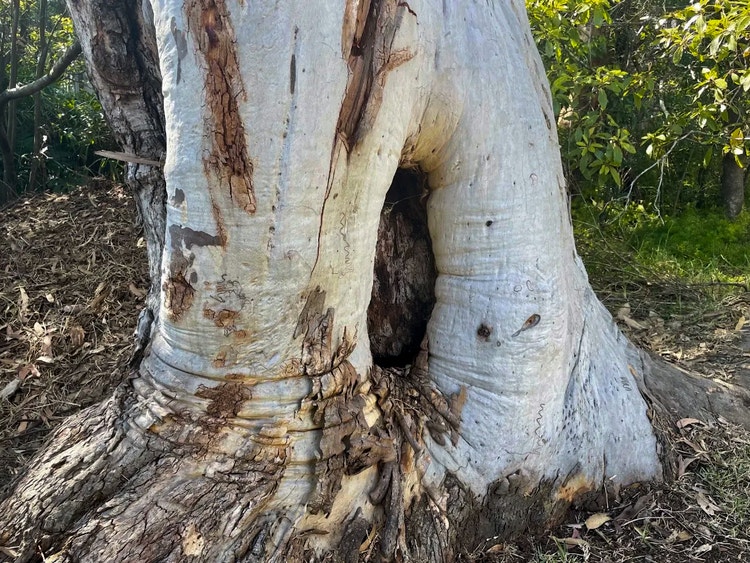
Older scribbly gums are especially important habitat trees. Hollows in trunks and branches can shelter possums, parrots, owls and other hollow-using animals. Fallen branches, logs, bark strips and leaf litter create habitat for fungi, beetles, spiders, skinks and decomposers.
What is the life cycle of scribbly gums?
Scribbly gums begin life as small seeds released from woody fruit capsules. When conditions are suitable, seeds can germinate in open soil with enough light, water and space. Seedlings grow into young trees, then mature trees that produce flower buds, flowers and new seed capsules.
The scribbles on the bark show the life cycle of another organism that depends on the tree. Female scribbly gum moths lay eggs on or near the bark. After hatching, the larvae tunnel through the bark tissue and feed as they grow. When the outer bark sheds, the tunnels are exposed as scribbles. The larvae later leave the bark and pupate in bark cracks or leaf litter before emerging as adult moths.
What adaptations do scribbly gums have to help them survive?
Scribbly gums are sclerophyll plants, which means they have tough leaves that help them survive dry conditions and nutrient-poor soils. Their leaves are thick and waxy, helping reduce water loss. Many mature leaves hang downwards, which can reduce exposure to strong sunlight during hot weather.
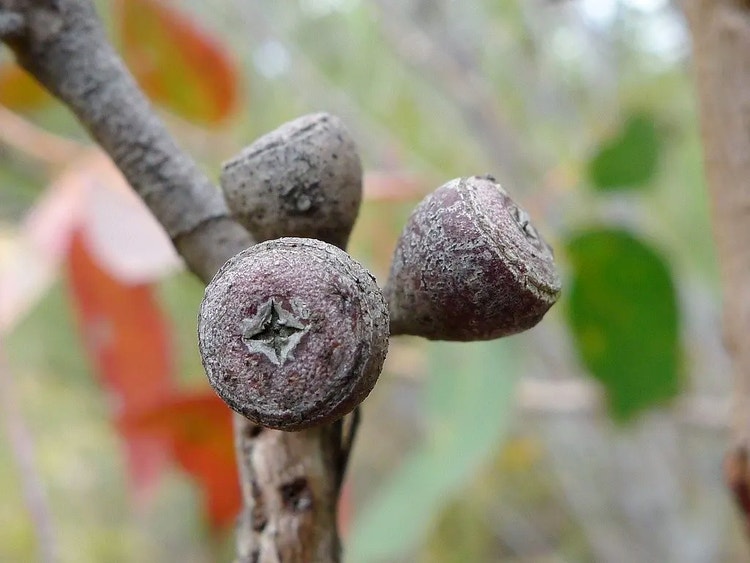
Scribbly gums also have fire survival adaptations. Woody capsules protect seeds, and new shoots can grow from epicormic buds beneath the bark after fire or damage. Their smooth bark sheds in layers, which exposes fresh bark and reveals the scribbly gum moth trails underneath.

Why are scribbly gums important?
Scribbly gums are important parts of dry eucalypt forest and woodland ecosystems. Their roots help hold shallow sandy soils in place, while their canopy provides shade, perches and movement pathways for animals. Flowers support pollinators and nectar-feeding animals, and leaves support insects and other invertebrates.
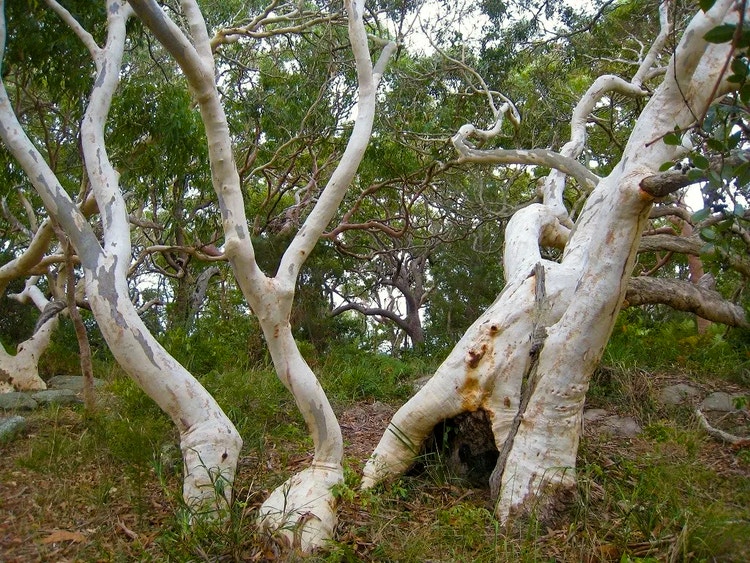
Old scribbly gums are especially valuable because tree hollows can take many decades to form. Hollows, fallen logs, bark strips and leaf litter provide shelter, nesting places and hunting areas for many species. Protecting mature scribbly gums helps protect whole food webs.
How can you help scribbly gums?
You can help scribbly gums by staying on tracks, leaving bark, leaves, flowers, seed capsules and fallen branches where they are, and observing trees without scratching or peeling the bark. Bark, logs and leaf litter are habitat for many small animals and help return nutrients to the soil.
Students can also help by learning to identify local native plants, joining supervised bushcare activities, keeping weeds out of bushland and protecting old hollow-bearing trees. If planting near bushland, choose locally appropriate native plants and follow local council, bushcare or nursery advice.
Related fact sheets
More plant fact sheets
- Plant fact sheets – Explore more native plant fact sheets from Field of Mars EEC.
- Sydney peppermint fact sheet – Learn about another eucalypt tree found in Sydney bushland.
- Sydney red gum fact sheet – Explore another local gum tree that provides food, hollows and habitat.
- Bracken fern fact sheet – Discover a ground-cover plant that grows in eucalypt forest understorey.
Habitats and ecosystems
- Field of Mars Reserve fact sheet – Learn about the local bushland where scribbly gums grow.
- Eucalypt forest fact sheet – Explore the forest ecosystem where eucalypts provide food, shelter and structure.
- Tree habitats fact sheet – Learn how trees provide homes, food and movement pathways for animals.
- Rock and log habitats fact sheet – Discover how fallen branches and logs support small animals.
- Leaf litter habitats fact sheet – Explore the habitat created by fallen leaves, bark and decomposing plant material.
Animals that use this habitat
- Common ringtail possum fact sheet – Learn about a possum that moves through tree canopies and uses plant material.
- Common brushtail possum fact sheet – Explore a hollow-using mammal that feeds and shelters in trees.
- Grey-headed flying-fox fact sheet – Discover a nectar-feeding mammal that helps pollinate native trees.
- Rainbow lorikeet fact sheet – Learn about a colourful bird that feeds on nectar and pollen.
- Red wattlebird fact sheet – Explore a honeyeater that visits flowering native trees.
Food webs and ecological relationships
- Insects fact sheet – Learn how insects use plants for food, shelter and life cycles.
- Birds fact sheet – Explore birds that feed, nest and move through forest habitats.
- Mammals fact sheet – Learn about mammals that use trees, hollows, flowers and leaf litter.
Attributions
References
Australian Museum. Scribbly gum moth. [online] Available at: https://australian.museum/learn/animals/insects/scribbly-gum-moth/
Australian National Botanic Gardens. Aboriginal Plant Use in South-Eastern Australia – Eucalyptus species. [online] Available at: https://anbg.gov.au/aborig.s.e.aust/eucalyptus-species.html
Backyard Buddies. Scribbly gums. [online] Foundation for National Parks & Wildlife. Available at: https://backyardbuddies.org.au/backyard-buddies/scribbly-gums/
City of Parramatta. Centre Design Features. [online] Available at: https://www.cityofparramatta.nsw.gov.au/community/libraries-and-community-hubs/community-hub-locations-and-opening-hours/yarra-community-centre/centre-design-features
CSIRO. Scribbly gum ‘scribbles’: an ancient dialect written in the trees. [online] Available at: https://www.csiro.au/en/news/All/Articles/2012/November/scribbly-gum-scribbles-an-ancient-dialect-written-in-the-trees
Dharug and Dharawal Resources. Dharug Dictionary – yarra. [online] Available at: https://dharug.dalang.com.au/language/dictionary?dialect=All&numeric=E&query=None&type=English
First Peoples – State Relations. Fact sheet: Aboriginal scarred trees. [online] Available at: https://www.firstpeoplesrelations.vic.gov.au/fact-sheet-aboriginal-scar-trees
NSW National Parks and Wildlife Service. Scribbly gum. [online] Available at: https://www.nationalparks.nsw.gov.au/plants-and-animals/scribbly-gum
PlantNET. Eucalyptus haemastoma Sm. [online] The Royal Botanic Gardens and Domain Trust. Available at: https://plantnet.rbgsyd.nsw.gov.au/cgi-bin/NSWfl.pl?page=nswfl&lvl=sp&name=Eucalyptus~haemastoma
The Australian National University. Tree scarring is our signature in the land. [online] Available at: https://www.anu.edu.au/news/all-news/tree-scarring-is-our-signature-in-the-land
Troy, J. The Sydney Language. Canberra: Australian Dictionaries Project and Australian Institute of Aboriginal and Torres Strait Islander Studies.
Image attributions
A scribble on a scribbly gum. – Field of Mars EEC (original illustration).
Scribbly gum bark has winding lines made by moth larvae beneath the bark. – ‘Scribbly Gum scribbles’ by John Tann. Creative Commons Attribution 2.0 Generic licence. Available at: https://www.flickr.com/photos/31031835@N08/8349111780/in/photostream/
Scribbly gums often grow on sandy soils and sandstone ridges. – Field of Mars EEC (original image).
Culturally modified trees are important evidence of Aboriginal knowledge, skill and connection to Country. – Field of Mars EEC (original image).
Scribbly gum flowers provide nectar and pollen for insects, birds and mammals. – ‘E.haemastoma IMG_4535’ by Margaret Donald. Creative Commons Attribution-ShareAlike 2.0 Generic licence. Available at: https://www.flickr.com/photos/13639096@N06/5771504050/
Woody scribbly gum capsules protect the seeds until they are ready to be released. – ‘Scribbly Gum fruit’ by John Tann. Creative Commons Attribution 2.0 Generic licence. Available at: https://www.flickr.com/photos/31031835@N08/8349101050
Epicormic shoots can help scribbly gums recover after fire. – ‘Resprouting scribbly gum post-fire’ by Doug Beckers. Creative Commons Attribution-ShareAlike 2.0 Generic licence. Available at: https://www.flickr.com/photos/37103729@N02/9468705388
Large old scribbly gums can provide hollows, shelter and movement pathways for wildlife. – ‘E. haemastoma IMG_3051’ by Margaret Donald. Creative Commons Attribution-ShareAlike 2.0 Generic licence. Available at: https://www.flickr.com/photos/13639096@N06/5498378774
Healthy scribbly gum forest depends on protected soil, bark, seedlings and leaf litter. – Field of Mars EEC (original image).
Learn with us

Book now
Book a Field of Mars Reserve or eucalypt forest excursion where students investigate gum trees, bark patterns, insects, habitats and food webs.

Learning programs
Explore Field of Mars EEC programs that support learning about scribbly gums, eucalypt forests, plant-animal interactions, habitats and biodiversity.

Learning resources
Use the scribbly gum fact sheet to support classroom learning about smooth bark, scribbly moth larvae, gum leaves, flowers and forest canopy habitats.

Flora and fauna fact sheets
Explore related fact sheets about eucalypt forests, tree habitats, insects, birds, mammals, reptiles and native plants.
Related programs
Classification and adaptations excursion
Identify native plants using structural features and investigate how leaves, bark and other adaptations support survival in sandstone forest.
Field guide HPGE enrichment program
Closely observe native plants and use photography, drawing and annotation to communicate detailed field observations.