Rainbow lorikeet fact sheet – warin | Field of Mars EEC
What are rainbow lorikeets?
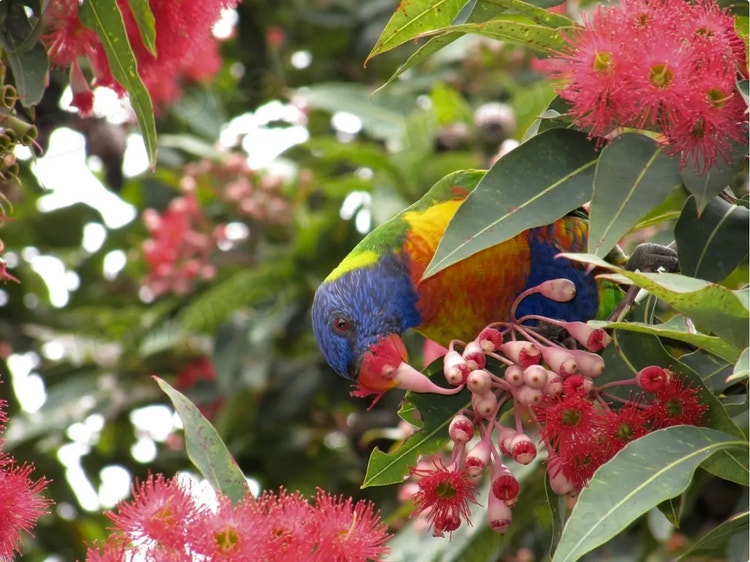
Rainbow lorikeets are colourful parrots that live in forests, woodlands, coastal bushland, parks and suburban gardens across eastern and northern Australia. Their scientific name is Trichoglossus moluccanus. These noisy birds are easy to recognise because of their bright blue heads, orange-yellow chests and green wings and backs. Students often notice them feeding in flowering trees or flying quickly overhead in loud, fast-moving flocks.
Rainbow lorikeets are highly social birds that spend much of their time feeding, calling to each other and defending feeding areas from other birds. They are specially adapted for feeding on nectar and pollen from flowers and play an important role in pollinating many Australian plants.
In Sydney, rainbow lorikeets are common in bushland reserves, school grounds, parks and suburban streets where flowering native plants provide food and nesting trees provide shelter. They are regularly seen in Field of Mars Reserve and Lane Cove National Park, especially when eucalyptus trees are flowering.
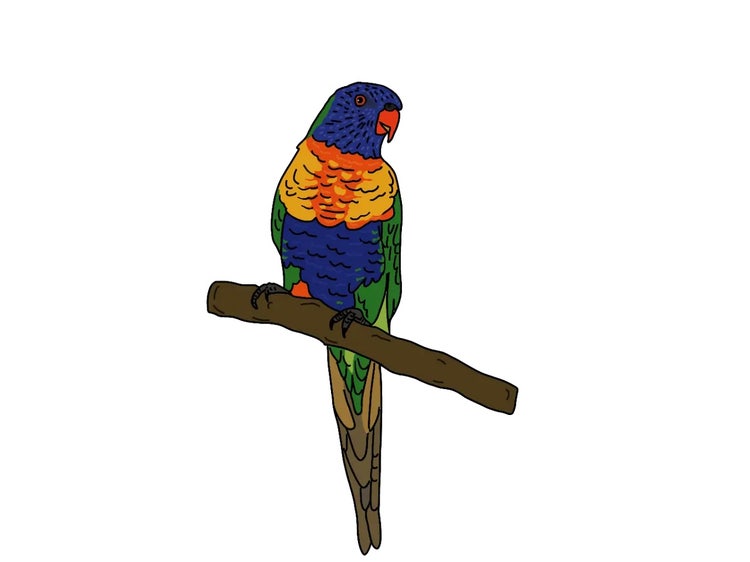
Fast facts – Rainbow lorikeet
Scientific name – Trichoglossus moluccanus
Scientific group – Rainbow lorikeets are parrots in the family Psittaculidae.
Appearance – Rainbow lorikeets have bright green wings and backs, blue heads, orange-yellow chests and red beaks.
Size – Rainbow lorikeets usually grow to about 25–30 centimetres long.
Diet – Rainbow lorikeets mainly eat nectar, pollen, flowers, fruits and soft plant material.
Habitat – Rainbow lorikeets live in forests, woodlands, coastal bushland, parks and suburban gardens.
Life cycle – Rainbow lorikeets hatch from eggs laid in tree hollows and young birds stay with their parents for several weeks before becoming independent. They can live for more than 20 years.
Special behaviour – Rainbow lorikeets use a brush-tipped tongue to collect nectar and pollen from flowers.

Where do rainbow lorikeets live?
Rainbow lorikeets live across eastern and northern Australia in forests, woodlands, mangroves, coastal heath and urban areas. They adapt well to cities and suburbs where flowering native trees, backyard gardens and parks provide food throughout the year. Large trees with hollows are important nesting sites for breeding pairs.
In Sydney, rainbow lorikeets are commonly seen in school grounds, reserves and suburban streets where eucalyptus, banksia and bottlebrush plants are flowering. Students visiting Field of Mars Reserve or Lane Cove National Park may hear their loud screeching calls before spotting them flying quickly through the tree canopy.
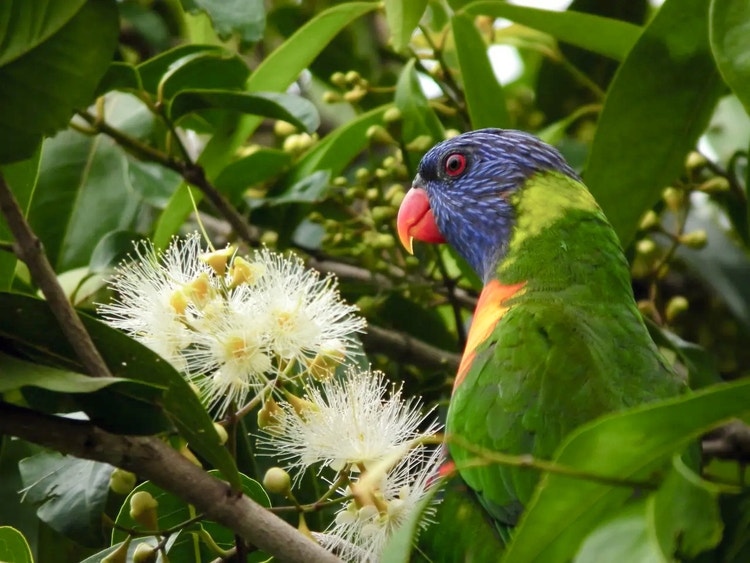
What do rainbow lorikeets eat?
Rainbow lorikeets mainly feed on nectar and pollen from flowering trees and shrubs. Their brush-like tongues help them collect liquid nectar from deep inside flowers. They also eat fruits, seeds, blossoms and insects when available.
These birds are important pollinators because pollen sticks to their feathers as they feed and is carried between flowers. Rainbow lorikeets often compete noisily with other birds for access to flowering trees and may gather in large flocks when food is abundant.
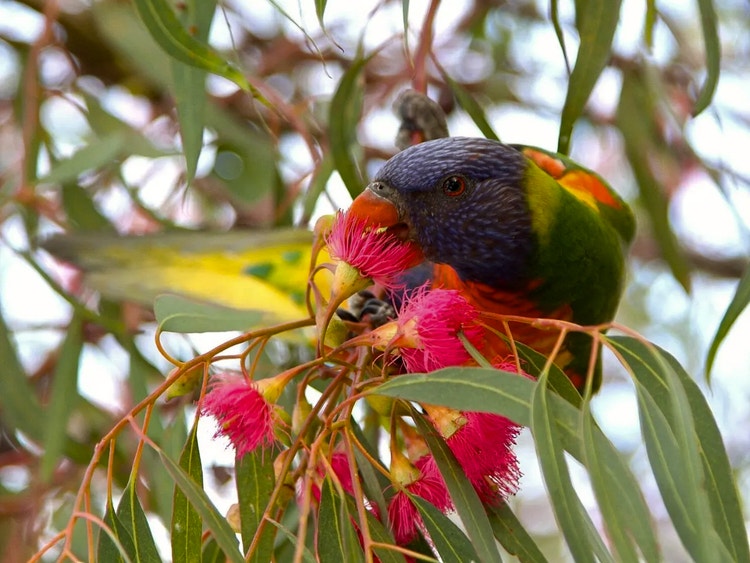
What do rainbow lorikeets sound like?
Rainbow lorikeets are loud and noisy birds that make high-pitched screeches, chatter and squawking calls. Flocks often call constantly while feeding or flying overhead. Their calls help birds stay together and warn other lorikeets about nearby food sources or danger.
At sunrise and sunset, rainbow lorikeets may gather in large communal roosts where hundreds of birds call loudly before settling for the night. Students in Sydney suburbs often hear these noisy evening gatherings near parks and bushland.
What is the life cycle of rainbow lorikeets?
Rainbow lorikeets usually breed during spring and summer when flowering plants provide plenty of food. Pairs nest in tree hollows high above the ground. The female usually lays two eggs and both parents help care for the chicks.
Young lorikeets hatch with very little feather covering and depend completely on their parents for warmth and food. After several weeks the chicks leave the nest, but young birds may continue learning feeding and survival behaviours from adult birds. Rainbow lorikeets can live for more than 20 years in the wild.
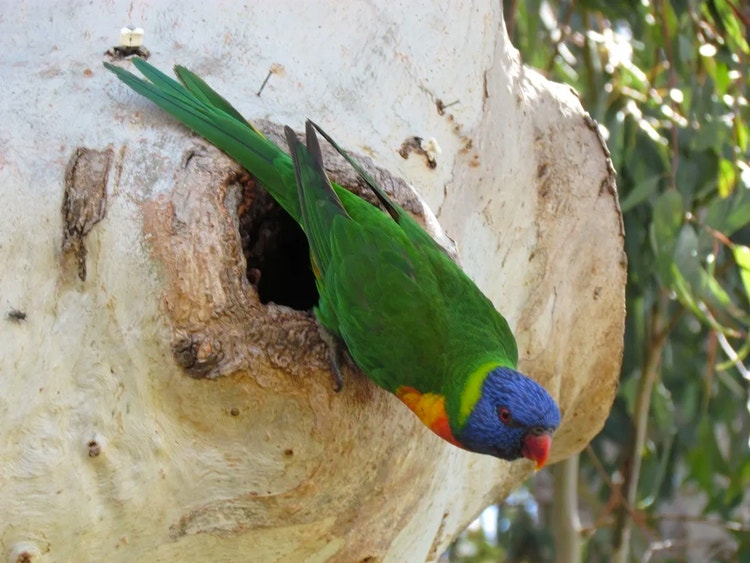
What adaptations do rainbow lorikeets have to help them survive?
Rainbow lorikeets have several adaptations that help them feed and move through forest canopies. Their curved beaks and specialised brush-tipped tongues are perfectly suited to collecting nectar and pollen from flowers. Strong feet with two toes facing forwards and two backwards help them grip branches and climb easily through trees.
Their bright feathers help lorikeets recognise each other in large flocks, while their fast, agile flight allows them to quickly travel between feeding areas. Rainbow lorikeets are also highly intelligent and adaptable, which has helped them survive successfully in changing urban environments.

Why are rainbow lorikeets important?
Rainbow lorikeets are important pollinators in Australian ecosystems. As they move between flowers searching for nectar, they transfer pollen between plants and help many native species reproduce. Flowering eucalyptus trees, banksias and bottlebrushes rely on birds, insects and other animals for pollination.
Rainbow lorikeets are also part of local food webs. Eggs and young birds may be eaten by snakes, goannas and birds of prey. Their presence in parks and bushland can also help people connect with nature and learn more about Australian wildlife.

How can you help rainbow lorikeets?
People can help rainbow lorikeets by protecting native bushland and planting local flowering plants that provide nectar and shelter. Trees with hollows are especially important because lorikeets depend on them for nesting sites.
Students can help by caring for local habitats, reducing litter and keeping cats indoors, especially at night when wildlife is active. Planting native species such as bottlebrushes, grevilleas and banksias in school gardens can provide important food sources for lorikeets and other native birds.
Related fact sheets
More bird fact sheets
- Birds fact sheet – Learn about bird features, life cycles, adaptations and ecological roles.
- Eastern spinebill fact sheet – Compare another nectar-feeding bird that helps pollinate native flowers.
- Crimson rosella fact sheet – Learn about another colourful Australian parrot that uses trees for food and shelter.
- Australian king parrot fact sheet – Discover another large forest parrot found in eastern Australia.
Habitats and ecosystems
- Tree habitats fact sheet – Explore how flowers, branches and hollows provide food and shelter for birds.
- Eucalypt forest fact sheet – Discover a habitat with flowering trees, nesting hollows and many native animals.
Animals that share this habitat
- Noisy miner fact sheet – Learn about another loud nectar-feeding bird found in parks, gardens and open forests.
- Red-browed finch fact sheet – Find out about a small bird that also uses shrubs, trees and garden habitats.
Food webs and ecological relationships
- Insects fact sheet – Discover small animals that are food for many birds and also help pollinate plants.
- Plant fact sheets – Learn how native plants provide nectar, pollen, seeds, shelter and habitat for wildlife.
Field of Mars habitats and wildlife
- Field of Mars Reserve fact sheet – Learn more about the local bushland habitats that support rainbow lorikeets and other native birds.
Attributions
References
Australian Museum. Rainbow lorikeet. [online] Available at: https://australian.museum/learn/animals/birds/rainbow-lorikeet/
BirdLife Australia. Rainbow lorikeet. [online] Available at: https://birdlife.org.au/bird-profiles/rainbow-lorikeet/
Birds in Backyards. Rainbow lorikeet. [online] Available at: https://www.birdsinbackyards.net/species/Trichoglossus-haematodus
Atlas of Living Australia. Trichoglossus moluccanus: Rainbow lorikeet. [online] Available at: https://bie.ala.org.au/species/Trichoglossus%2Bhaematodus
NSW Department of Climate Change, Energy, the Environment and Water. The danger of feeding lorikeets. [online] Available at: https://www.environment.nsw.gov.au/topics/animals-and-plants/native-animals/native-animal-facts/parrots/the-danger-of-feeding-lorikeets
Centennial Parklands. Rainbow lorikeet. [online] Available at: https://www.centennialparklands.com.au/visit/environment/birds/rainbow-lorikeet
Birds in Backyards. Parrots in urban environments. [online] Available at: https://www.birdsinbackyards.net/Parrots-Urban-Environments
Australian Museum. Hollows as homes. [online] Available at: https://australian.museum/blog-archive/amri-news/hollows-as-homes/
Image attributions
A rainbow lorikeet. – Field of Mars EEC (original illustration).
Rainbow lorikeets feed on nectar and pollen from flowering eucalyptus trees. – ‘Rainbow Lorikeet (Trichoglossus moluccanus) in Brisbane, Queensland’ by Andrew Mercer. Creative Commons Attribution-Share Alike 4.0 International licence. Available at: https://commons.wikimedia.org/wiki/File:Rainbow_Lorikeet_(Trichoglossus_moluccanus)_in_Brisbane,_Queensland.jpg
_in_Brisbane,_Queensland.jpg)
Rainbow lorikeets are common in Sydney bushland, parks and suburban gardens. – ‘Rainbow Lorikeet feeding on a lemon myrtle tree’ by James Niland. Creative Commons Attribution 2.0 Generic licence. Available at: https://www.flickr.com/photos/jamesniland/4260391581
A rainbow lorikeet uses its specialised tongue to feed on nectar. – ‘Rainbow lorikeet collecting nectar from a gum blossom using its brush-tipped tongue’ by Edoddridge. Creative Commons Attribution-Share Alike 3.0 Unported licence. Available at: https://commons.wikimedia.org/wiki/File:Rainbow_lorikeet_collecting_nectar_from_a_gum_blossom_using_its_brush-tipped_tongue.jpg

Rainbow lorikeets raise their chicks in tree hollows. – ‘A rainbow lorikeet leaving its nesting hollow’ by Pxhere. Creative Commons CC0 1.0 Universal Public Domain Dedication. Available at: https://pxhere.com/en/photo/1436539
Rainbow lorikeets have a strong beak and opposable toes that enable them to climb branches to access flower blossoms. – ‘Rainbow lorikeet, Trichoglossus haematodus, feeding on flowers at the Royal Botanical Garden, Sydney, Australia’ by Derek Keats. Creative Commons Attribution 2.0 Generic licence. Available at: https://www.flickr.com/photos/dkeats/8090305442
Rainbow lorikeets help pollinate many Australian native plants. – ‘Rainbow lorikeet, Trichoglossus haematodus, feeding on flowers at the Royal Botanical Garden, Sydney, Australia’ by Derek Keats. Creative Commons Attribution 2.0 Generic licence. Available at: https://www.flickr.com/photos/dkeats/8090305442
Native flowering plants provide food for rainbow lorikeets and other birds. – ‘Rawpixel’ by Rawpixel. Creative Commons CC0 1.0 Universal Public Domain Dedication. Available at: https://www.rawpixel.com/image/5909739/photo-image-public-domain-nature-bird-avian
Learn with us

Book now
Book a birdwatching or curriculum-aligned excursion where students investigate parrots, nectar feeding, bright colours, tree habitats and food webs.

Learning programs
Explore Field of Mars EEC programs that support learning about rainbow lorikeets, bird adaptations, flowering trees, urban wildlife and ecosystem connections.

Learning resources
Use the rainbow lorikeet fact sheet to support classroom learning about parrots, brush-tipped tongues, nectar, pollen, fruit, seeds and tree hollows.

Flora and fauna fact sheets
Explore related fact sheets about birds, native plants, eucalypt forests, tree habitats, flowering plants, insects and urban environments.
Related programs
The secret life of birds excursion
Observe local birds, investigate their features and behaviours, and explore the habitats birds need to survive.
Junior birder HPGE enrichment program
Use binoculars, field observations and identification evidence to investigate birds and create a detailed digital bird artwork.