Crimson rosella fact sheet – bundaluk, gurilla | Field of Mars EEC
What are crimson rosellas?
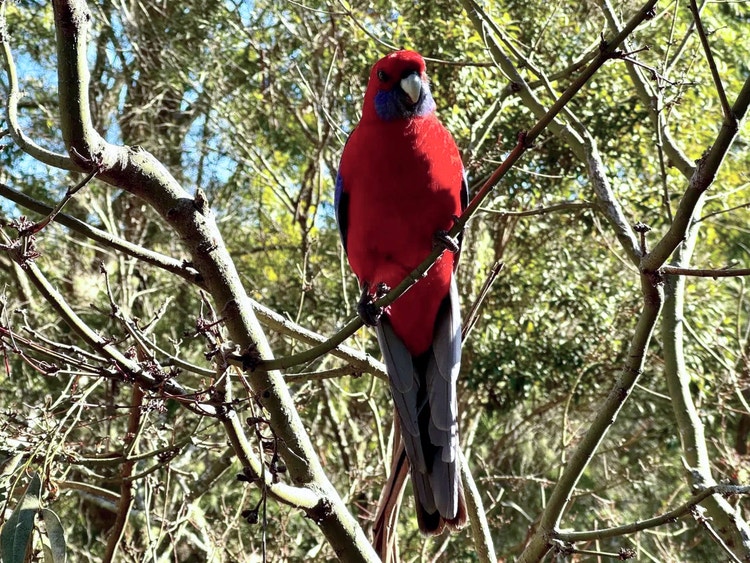
Crimson rosellas (Platycercus elegans) are colourful Australian parrots that live in forests, woodlands, parks and gardens along eastern Australia. Their Dharug names are bundaluk and gurilla. Their bright red feathers, blue cheeks and blue-black wings make them one of the easiest parrots to recognise. Young birds look very different from adults and are mostly green with patches of red and blue.
Crimson rosellas are common in Sydney bushland, including areas around Field of Mars Reserve and Lane Cove National Park. Students may hear their ringing calls before spotting them feeding in trees, flying across open spaces or searching for seeds on the ground.
These parrots are strong fliers and often travel in pairs or small family groups. They use their curved beaks and strong feet to hold and crack seeds, fruit and blossoms. Crimson rosellas are also known for their curious behaviour and can become used to people in parks and picnic areas.
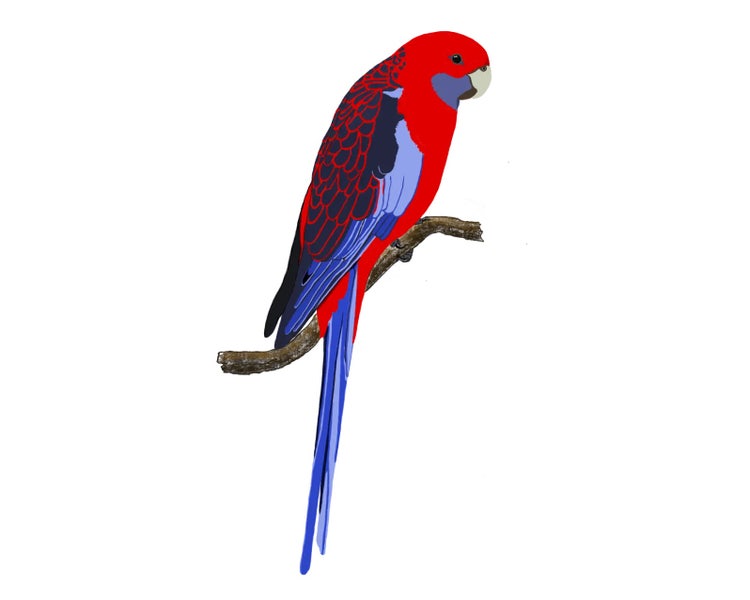
A crimson rosella.
Fast facts – Crimson rosella
Scientific name – Platycercus elegans
Scientific group – Crimson rosellas are parrots in the family Psittaculidae.
Appearance – Adult crimson rosellas have bright red feathers, blue cheeks and blue-black wings with black scalloped markings.
Size – Crimson rosellas usually grow to about 30–36 centimetres long.
Diet – Crimson rosellas eat seeds, fruit, flowers, nectar and insects.
Habitat – Crimson rosellas live in forests, woodlands, rainforests, parks and gardens across eastern Australia.
Life cycle – Crimson rosellas hatch from eggs laid in tree hollows and young birds stay with their parents for several weeks before becoming independent. They can live for more than 15 years in the wild.
Special behaviour – Crimson rosellas use their strong curved beaks and feet together to hold and crack hard seeds and fruit.

Where do crimson rosellas live?
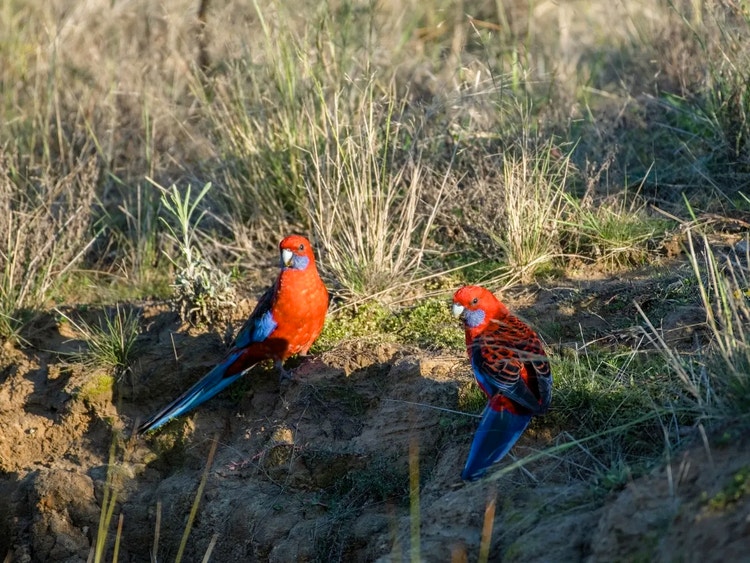
Crimson rosellas live along eastern and south-eastern Australia, including coastal forests, mountain forests, woodlands and rainforest edges. They are also common in parks, gardens and school grounds where large trees provide food and nesting hollows. These parrots are especially attracted to areas with flowering eucalyptus trees and native shrubs.
In Sydney, crimson rosellas can be seen in bushland areas around Field of Mars Reserve and Lane Cove National Park. Students may notice them flying through the tree canopy, feeding quietly in branches or searching for fallen seeds on the ground. They often rest high in trees during the middle of the day and become more active in the morning and afternoon.
What do crimson rosellas eat?
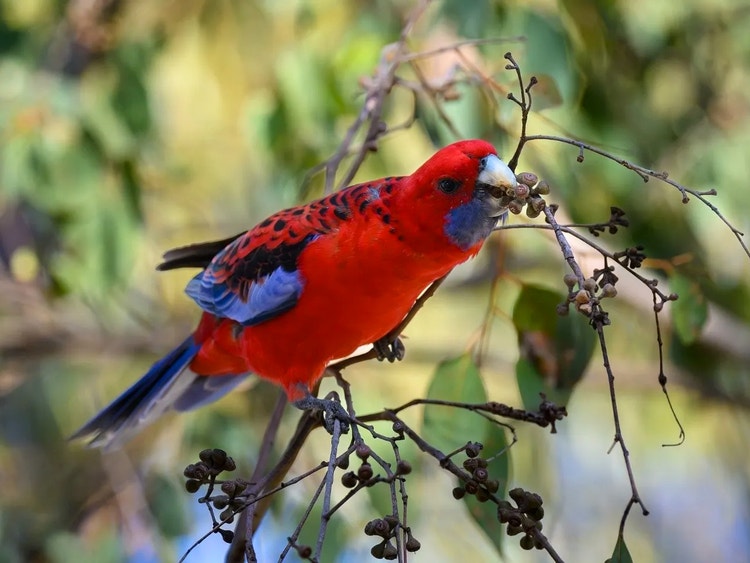
Crimson rosellas mostly eat seeds from grasses, shrubs and native trees. They also feed on fruit, berries, blossoms and nectar. Their strong curved beaks allow them to crack open hard seeds and nuts that many other animals cannot eat. They sometimes feed on insects and larvae, especially during the breeding season when extra protein helps growing chicks.
These parrots play an important role in forest food webs. While feeding on flowers they may help move pollen between plants, and they also spread seeds through the environment. Crimson rosellas are prey for larger birds of prey, snakes and mammals, so they are part of the complex relationships that help ecosystems stay balanced.
What do crimson rosellas sound like?
Crimson rosellas make loud ringing calls that can carry through forests and suburban bushland. Their calls are often described as musical whistles or sharp repeated chimes. Pairs and family groups use calls to stay in contact while feeding or flying between trees.
Young rosellas make softer begging sounds when asking adults for food. Students walking through bushland may hear crimson rosellas before seeing them because the birds often stay high in the canopy.
What is the life cycle of crimson rosellas?
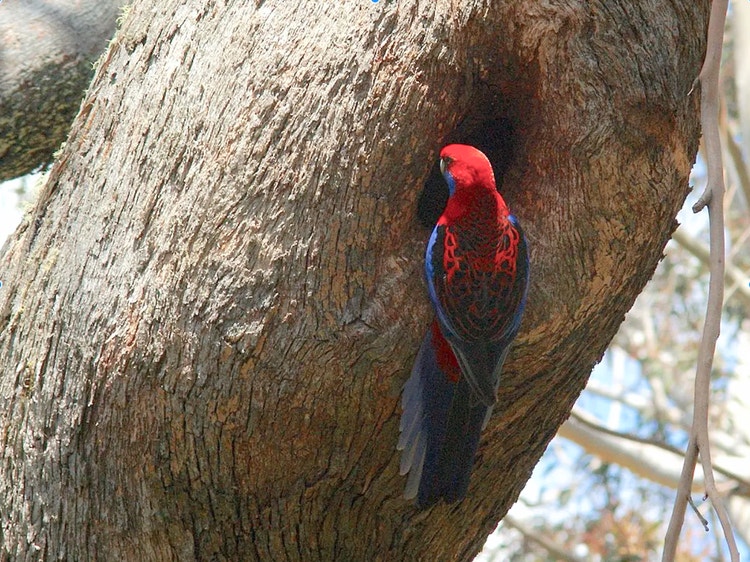
Crimson rosellas usually breed from spring to summer. Females lay eggs inside deep tree hollows lined with wood dust. Large old trees are important because suitable hollows can take many decades to form naturally. The female incubates the eggs while the male helps provide food.
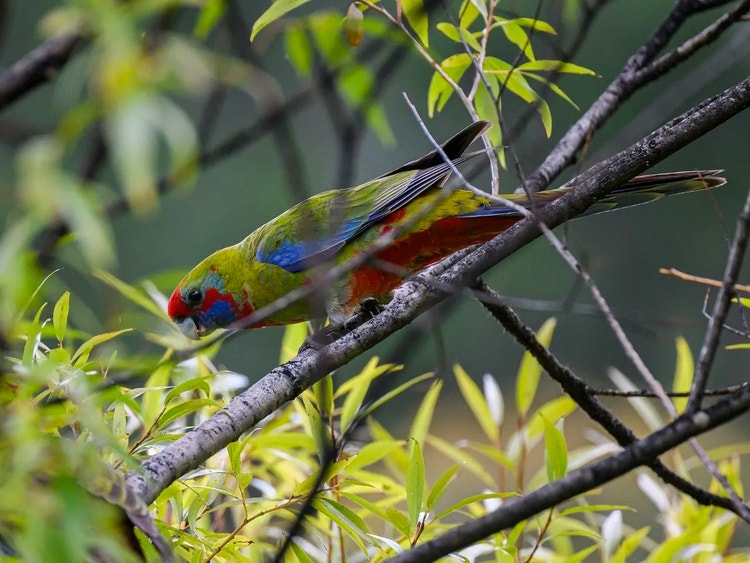
After hatching, the chicks remain in the nest hollow for several weeks while both parents feed them. Young crimson rosellas are mostly green, which helps camouflage them in leaves and branches. As they mature, more red feathers appear until they develop the bright adult colours. Some birds can live for many years in stable forest habitats.

What adaptations do crimson rosellas have to help them survive?
Crimson rosellas have strong curved beaks that help them crack seeds and strip fruit from branches. Their feet can grip branches firmly and hold food while eating. These adaptations allow them to feed on a wide range of plant material in forests and gardens.
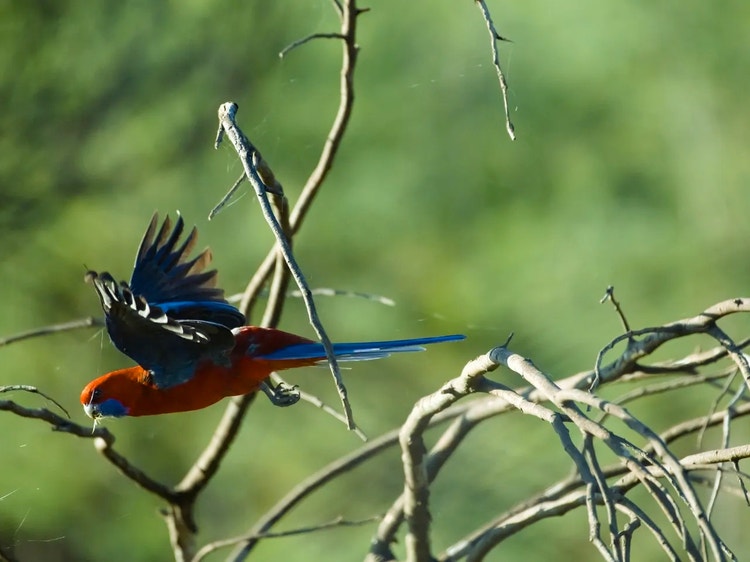
Their bright colours help them recognise other rosellas, while the darker wing markings can break up their outline among leaves and shadows. Juvenile birds have green feathers that provide better camouflage from predators. Crimson rosellas are also agile fliers that can quickly escape danger by weaving through trees.
Why are crimson rosellas important?
Crimson rosellas are important seed eaters and part of healthy Australian forest ecosystems. They help move seeds through bushland and may assist with pollination while feeding on flowers and nectar. They are also an important food source for predators such as powerful owls and birds of prey.
These parrots are part of the rich bird diversity found in Sydney bushland. Seeing and hearing crimson rosellas helps people connect with nature and understand the importance of protecting habitats with mature trees and nesting hollows.
How can you help crimson rosellas?
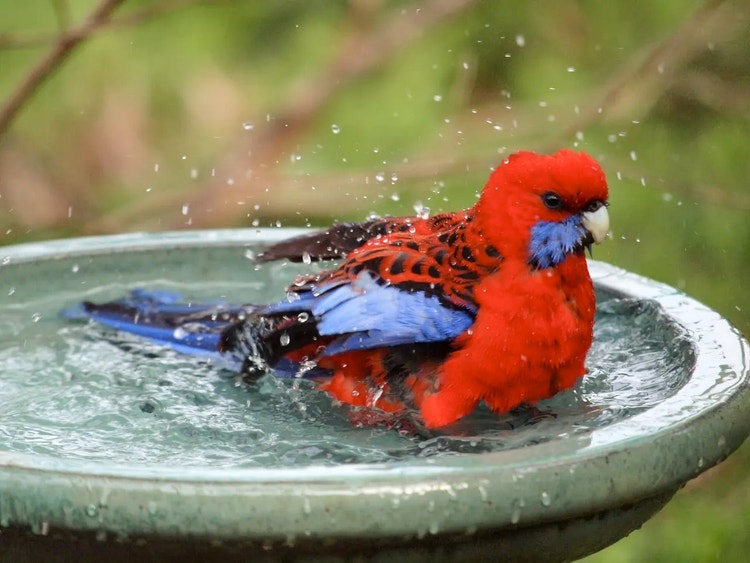
People can help crimson rosellas by protecting bushland habitats and large old trees that contain nesting hollows. Planting native trees and shrubs in gardens, schools and parks can provide food and shelter for rosellas and many other native birds.
Keeping cats indoors, reducing habitat clearing and avoiding feeding birds unhealthy human food can also help protect crimson rosellas. Students visiting local bushland areas can observe birds respectfully by keeping noise low and leaving nests and habitat undisturbed.

Related fact sheets
More bird fact sheets
- Birds fact sheet – Learn about the features, life cycles and adaptations of birds.
- Australian king parrot fact sheet – Discover another colourful forest parrot found in eastern Australia.
- Sulphur-crested cockatoo fact sheet – Compare another strong-beaked parrot that feeds on seeds and plant material.
- Yellow-tailed black cockatoo fact sheet – Learn about a large cockatoo that depends on forests and tree hollows.
Habitats and ecosystems
- Tree habitats fact sheet – Explore how trees provide food, shelter and nesting hollows for birds.
- Habitat fact sheet – Learn how different habitat layers support wildlife.
- Field of Mars Reserve fact sheet – Discover local bushland habitats that support crimson rosellas and other native animals.
Animals that share this habitat
- Eastern spinebill fact sheet – Learn about a nectar-feeding bird found in flowering shrubs and trees.
- Red-browed finch fact sheet – Find out about a small seed-eating bird that uses grasses and shrubs for shelter.
- Powerful owl fact sheet – Explore a forest predator that depends on large trees and hollows.
Food webs and ecological relationships
- Insects fact sheet – Discover small animals that form part of many bird food webs.
- Leaf litter habitats fact sheet – Explore how fallen leaves support insects, seeds and decomposers.
Attributions
References
References
Australian Museum. Crimson Rosella. [online] Available at: https://australian.museum/learn/animals/birds/crimson-rosella/
BirdLife Australia. Crimson Rosella. [online] Available at: https://birdlife.org.au/bird-profiles/crimson-rosella/
Birds in Backyards. Crimson Rosella. [online] Available at: https://www.birdsinbackyards.net/species/Platycercus-elegans
Museums Victoria Collections. Platycercus elegans, Crimson Rosella. [online] Available at: https://collections.museumsvictoria.com.au/species/8183
Birds in Backyards. Nest box for the Crimson Rosella. [online] Available at: https://www.birdsinbackyards.net/sites/www.birdsinbackyards.net/files/Crimson%20Rosella_0.pdf
Backyard Buddies. Rosellas. [online] Available at: https://backyardbuddies.org.au/backyard-buddies/rosellas/
Booderee National Park. Crimson rosella. [online] Available at: https://booderee.gov.au/discover/nature/birds/crimson-rosella/
Dharug and Dharawal Resources. Bird. [online] Available at: https://dharug.dalang.com.au/plugin_wiki/pages_by_tag/bird
Dharug and Dharawal Resources. Dictionary. [online] Available at: https://dharug.dalang.com.au/language/dictionary?dialect=All&numeric=R&query=None&type=English
Image attributions
A crimson rosella. – Field of Mars EEC (original illustration).
Crimson rosellas use their strong beaks to crack seeds and fruit. – ‘Crimson rosella-6283’ by Daniela Parra. Creative Commons Attribution-NonCommercial 2.0 Generic. Available at: https://flic.kr/p/28jG8eM
Crimson rosellas live in forests, woodlands and urban bushland across eastern Australia. – ‘Two crimson rosellas on the ground looking for grass seeds’ by Pikrepo. Creative Commons CC0 1.0 Universal. Available at: https://www.pikrepo.com/en/free-photo-zwwje
Crimson rosellas feed on seeds, blossoms, fruit and nectar. – ‘Wild crimson rosella snacking on gum nuts, Victorian High Country, Australia’ by pen_ash. Unsplash. Available at: https://unsplash.com/@pen_ash
A crimson rosella inspecting a tree hollow. – ‘Platycercus elegans -near Govetts Leap, Grose Valley, Blue Mountains, New South Wales, Australia -nest-8.jpg’ by Ian Sutton. Creative Commons Attribution 2.0 Generic. Available at: https://commons.wikimedia.org/wiki/File:Platycercus_elegans_-near_Govetts_Leap,_Grose_Valley,_Blue_Mountains,_New_South_Wales,Australia-nest-8.jpg

A juvenile crimson rosella gradually develops red adult feathers as it matures. – ‘Crimson rosella’ by Leo. Creative Commons Attribution-NonCommercial-ShareAlike 2.0 Generic. Available at: https://flic.kr
Crimson rosellas are agile fliers that can quickly escape danger. – ‘A crimson rosella in flight’ by Pikrepo. Creative Commons CC0 1.0 Universal. Available at: https://www.pikrepo.com
Crimson rosellas use their feet and curved beaks together to handle food. – Field of Mars EEC (original image).
Crimson rosellas are part of healthy forest food webs. – ‘Yellow Rosella 4436.jpg’ by John Harrison. Creative Commons Attribution-Share Alike 4.0 International. Available at: https://commons.wikimedia.org/wiki/File:Yellow_Rosella_4436.jpg

Native plants provide food and shelter for crimson rosellas. – ‘Crimson rosella eating a dandelion blossom’ by Pikrepo. Creative Commons CC0 1.0 Universal. Available at: https://www.pikrepo.com
Clean, raised bird baths can provide water for crimson rosellas and other native birds. – ‘Platycercus elegans -Canberra, Australia -bird bath-8.jpg’ by Duncan McCaskill. Creative Commons Attribution 3.0 Unported. Available at: https://commons.wikimedia.org/wiki/File:Platycercus_elegans_-Canberra,Australia-bird_bath-8.jpg

Related programs
Field guide HPGE enrichment program
Work as a field naturalist using observation, photography and digital illustration to document native animals and their habitats.
Junior birder HPGE enrichment program
Use binoculars and identification evidence to investigate birds and create a scientifically accurate vintage-style bird artwork.
Learn with us

Book now
Book a birdwatching or curriculum-aligned excursion where students investigate parrots, seed eating, forest habitats, colours and adaptations.

Learning programs
Explore Field of Mars EEC programs that support learning about crimson rosellas, parrots, feeding adaptations, tree habitats and forest ecosystems.

Learning resources
Use the crimson rosella fact sheet to support classroom learning about bright colours, strong beaks, seeds, fruit, flowers and tree hollows.

Flora and fauna fact sheets
Explore related fact sheets about birds, native plants, tree habitats, eucalypt forests, woodland ecosystems, seeds and food webs.