Australian king parrot fact sheet | Field of Mars EEC
What are Australian king parrots?
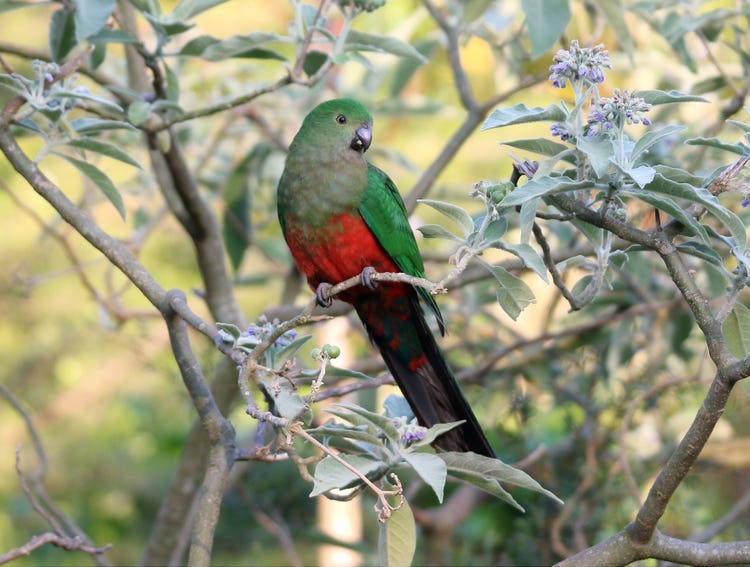
Australian king parrots are large, colourful parrots that live in forests and woodlands along eastern Australia. Male Australian king parrots have a bright red head and chest with green wings and back feathers, while females are mostly green with a small red patch on the belly. Their scientific name is Alisterus scapularis.
These parrots are often seen quietly feeding high in trees, gliding through the forest canopy or visiting gardens and picnic areas near bushland. Students visiting bush reserves around Sydney, including Field of Mars Reserve and Lane Cove National Park, may spot Australian king parrots feeding in eucalypt trees or hear their soft whistles overhead.
Australian king parrots are strong fliers and use their curved beaks and climbing feet to move through branches while feeding on seeds, fruits, flowers and insects. Unlike some noisy parrots, they are usually calm and quiet birds that spend much of their time in pairs or small family groups.
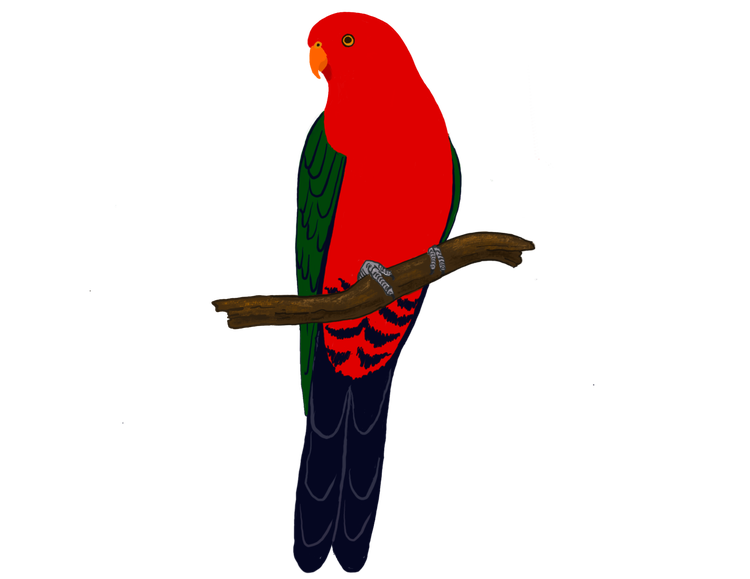
Fast facts – Australian king parrot
Scientific name – Alisterus scapularis
Scientific group – Australian king parrots are parrots in the family Psittaculidae.
Appearance – Male Australian king parrots have a bright red head and chest with green wings, while females are mostly green with a red belly patch.
Size – Australian king parrots usually grow to about 40–45 cm long.
Diet – Australian king parrots eat seeds, fruits, berries, flowers and small insects.
Habitat – Australian king parrots live in forests, woodlands, rainforests and bushland along eastern Australia.
Life cycle – Australian king parrots hatch from eggs laid in tree hollows and young birds stay with their parents after fledging. They can live for more than 20 years.
Special behaviour – Australian king parrots use their strong beaks and climbing feet to move carefully through branches while feeding high in trees.
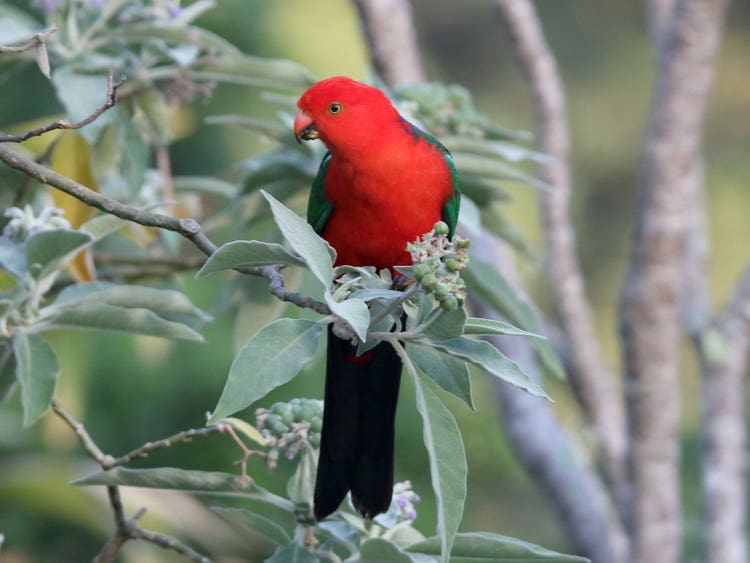
A male Australian king parrot.
Where do Australian king parrots live?
Australian king parrots live along the eastern coast of Australia from northern Queensland to Victoria. They are commonly found in rainforests, wet forests, open woodlands and forest edges where there are tall trees for shelter and nesting. They usually stay close to areas with plenty of seeds, fruiting plants and tree hollows.
In Sydney, Australian king parrots are sometimes seen in larger bushland reserves, national parks and leafy suburban gardens near forests. Students visiting Field of Mars Reserve or Lane Cove National Park may spot them feeding quietly in the canopy or flying between trees with slow wingbeats and long tails trailing behind them.
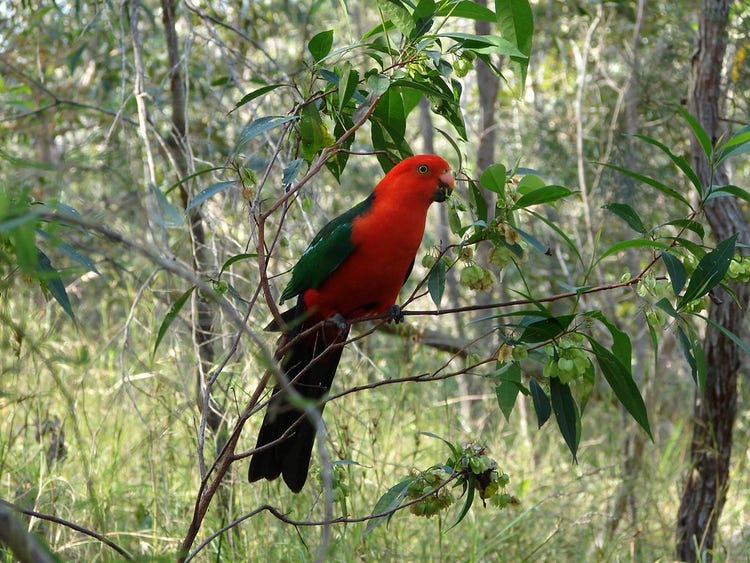
Australian king parrots live in forests and woodlands along eastern Australia.
What do Australian king parrots eat?
Australian king parrots mainly eat seeds, fruits, berries, blossoms and other plant material. They use their strong curved beaks to crack seeds and carefully pick food from branches. They may also eat insects and insect larvae, especially during the breeding season when young birds need extra protein.
These parrots help spread seeds through forests as they move between feeding areas. Their feeding habits also connect them to local food webs because they compete with other birds for food and are prey for larger predators such as powerful owls and large snakes.

What do Australian king parrots sound like?
Australian king parrots make soft whistles, high-pitched calls and short screeching sounds. Their calls are usually quieter than many other parrots, so students may hear them before spotting them moving through the canopy.
During the breeding season, pairs may call to each other while feeding or flying between trees. Young birds also make repeated begging calls when waiting for food from their parents.
What is the life cycle of Australian king parrots?
Australian king parrots usually breed from spring to summer. Females lay several eggs inside large tree hollows high above the ground. Tree hollows are important because they protect eggs and chicks from weather and predators.
After hatching, chicks stay in the nest while both parents collect food. Young parrots develop feathers before leaving the hollow as fledglings. Juvenile birds are mostly green and slowly develop adult colours as they mature. Australian king parrots may live for more than 20 years in suitable habitats.

A female Australian king parrot.

Juvenile male Australian king parrots are mostly green at first and develop red plumage as they mature.
What adaptations do Australian king parrots have to help them survive?
Australian king parrots have strong curved beaks that help them crack seeds and hold fruit while feeding. Their feet have two toes facing forward and two facing backwards, giving them a strong grip when climbing and balancing on branches.
Their long tails help them steer while flying through forests, and their green wing feathers help camouflage them among leaves. Although males are brightly coloured, their colours still blend surprisingly well into forest light and shadows when viewed from below.

This king parrot has collected an acorn seed with its beak.

Why are Australian king parrots important?
Australian king parrots play an important role in forest ecosystems by spreading seeds and helping plants reproduce. As they move through forests feeding on fruits and seeds, they help maintain healthy vegetation and biodiversity.
They are also part of local food webs and are indicators of healthy bushland habitats with mature trees and nesting hollows. Protecting Australian king parrots also helps protect many other native species that rely on the same forests and woodland habitats.

How can you help Australian king parrots?
People can help Australian king parrots by protecting forests, old trees and bushland habitats. Large trees with hollows are especially important because parrots rely on them for nesting. Planting local native trees and shrubs can also provide food and shelter for parrots and other birds.
Students can help by observing wildlife respectfully, keeping pets away from nesting areas and learning about local ecosystems. Supporting healthy bushland areas around Sydney helps Australian king parrots and many other native species survive.

Related fact sheets
More bird fact sheets
- Birds fact sheet – Learn about Australian bird groups, adaptations and habitats.
- Eastern spinebill fact sheet – Discover another bird that feeds on flowering plants.
- Superb fairy-wren fact sheet – Explore a small bushland bird that uses shrubs and low vegetation.
Habitats and ecosystems
- Tree habitats fact sheet – Explore how trees provide food, shelter, nesting places and hollows for wildlife.
- Eucalypt forest fact sheet – Discover a forest habitat that supports parrots and other native birds.
- Field of Mars Reserve fact sheet – Learn more about local bushland habitats that support native plants and animals.
Animals that share this habitat
- Common brushtail possum fact sheet – Explore another tree-dwelling animal that uses hollows and forest habitats.
- Common ringtail possum fact sheet – Learn about a nocturnal animal that lives in trees, gardens and bushland.
- Eastern water dragon fact sheet – Find out about another animal found in Sydney bushland and nearby waterways.
Attributions
References
Australian Museum. Australian King-Parrot. [online] Available at: https://australian.museum/learn/animals/birds/australian-king-parrot
BirdLife Australia. Australian King-Parrot. [online] Available at: https://birdlife.org.au/bird-profiles/australian-king-parrot
BirdLife Australia. Australian King-Parrot. [online] Available at: https://www.birdsinbackyards.net/species/Alisterus-scapularis
Museums Victoria. Alisterus scapularis (Lichtenstein, 1816), Australian King-parrot. [online] Available at: https://collections.museumsvictoria.com.au/species/8180
Booderee National Park. Australian king parrot. [online] Available at: https://booderee.gov.au/discover/nature/birds/australian-king-parrot
BirdLife International. Australian King-parrot Alisterus scapularis species factsheet. [online] Available at: https://datazone.birdlife.org/species/factsheet/australian-king-parrot-alisterus-scapularis
Image attributions
A male king parrot. – Field of Mars EEC (original illustration).
A male Australian king parrot. – ‘Australian King-Parrot (Alisterus scapularis)’ by Dominic Sherony. Creative Commons Attribution-ShareAlike 2.0 Generic licence. Available at: https://www.flickr.com/photos/dominicsherony/15695721764
A female Australian king parrot with a mainly green body and a dark grey beak. – ‘Australian King-Parrot (Alisterus scapularis) female’ by Dominic Sherony. Creative Commons Attribution-ShareAlike 2.0 Generic licence. Available at: https://www.flickr.com/photos/dominicsherony/16317906991
Australian king parrots live in forests and woodlands along eastern Australia. – ‘King parrot in the Australian bush’ by Tatters. Creative Commons Attribution 2.0 Generic licence. Available at: https://www.flickr.com/photos/51035724586@N01/5524128009
Australian king parrots use their curved beaks to feed on seeds and fruit. – ‘Alisterus scapularis -juvenile -feeding-8.jpg’ by Andy. Creative Commons Attribution-ShareAlike 2.0 Generic licence. Available at: https://commons.wikimedia.org/wiki/File:Alisterus_scapularis_-juvenile_-feeding-8.jpg

A female king parrot. – ‘Alisterus scapularis female.jpg’ by David J. Stang. Creative Commons Attribution-ShareAlike 4.0 International licence. Available at: https://commons.wikimedia.org/wiki/File:Alisterus_scapularis_female.jpg

Juvenile male king parrots resemble females at first. As they mature into their red plumage they have mottled green and red feathers. – ‘A juvenile male Australian King Parrot near Avoca Beach, New South Wales, Australia’ by Andrew Hill. Creative Commons Attribution 2.0 Generic licence. Available at: https://commons.wikimedia.org/wiki/File:A_juvenile_male_Australian_King_Parrot_near_Avoca_Beach,_New_South_Wales,_Australia.jpg

This king parrot has collected an acorn seed with its beak. – Photograph by Stephen Hobbs, used with permission.
An Australian king parrot holds food with its foot and bites pieces with its curved beak. – Photograph by Stephen Hobbs, used with permission.
Australian king parrots help spread seeds through forests. – ‘Alisterus scapularis -eating seeds from tree-8c.jpg’ by Doug Beckers. Creative Commons Attribution-ShareAlike 2.0 Generic licence. Available at: https://commons.wikimedia.org/wiki/File:Alisterus_scapularis_-eating_seeds_from_tree-8c.jpg

Protecting bushland and old trees helps Australian king parrots survive. – Field of Mars EEC (original image).
Learn with us

Book now
Book a birdwatching or curriculum-aligned excursion where students investigate parrots, seed eating, fruit, forest habitats and adaptations.

Learning programs
Explore Field of Mars EEC programs that support learning about Australian king parrots, seed dispersal, forest birds, feeding adaptations and biodiversity.

Learning resources
Use the Australian king parrot fact sheet to support classroom learning about parrots, strong beaks, seeds, fruit, flowers and forest habitats.

Flora and fauna fact sheets
Explore related fact sheets about birds, native plants, eucalypt forests, tree habitats, shrub habitats, seeds and food webs.
Related programs
Digital woodlands excursion
Use iPads to photograph natural subjects, apply composition techniques and create a collaborative digital photo book.
Junior birder HPGE enrichment program
Observe birds using binoculars and field evidence, identify species and create a scientifically accurate digital bird artwork.