Australian white ibis fact sheet | Field of Mars EEC
What are Australian white ibises?
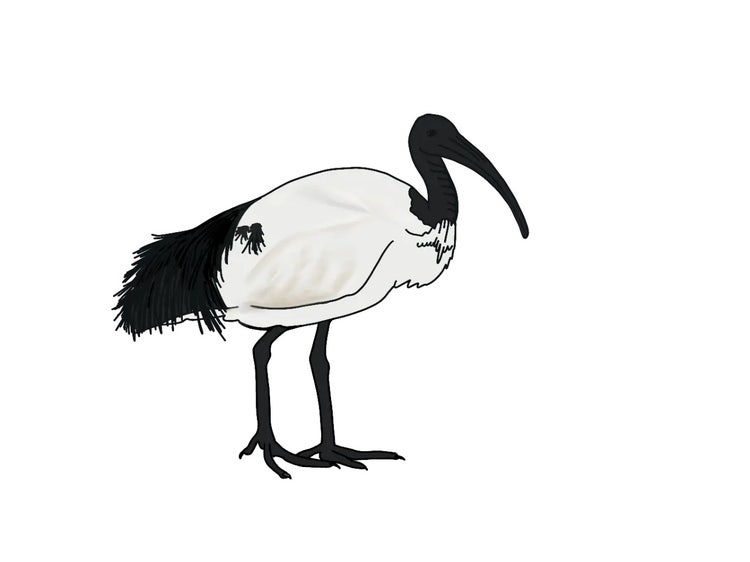
Australian white ibises are large native waterbirds often seen walking through wetlands, parks, sports fields and city streets around eastern Australia. Their scientific name is Threskiornis molucca. These birds have long black curved beaks, white feathers and bare black skin around the head and neck. In breeding season, adults develop long delicate feathers on their backs and a yellow patch under the wings.
White ibises naturally live in wetlands, floodplains, mudflats and shallow waterways where they search for food in mud and water. In Sydney, they are also common in urban parks, school grounds and rubbish bins because cities provide easy food and reliable water.
White ibises are intelligent and adaptable birds. They use their long curved beaks to feel for food hidden under mud, leaf litter or grass. Although they are sometimes called “bin chickens”, white ibises are important native animals that play an important role in wetland ecosystems by cleaning up waste, eating insects and helping recycle nutrients.
Fast facts – Australian white ibis
Scientific name – Threskiornis molucca
Scientific group – White ibises are large wading birds in the ibis and spoonbill family.
Appearance – White ibises have white feathers, black bare skin on the head and neck, long black legs and a curved black beak.
Size – Adult white ibises usually grow to about 65–75 centimetres tall with a wingspan of more than one metre.
Diet – White ibises eat insects, worms, crustaceans, frogs, fish, eggs and scraps of human food.
Habitat – White ibises live in wetlands, floodplains, parks, rubbish tips, estuaries and urban waterways across much of Australia.
Life cycle – White ibises hatch from eggs in large nesting colonies and young birds fledge after about six weeks. They can live for more than 20 years.
Special behaviour – White ibises use sensitive beaks to feel for hidden prey in mud and shallow water.

Where do Australian white ibises live?
White ibises live across much of Australia, especially near wetlands, floodplains, estuaries and shallow freshwater environments. They are common in eastern and northern Australia and move between habitats depending on rainfall and water availability. Natural wetland habitats provide mud, shallow water and dense vegetation where ibises can feed, roost and breed safely.
In Sydney, white ibises are now common in urban areas because parks, sports fields, drains, rubbish bins and artificial lakes provide reliable food and water. Students may see them at Field of Mars Reserve, along the Parramatta River, around school playgrounds or near picnic areas. White ibises often gather in groups and may fly long distances between feeding and nesting sites.

What do Australian white ibises eat?
White ibises are omnivores and eat many different foods. In natural wetlands they feed on insects, worms, yabbies, frogs, fish, crustaceans and small animals hidden in mud or shallow water. Their long curved beaks contain sensitive nerve endings that help them detect prey without needing to see it.
Urban environments have changed the feeding behaviour of many white ibises. In cities they often search through rubbish bins, picnic areas and outdoor eating spaces for scraps of human food. Although this behaviour helps ibises survive in urban areas, processed food is less healthy than their natural diet and can increase conflict between people and wildlife.

What do Australian white ibises sound like?
White ibises are usually quieter than many other large birds, but they make a range of croaking, grunting and harsh squawking sounds. These calls are most common around nesting colonies where many birds gather closely together. Young birds also make repeated begging calls when waiting for food from adults.
During breeding season, white ibises communicate using body movements, wing displays and calls to attract mates and defend nesting areas. Large colonies can become noisy when adults arrive with food or when birds compete for nesting space.
What is the life cycle of Australian white ibises?
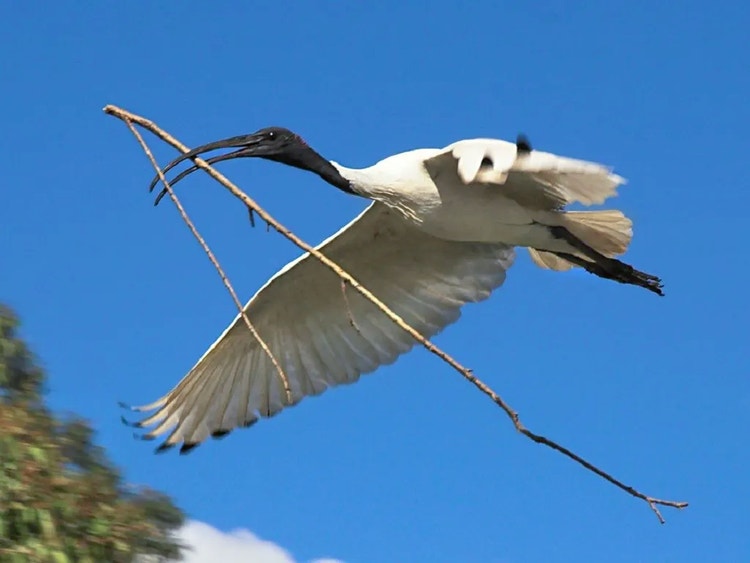
White ibises usually breed after periods of heavy rain when wetlands contain abundant food. They nest in large colonies near water, often with spoonbills, herons and egrets. Nests are built from sticks and reeds in trees, shrubs or dense wetland vegetation. Females usually lay two to three eggs, and both parents help incubate the eggs and feed the chicks.
Young ibises hatch with soft down feathers and depend completely on their parents for protection and food. Chicks grow quickly and begin leaving the nest after about six weeks. Juvenile birds gradually develop adult plumage over several years. White ibises can live for decades in suitable habitats.
What adaptations do Australian white ibises have to help them survive?
White ibises have several adaptations that help them survive in wetlands and urban environments. Their long curved beaks are specially adapted for probing mud, grass and shallow water to detect hidden prey. Sensitive nerve endings inside the beak help them locate food by touch. Long legs allow them to walk through shallow water while searching for food.
White ibises are also highly adaptable birds. They can travel long distances to find water and food during droughts and floods. Their intelligence and flexible diet have helped them survive in cities where natural wetlands have been reduced. White feathers reflect sunlight and help keep the birds cooler in hot Australian conditions.

Why are Australian white ibises important?
White ibises are important scavengers and predators in Australian ecosystems. They help control insect populations and remove dead material and waste from wetlands and urban areas. By feeding on many different animals, they are part of complex food webs that connect wetlands, rivers and urban habitats.
White ibises are also indicators of environmental change. Their increasing movement into cities shows how wetland loss, drought and urban development affect wildlife habitats. Protecting healthy wetlands helps white ibises and many other native species survive.

How can you help Australian white ibises?
People can help white ibises by protecting wetlands, reducing litter and keeping waterways clean. Native wetland plants provide shelter, nesting sites and food for many waterbirds. Rubbish should always be placed securely in bins so birds do not become dependent on unhealthy human food.
Students can also help by observing wildlife respectfully and avoiding disturbance to nesting colonies. Learning about native wetland animals helps communities understand why urban wetlands are important for biodiversity and healthy ecosystems.

Related fact sheets
More bird fact sheets
- Bird fact sheets – Browse bird species found in bushland, wetlands and urban habitats.
- Dusky moorhen fact sheet – Learn about another wetland bird that uses ponds, creeks and reeds.
- Pacific black duck fact sheet – Compare another waterbird often seen near creeks and ponds.
- White-bellied sea eagle fact sheet – Explore a large bird predator linked to waterways and estuaries.
Habitats and ecosystems
- Water habitats fact sheet – Discover freshwater habitats where wetland animals feed, shelter and breed.
- Mangrove forest fact sheet – Learn about tidal habitats where white ibises may search for food.
- Coastal salt marsh fact sheet – Explore another wetland environment used by waterbirds.
- Field of Mars Reserve fact sheet – Learn more about local bushland, wetland and waterway habitats.
Animals that share this habitat
- Eastern snake-necked turtle fact sheet – Find out about a freshwater reptile that lives in ponds, wetlands and creeks.
- Common eastern froglet fact sheet – Learn about a small frog that lives near damp ground and freshwater habitats.
- Red-fingered marsh crab fact sheet – Explore an invertebrate found in muddy mangrove and saltmarsh habitats.
Food webs and ecological relationships
- Invertebrate fact sheets – Discover small animals that form an important food source for wetland birds.
Attributions
References
Atlas of Living Australia. Threskiornis molucca: Australian white ibis. [online] Available at: https://bie.ala.org.au/species/Threskiornis+molucca
Australian Museum. Australian white ibis. [online] Available at: https://australian.museum/learn/animals/birds/australian-white-ibis/
BirdLife Australia. Australian white ibis. [online] Available at: https://birdlife.org.au/bird-profiles/australian-white-ibis/
BirdLife International. Australian ibis Threskiornis moluccus species factsheet. [online] Available at: https://datazone.birdlife.org/species/factsheet/australian-ibis-threskiornis-moluccus
Museums Victoria. Threskiornis molucca, Australian white ibis. [online] Available at: https://collections.museumsvictoria.com.au/species/8271
NSW Department of Environment and Conservation. Wild about ibis: living with urban wildlife. [online] Available at: https://nswdpe.intersearch.com.au/nswdpejspui/bitstream/1/11302/1/wild-about-ibis-living-with-urban-wildlife-060473.pdf
NSW Department of Planning and Environment. Wetlands. [online] Available at: https://www.environment.nsw.gov.au/topics/water/wetlands
Cumberland City Council. Ibis management plan. [online] Available at: https://www.cumberland.nsw.gov.au/ibis-management-plan
Image attributions
An Australian white ibis. – Field of Mars EEC (original illustration).
An Australian white ibis foraging for food in shallow water. – “Australian White Ibis” by 0ystercatcher. Creative Commons Attribution-NonCommercial-ShareAlike 2.0 Generic licence. Available at: https://www.flickr.com/photos/49828152@N00/11764493264
An Australian white ibis in an urban habitat in Sydney. – “Australian White Ibis” by maxarens. Creative Commons Attribution-NonCommercial 2.0 Generic licence. Available at: https://www.flickr.com/photos/85672706@N05/8375873044
An Australian white ibis uses its curved beak to locate food hidden in mud and soil. – “Australian White Ibis” by Tatters ✾. Creative Commons Attribution 2.0 Generic licence. Available at: https://www.flickr.com/photos/62938898@N00/2641591785
Australian white ibises collect sticks to build their nest. – “Look what I’m bringing home.” by Kiwi Mikex. Creative Commons Attribution-NoDerivs 2.0 Generic licence. Available at: https://www.flickr.com/photos/37496740@N00/225541859
Long legs help Australian white ibises move through shallow water while feeding. – “Australian-White-Ibis,-Vic,-3.1.2008.jpg” by jjron. Creative Commons Attribution-Share Alike 3.0 Unported licence. Available at: https://commons.wikimedia.org/wiki/File:Australian-White-Ibis,-Vic,-3.1.2008.jpg

Healthy wetlands provide important habitat for Australian white ibises and other waterbirds. – “Australian white ibis.jpg” by Aatu Dorochenko. Creative Commons Attribution-Share Alike 4.0 International licence. Available at: https://commons.wikimedia.org/wiki/File:Australian_white_ibis.jpg

Clean wetlands support healthy habitats for Australian white ibises and other native animals. – “Australian White Ibis RWD.jpg” by DickDaniels. Creative Commons Attribution-Share Alike 3.0 Unported licence. Available at: https://commons.wikimedia.org/wiki/File:Australian_White_Ibis_RWD.jpg

Learn with us

Book now
Book a water environment, urban environment or curriculum-aligned program where students investigate waterbirds, wetlands, parks and food webs.

Learning programs
Explore Field of Mars EEC programs that support learning about Australian white ibis, waterbirds, wetland habitats, urban adaptation and human impacts.

Learning resources
Use the Australian white ibis fact sheet to support classroom learning about long curved beaks, wetlands, feeding behaviour, urban wildlife and nesting colonies.

Flora and fauna fact sheets
Explore related fact sheets about birds, water habitats, freshwater wetlands, urban environments, invertebrates, rivers and creeks.
Related programs
Water environments excursion
Explore creek and river environments, observe living things and investigate how people use, value and care for waterways.
Environmental change and management excursion
Investigate environmental change, habitat condition, human impacts and management strategies through geographical fieldwork.