Swamp wallaby fact sheet - banggaray | Field of Mars EEC
What are swamp wallabies?
Swamp wallabies are medium-sized marsupials that live in forests, woodlands and thick bushland across eastern Australia. Their scientific name is Wallabia bicolor. In local Dharug language, these wallabies are called banggaray – swamp wallaby or wallaba – wallaby. They are shy animals that are usually seen alone, especially early in the morning or late in the afternoon when they leave dense vegetation to feed.
Swamp wallabies have dark brown to black fur, a lighter belly and a distinctive pale stripe on the cheek. Their tail is long and dark, and their feet are adapted for moving quietly through thick undergrowth. Unlike kangaroos that often gather in large mobs, swamp wallabies are usually solitary and rely on camouflage and shelter to stay safe.
Students may spot swamp wallabies in bushland reserves around Sydney, including quiet parts of Lane Cove National Park and the Field of Mars Reserve. They are often noticed when they suddenly bound away through dense shrubs or pause silently beside walking tracks. Their strong back legs help them leap quickly through thick vegetation where larger kangaroos may struggle to move.

Fast facts – Swamp wallaby
Scientific name – Wallabia bicolor
Scientific group – A marsupial mammal related to kangaroos and wallaroos.
Appearance – Swamp wallabies have dark fur, a pale cheek stripe and a long dark tail.
Size – Adults grow to about 70–85 centimetres tall, not including the tail.
Diet – They mainly eat leaves, grasses, ferns and shrubs.
Habitat – Swamp wallabies live in forests, heathlands and dense bushland with thick ground cover.
Life cycle – Joeys develop inside the mother’s pouch for several months before continuing to grow outside the pouch. Females can raise a new joey while another young joey is still developing. Swamp wallabies may live for more than 10 years in the wild.
Special behaviour – Swamp wallabies are usually solitary and hide quietly in dense vegetation during the day.

Where do swamp wallabies live?
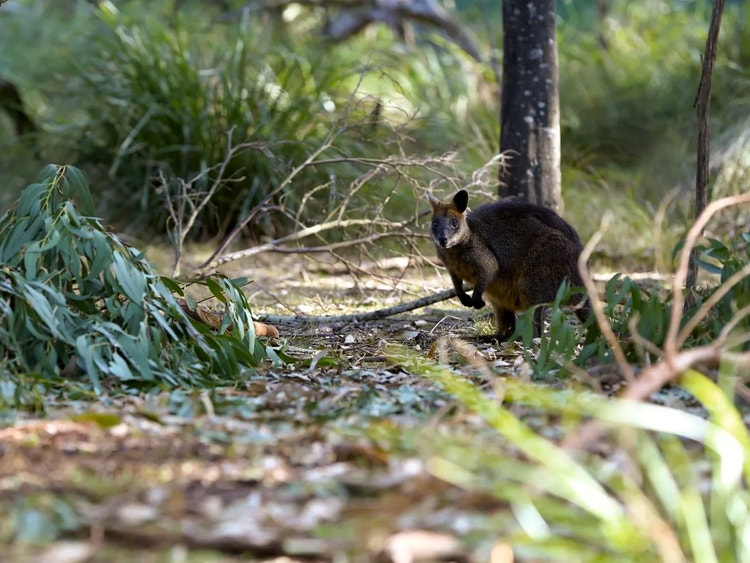
Swamp wallabies live along the eastern coast of Australia from Queensland through New South Wales and into eastern Victoria. They prefer forests, wet sclerophyll bushland, rainforests, heathlands and dense shrub habitats where they can hide among thick vegetation. Unlike some kangaroos that prefer open grasslands, swamp wallabies spend much of their time under cover.
In Sydney, swamp wallabies can be found in larger bushland reserves including Lane Cove National Park and areas connected to the Field of Mars Reserve. They shelter in dense undergrowth during the heat of the day and often emerge in the early morning or evening to feed. Students walking quietly along bush tracks may notice rustling leaves, tracks or droppings before seeing the animal itself.
What do swamp wallabies eat?
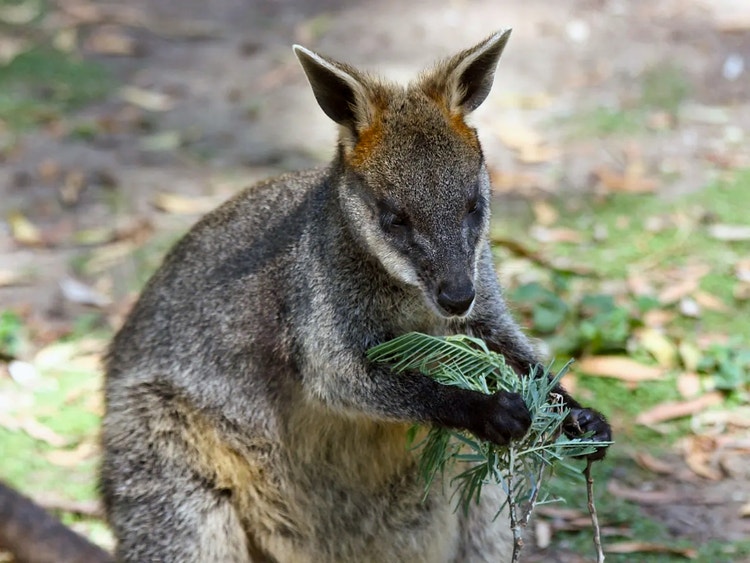
Swamp wallabies are herbivores, which means they eat plants. Their diet includes grasses, leaves, shoots, ferns, shrubs and sometimes bark or fungi. They often feed on a wide range of plants depending on what is available in the habitat and the season.
These wallabies play an important role in bushland food webs because they help shape plant growth and spread seeds through the environment. Young joeys and smaller wallabies may also become prey for predators such as dingoes, large birds of prey or introduced predators including foxes in some areas.
What is the life cycle of swamp wallabies?
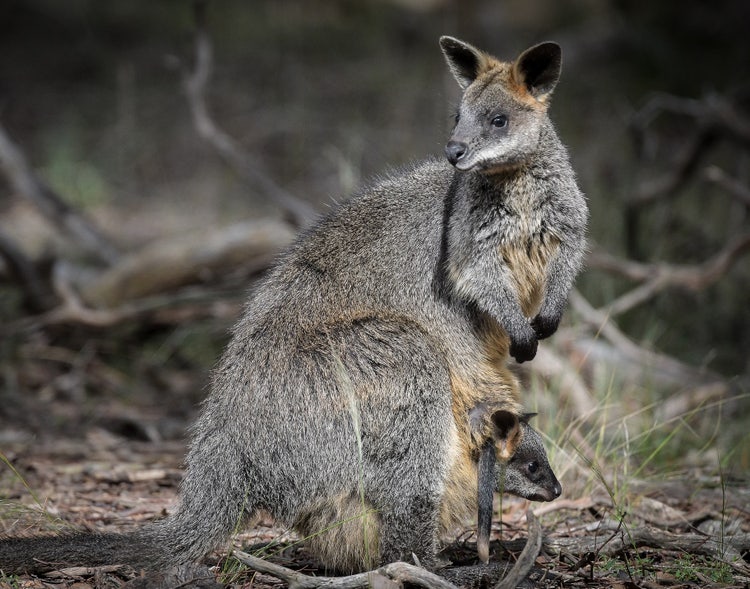
Like other marsupials, swamp wallabies give birth to very underdeveloped young called joeys. After birth, the tiny joey crawls into the mother’s pouch where it continues to grow and drink milk. The joey stays in the pouch for several months before beginning to explore outside while still returning for protection and feeding.
Swamp wallabies have an unusual breeding cycle because females can carry an embryo that pauses development while another joey is still growing in the pouch. This helps them reproduce efficiently in changing environments. Young wallabies stay close to their mother while learning how to find food and shelter in dense bushland.
What adaptations do swamp wallabies have to help them survive?
Swamp wallabies have strong back legs and large feet that help them move quickly through thick vegetation. Their dark fur provides camouflage in shaded forests and dense shrubs, helping them stay hidden from predators. They also have excellent hearing and a strong sense of smell to detect danger.
Their solitary behaviour is another important adaptation. Instead of gathering in large groups, swamp wallabies rely on staying quiet and hidden. They often freeze when disturbed before suddenly bounding away through dense undergrowth. Their ability to feed on many different plants also helps them survive in changing environments.

Why are swamp wallabies important?
Swamp wallabies are important members of Australian bushland ecosystems. As plant eaters, they influence vegetation growth and help maintain balance within forest and woodland habitats. They are also part of local food webs and provide prey for native predators.
These animals are also important for helping students understand Australian marsupials and bushland biodiversity. Seeing a swamp wallaby in the wild can encourage people to value and protect natural habitats in Sydney and across Australia. Healthy bushland corridors help swamp wallabies move safely between feeding and shelter areas.

How can you help swamp wallabies?
People can help swamp wallabies by protecting bushland habitats and staying on walking tracks when visiting reserves. Dogs should be kept under control near bushland because roaming pets can disturb or injure wildlife. Drivers should also slow down near bushland roads, especially at dawn and dusk when wallabies are more active.
Students can help local wildlife by learning about native ecosystems and supporting conservation programs that protect forests and bushland corridors. Planting native vegetation in gardens and school grounds can also provide shelter and food for many native animals that share the same habitat as swamp wallabies.

Related fact sheets
More mammal fact sheets
- Mammals fact sheet – Learn about Australian mammals and their adaptations.
- Common brushtail possum fact sheet – Explore another native marsupial found in Sydney bushland.
- Common ringtail possum fact sheet – Discover another tree-dwelling marsupial that lives in bushland and gardens.
- Long-nosed bandicoot fact sheet – Learn about another ground-dwelling marsupial found in urban bushland.
- Short-beaked echidna fact sheet – Find out about another native mammal that forages on the ground.
Habitats and ecosystems
- Eucalypt forest fact sheet – Explore a forest habitat where swamp wallabies may find food and shelter.
- Field of Mars Reserve fact sheet – Learn more about local bushland habitats that support native wildlife.
- Tree habitats fact sheet – Discover how trees provide food, shelter and habitat for many animals.
- Shrub habitats fact sheet – Learn about dense vegetation that provides cover for small and medium-sized animals.
- Ground cover habitats fact sheet – Explore the low plants and grasses that support bushland animals.
Animals that share this habitat
- Powerful owl fact sheet – Find out about a forest predator that depends on healthy bushland food webs.
- Red fox fact sheet – Learn about an introduced predator that affects native wildlife.
- Eastern water dragon fact sheet – Discover another animal that lives in Sydney bushland and creek habitats.
Attributions
References
Australian Museum. Swamp wallaby. [online] Available at: https://australian.museum/learn/animals/mammals/swamp-wallaby/
NSW National Parks and Wildlife Service. Swamp wallaby. [online] Available at: https://www.nationalparks.nsw.gov.au/animals/swamp-wallaby
Animal Diversity Web. Wallabia bicolor. [online] Available at: https://animaldiversity.org/accounts/Wallabia_bicolor/
Museum Victoria. Swamp wallaby. [online] Available at: https://museumsvictoria.com.au/article/swamp-wallaby/
Australian Wildlife Conservancy. Swamp wallaby. [online] Available at: https://www.australianwildlife.org/wildlife/swamp-wallaby/
Atlas of Living Australia. Wallabia bicolor. [online] Available at: https://bie.ala.org.au/species/https://biodiversity.org.au/afd/taxa/Wallabia_bicolor
Image attributions
A swamp wallaby. – Field of Mars EEC (original illustration).
A swamp wallaby moving through dense bushland. – ‘Swamp wallaby (24056293336).jpg’ by Sean Kelleher. Creative Commons Attribution-Share Alike 2.0 Generic licence. Available at: https://commons.wikimedia.org/wiki/File:Swamp_wallaby_(24056293336).jpg
.jpg)
Swamp wallabies live in dense shrubby bushland. – ‘Swamp Wallaby’ by Shiny Things. Creative Commons Attribution 2.0 Generic licence. Available at: https://www.flickr.com/photos/33389938@N00/17200581450
Swamp wallabies are herbivores. – ‘Swamp-Wallaby-Feeding-2,-Vic,-Jan.2008.jpg’ by jjron. Creative Commons Attribution-Share Alike 3.0 Unported licence. Available at: https://commons.wikimedia.org/wiki/File:Swamp-Wallaby-Feeding-2,-Vic,-Jan.2008.jpg

A female swamp wallaby with a joey in her pouch. – ‘Swamp Wallaby and Joey Lisarow.jpg’ by WikiWookie. Creative Commons Attribution-Share Alike 4.0 International licence. Available at: https://commons.wikimedia.org/wiki/File:Swamp_Wallaby_and_Joey_Lisarow.jpg

Swamp wallabies are well camouflaged in the environment. – Field of Mars EEC (original image).
Swamp wallaby droppings return nutrients to bushland environments. – ‘Very fresh swamp wallaby scats’ by Doug Beckers. Creative Commons Attribution-Share Alike 2.0 Generic licence. Available at: https://www.flickr.com/photos/dougbeckers/48895456402
Protecting bushland habitats helps swamp wallabies survive. – ‘Swamp wallaby, Greater Bendigo NP.jpg’ by Peterdownunder. Creative Commons Attribution-Share Alike 3.0 Unported licence. Available at: https://commons.wikimedia.org/wiki/File:Swamp_wallaby,_Greater_Bendigo_NP.jpg

Learn with us

Book now
Book a bushland or ecosystem program where students investigate wallabies, dense vegetation, native plants, movement, shelter and food webs.

Learning programs
Explore Field of Mars EEC programs that support learning about swamp wallabies, mammal adaptations, shrub habitats, bushland biodiversity and ecosystem interactions.

Learning resources
Use the swamp wallaby fact sheet to support classroom learning about marsupials, grazing and browsing, dense cover, joeys, movement and habitat needs.

Flora and fauna fact sheets
Explore related fact sheets about mammals, shrub habitats, ground cover habitats, native plants, eucalypt forests and Field of Mars Reserve.
Related programs
National parks excursion
Explore protected bushland environments and investigate natural features and management strategies that help conserve native wildlife and habitat.
Documentary in a day excursion
Observe bushland habitats and use field evidence, video and photography to create a short nature documentary.