Wood duck fact sheet – yurangai | Field of Mars EEC
What are wood ducks?
Wood ducks are native Australian ducks often seen walking on grass near water. Their scientific name is Chenonetta jubata. Local Aboriginal Peoples may have referred to wood ducks as yurangai, the Darug name for duck. They are also called Australian wood ducks, maned ducks or maned geese because they spend so much time grazing on land and male birds have a small mane of feathers on the back of the head.
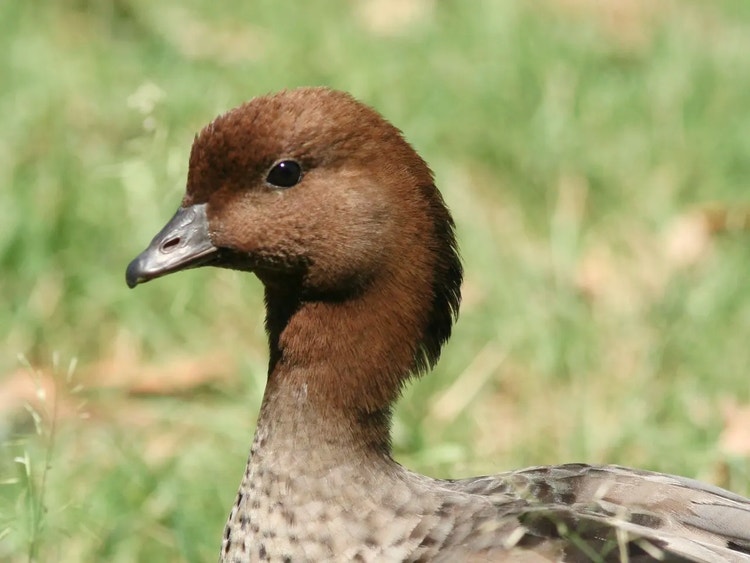
Wood ducks have brown heads, grey bodies, dark wing markings and speckled breasts. Females have pale stripes above and below the eye, while males usually have a darker head and smoother grey body. Students may notice them feeding calmly on ovals, lawns and grassy banks beside creeks and ponds.
In Sydney, wood ducks can be seen around freshwater and grassy places, including parts of Field of Mars Reserve near Buffalo Creek and other waterways in the Lane Cove River catchment.

Fast facts – Wood duck
Scientific name – Chenonetta jubata
Scientific group – Wood ducks are birds in the duck, goose and swan family.
Appearance – Wood ducks have a brown head, grey body, dark wing markings and a speckled breast.
Size – Adult wood ducks are usually about 44 to 50 centimetres long.
Diet – Wood ducks mostly eat grasses, clover, herbs, seeds and small invertebrates.
Habitat – Wood ducks live in open grassy places near freshwater, including creeks, dams, wetlands, parks, farms and sports fields.
Life cycle – Wood ducks hatch from eggs laid in tree hollows, leave the nest as downy ducklings and develop flight feathers after about 50 to 57 days.
Special behaviour – Wood duck ducklings can jump from a tree hollow soon after hatching and follow their parents to the ground or nearby water.
Where do wood ducks live?
Wood ducks are widespread across much of Australia, including Tasmania. They prefer open grassy places near freshwater, such as creeks, dams, wetlands, ponds, farm paddocks, urban parks and sports fields. They also use open woodland and flooded grassland, but are less common in very dry places where water and green grazing areas are scarce.
At Field of Mars Reserve, wood ducks are often noticed near Buffalo Creek and nearby grassy edges. Students should observe them quietly from a distance, especially when ducklings are present, because adult birds may give warning calls or move their young away if people come too close.

Wood ducks jumping into Buffalo Creek.
What do wood ducks eat?
Wood ducks mostly eat plant material. They graze on grasses, clover, herbs and seeds, and may also eat insects, worms and other small invertebrates, especially after rain.
Unlike many ducks, wood ducks spend much of their feeding time on land or at the edge of water. Their grazing helps move plant material through the food web, and their eggs, ducklings and sometimes adults provide food for predators.

What do wood ducks sound like?
Wood ducks are not as noisy as some wetland birds, but they do use calls to stay in contact. Females make a long, loud, rising gnow call, while males usually make shorter and higher calls. Feeding flocks may also make soft chattering sounds.
Parents and ducklings use calls to keep together. Around nesting time, adults may call to ducklings from the ground after they hatch in a tree hollow and are ready to leave the nest.
What is the life cycle of wood ducks?
Wood ducks usually form long-term pairs and are often seen as a male and female together. In southern Australia, breeding is most common in spring, but wood ducks may breed after good rain when food and nesting conditions improve.
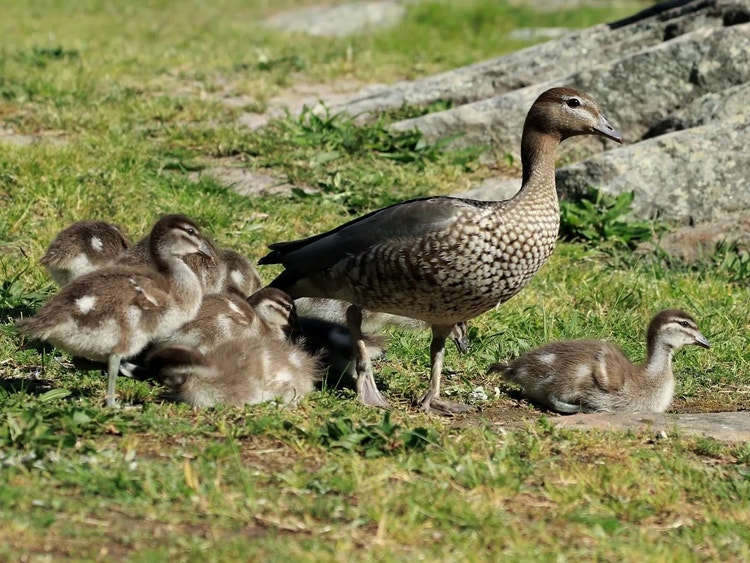
The female lays about 8 to 12 eggs in a tree hollow, often above or near water. The eggs hatch after about 28 days. Soon after hatching, the light ducklings leave the hollow and drop to the ground, where their parents guide and protect them. Young birds grow quickly, develop flight feathers after about 50 to 57 days and may stay near the adults for several more weeks.
What adaptations do wood ducks have to help them survive?
Wood ducks have adaptations that help them live between land and water. Their strong legs help them walk and graze on grass, while their webbed feet allow them to swim when they need to escape danger or move along creeks and ponds. Their waterproof feathers keep them dry and help them float.
Their short, pointed bills are useful for picking grass, seeds and small invertebrates from the ground. Mottled feathers help females and young birds blend into grass and wetland edges. Behaviour is also important. Parents guard young ducklings, give warning calls and may distract predators by moving away from the chicks.
Why are wood ducks important?
Wood ducks are part of wetland and grassy habitat food webs. They feed on plants and small invertebrates, and they are prey for larger animals. Eggs and ducklings may be eaten by snakes, goannas, eels, ravens, currawongs, kookaburras, foxes, cats and dogs.
They also show students how different habitat features connect. A wood duck family may need a tree hollow for nesting, grass for food, fresh water nearby and shelter from predators. Healthy populations of wood ducks can show that local waterways, grassy edges and old hollow-bearing trees are supporting wildlife.

How can you help wood ducks?
People can help wood ducks by protecting freshwater habitats, keeping rubbish out of creeks and leaving native vegetation along waterways. Old trees with hollows are important nesting places for many birds, including wood ducks, so they should be protected where it is safe to do so.
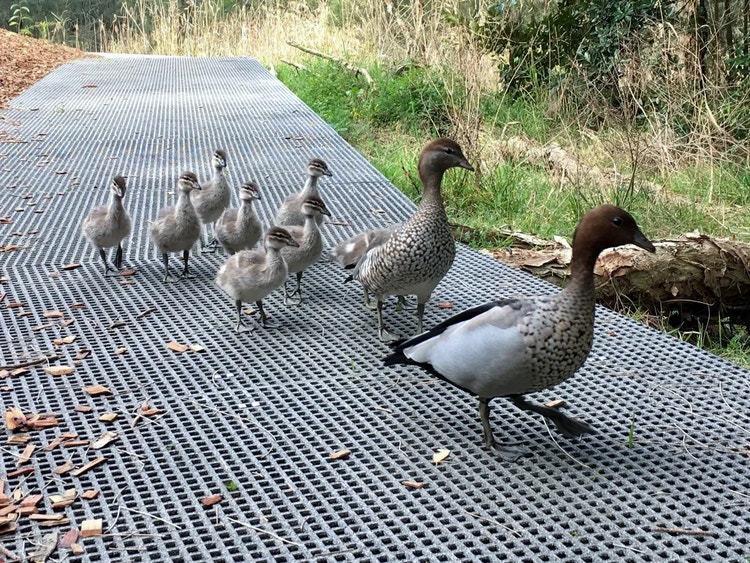
Students can help by watching wood ducks quietly, staying on tracks, keeping dogs away from duck families and never chasing birds or ducklings. Do not feed wood ducks bread or other human food because it can make them sick, reduce natural foraging and attract pests or predators.
Related fact sheets
More bird fact sheets
- Birds fact sheet – Explore the features, life cycles and adaptations shared by birds.
- Pacific black duck fact sheet – Compare another native duck found around creeks, ponds and wetlands.
- Dusky moorhen fact sheet – Learn about another waterbird that lives around ponds, creeks and reeds.
- Australian white ibis fact sheet – Find out about another native bird that feeds in wetland and urban habitats.
Habitats and ecosystems
- Water habitats fact sheet – Discover freshwater habitats where wood ducks feed, drink and shelter.
- Tree habitats fact sheet – Explore how tree hollows provide nesting places for ducks and other animals.
- Field of Mars Reserve fact sheet – Learn more about local bushland, creek and wetland habitats.
Animals that share this habitat
- Common eastern froglet fact sheet – Learn about a small frog that lives near damp ground, ponds and drains.
- Striped marsh frog fact sheet – Explore another animal that depends on freshwater habitats for breeding.
- Dragonfly fact sheet – Find out about insects that use freshwater habitats as nymphs and flying adults.
Food webs and ecological relationships
- Insects fact sheet – Explore small animals that are part of wetland and grassy habitat food webs.
- Mosquito fact sheet – Learn about insects that breed in water and provide food for other animals.
- Laughing kookaburra fact sheet – Discover a bird predator that may feed on small animals, eggs and chicks.
Attributions
References
Australian Museum. Australian Wood Duck. [online] Available at: https://australian.museum/learn/animals/birds/australian-wood-duck/
BirdLife Australia. Australian Wood Duck. [online] Available at: https://www.birdsinbackyards.net/species/Chenonetta-jubata
Centennial Parklands. Australian Wood Duck. [online] Available at: https://www.centennialparklands.com.au/visit/environment/birds/australian-wood-duck
Dharug and Dharawal Resources. Dharug dictionary: duck. [online] Available at: https://dharug.dalang.com.au/language/dictionary?dialect=All&numeric=Exact&query=duck&type=English
Foundation for National Parks & Wildlife. Wood Duck. [online] Available at: https://backyardbuddies.org.au/backyard-buddies/wood-duck/
RSPCA Australia Knowledgebase. What are the animal welfare issues associated with feeding wildlife? [online] Available at: https://kb.rspca.org.au/categories/wild-animals/living-with-wildlife/what-are-the-animal-welfare-issues-associated-with-feeding-wildlife
Image attributions
A wood duck. – Field of Mars EEC (original illustration).
Male wood ducks have a dark brown head and a small mane of feathers. – ‘Australian Wood Duck.jpg’ by Glen Fergus. Creative Commons Attribution-Share Alike 2.5 Generic. Available at: https://commons.wikimedia.org/wiki/File:Australian_Wood_Duck.jpg

Wood ducks often live near freshwater and open grassy areas. – ‘Wood Ducks and Freckled Ducks’ by Ed Dunens. Creative Commons Attribution 2.0 Generic. Available at: https://www.flickr.com/photos/40883175@N06/21664050360
Wood ducks graze on grasses, clover and seeds near water. – ‘Photo 292294298’ by Tim Boote. Creative Commons Attribution-NonCommercial 4.0 International. Available at: https://inaturalist.ala.org.au/photos/292294298
Wood duck ducklings have soft down feathers and stay close to their parents. – ‘Chenonetta jubata -Australia -adult female with chicks-8.jpg’ by Colin J. Creative Commons Attribution-Share Alike 2.0 Generic. Available at: https://commons.wikimedia.org/wiki/File:Chenonetta_jubata_-Australia_-adult_female_with_chicks-8.jpg

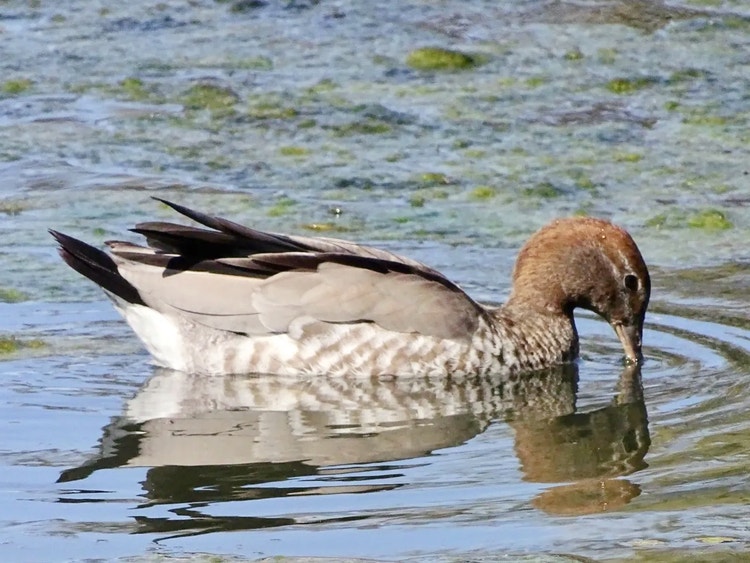
Waterproof feathers and webbed feet help wood ducks move through water. – ‘Photo 317309200’ by Tim Boote. Creative Commons Attribution-NonCommercial 4.0 International. Available at: https://www.inaturalist.org/photos/317309200
Healthy bushland and waterways support wood ducks and many other animals. – ‘Australian Wood Ducks - AndrewMercer IMG15714.jpg’ by Andrew Mercer. Creative Commons Attribution-Share Alike 4.0 International. Available at: https://commons.wikimedia.org/wiki/File:Australian_Wood_Ducks_-_AndrewMercer_IMG15714.jpg

Keep away from duck families so adults can safely guide and protect their ducklings. – Field of Mars EEC (original image).
Learn with us

Book now
Book a water environment, urban environment or curriculum-aligned program where students investigate ducks, grasslands, wetlands and feeding adaptations.

Learning programs
Explore Field of Mars EEC programs that support learning about wood ducks, grazing birds, water habitats, open grass, urban wildlife and food webs.

Learning resources
Use the wood duck fact sheet to support classroom learning about grazing ducks, webbed feet, water, grass, nesting hollows and open habitats.

Flora and fauna fact sheets
Explore related fact sheets about birds, water habitats, grassland ecosystems, urban environments, tree habitats and freshwater wetlands.
Related programs
Water environments excursion
Explore creek and river environments, observe living things and investigate the connections between waterways, habitats and people.
Wild words excursion
Explore bushland as park rangers, building vocabulary to describe living things, habitats and ways people care for environments.