
Documentary in a day excursion | Stage 3 English
Program overview
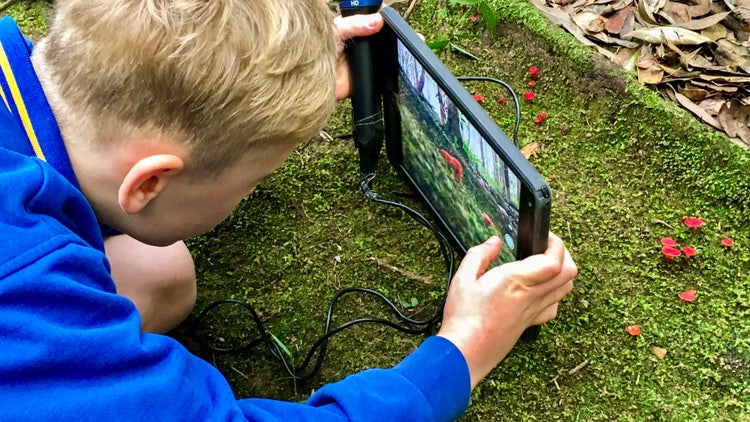
Documentary in a day is a Stage 3 English excursion where students work in pairs to plan, script, film and edit a short nature documentary in Field of Mars Reserve. Using iPads, students investigate habitats and living things, then transform their field observations into an informative multimodal text for an audience.
Students learn how narration, visuals and sound work together, practise purposeful camera techniques and use iMovie to sequence footage, record voice-overs and add titles, captions and music. Completed documentaries are shared with the school through Google Drive.
We have been advised that this program is exempt from the screen use limits under the new screen use guidelines for schools, as the use of technology in this program is purposeful, intensive and curriculum aligned.
This program is also available for Stage 2 and as a Documentary in a day incursion.
Learning intention
- We are learning to plan, film and edit an informative nature documentary about habitats.
Jump to: Program and curriculum | Essential information | Plan and prepare | Location | Related excursions

Program and curriculum information
Program activities
Activities may change to suit student needs, timing and weather conditions.
Documentary workshop
Students examine short documentary examples and identify how narration, visuals, text and sound communicate information and engage an audience. They learn the documentary workflow and explore the planning guides, filming checklists and success criteria they will use throughout the day.
Scriptwriting and field filming
Working in pairs, students plan the structure of their documentary and draft a concise informative script using habitat vocabulary and field observations. They identify the footage required to illustrate and strengthen each section of their narration.
Students explore the reserve and practise camera shots, angles and movements before filming habitat features and living things. They make purposeful decisions about framing, focus and camera position while following their script and filming plan.
Editing and sharing
Students use iMovie to arrange footage, adjust clip length and record voice-over narration. They remove unwanted audio, add titles and captions, select suitable music and create a closing credits sequence.
Students export and share their finished documentaries, then reflect on how effectively the narration, visuals and sound communicated information about the natural environment. Completed videos are returned to the school through Google Drive.
Suggested timetable
Time |
Activities |
| 9.45–10.15 | Documentary workshop |
| 10.15–10.30 | Toilets, crunch and sip or recess |
| 10.30–12.30 | Scriptwriting and mobile filmmaking |
| 12.30–1.00 | Lunch and toilets |
| 1.00–2.00 | Editing and sharing |
| 2.00–2.15 | Pack up, toilets and depart |
Syllabus outcomes and content
Students will learn to
- analyse how narration, visuals, text and sound communicate information and engage an audience
- plan and draft a structured informative script using precise vocabulary and coherent ideas
- select camera shots, angles and movements that reinforce narration
- choose multimodal features suited to purpose and audience
- sequence and refine footage, narration, titles, captions and sound
- evaluate and revise a completed informative multimodal text
The excursion addresses the following Stage 3 content from the English K–10 Syllabus (2022).
English K–10 Syllabus (2022)
Creating written texts
Outcome
- EN3-CWT-01 – Plans, creates and revises written texts for multiple purposes and audiences through selection of text features, sentence-level grammar, punctuation and word-level language
Content addressed
- Choose multimodal features suited to a target audience and purpose, to reinforce and extend ideas
- Create hybrid texts for target audiences, using print or digital tools
English K–10 Syllabus (2022) © NSW Education Standards Authority for and on behalf of the Crown in right of the State of New South Wales, 2022
Tier 2 and 3 vocabulary
Essential information
Cost, class numbers and booking
Cost
DoE $27 per student – GST free
Non-government school $37 per student – GST free, minimum charge $750 per class
Term 1 non-government weeks 3 to 5 – DoE cost, GST free, minimum charge $750
Classes
Recommended maximum 4 classes, with up to 30 students per class.
Program costs
Program costs may change. If program costs change after you book, you will be charged at the original cost.
Booking policy
Confirm final student numbers and classes 7 working school days before the program.
Risk assessment and accessibility
Field of Mars Reserve risk assessment and location information – main location
The program includes bushwalking on uneven natural tracks. Some program areas at Field of Mars Reserve may be wheelchair accessible.
Students who are unwell should not attend.
Classroom teachers are expected to attend and actively supervise students throughout the excursion.
Notify Field of Mars EEC before the visit about medical, mobility, sensory, communication or other support needs so reasonable adjustments can be considered.
What students should bring
Weather, cancellations and rescheduling
The program may be modified, postponed or cancelled because of predicted extreme temperatures, bush fire danger, heavy rainfall, high winds or dust storms.
Cancellation or rescheduling with less than 30 school days’ notice before the booking date – $650
Cancellation with less than 14 school days’ notice before the booking date – full program cost
Cancellation due to unsafe weather or fire danger – $0
Plan and prepare for your visit

Documentary in a day social story
Help Year 5 and 6 students understand what will happen before, during and after their Documentary in a day excursion.

Preparing for your excursion
Find information about what students should wear and bring, transport, arrival procedures, safety and preparing classes for active outdoor learning.
Location

Field of Mars Reserve
Main location
Find risk assessment information, risk management advice, bus access details and walking track information for Field of Mars Reserve.
Extend student learning
Use these student-friendly fact sheets before or after the Documentary in a day excursion to develop habitat knowledge, subject vocabulary and ideas for nature documentary scripts.
- Habitat fact sheet – Learn how food, water, shelter and space help living things survive.
- Field of Mars Reserve environment fact sheet – Explore the bushland environment students use as the setting for their documentary.
- Eucalypt forest ecosystems fact sheet – Learn about forest layers, food webs and living and non-living features.
- Tree habitat fact sheet – Discover how bark, branches, leaves, flowers and hollows support living things.
- Leaf litter habitat fact sheet – Explore a forest-floor habitat used by decomposers, invertebrates and small reptiles.
- Invertebrate fact sheets – Research insects, spiders, worms, molluscs and other small animals that could feature in a documentary.
Learn with us

Book this excursion
Book this Stage 3 English excursion using our online booking form.

Nature documentary learning resource
Use Nature documentary learning resources to support planning, scripting, filming and reviewing nature documentaries.
Related Stage 3 excursions
Digital woodlands excursion
Use iPads to photograph natural features, apply composition techniques and create a collaborative digital photo book.
Poetic adventures excursion
Collect sensory words and images in bushland, then create an illustrated poem with narration, titles and sound.