
Ranger for a day | Stage 1 | English excursion | Field of Mars EEC
Program overview
Ranger for a day is a Stage 1 English excursion designed to build oral language and vocabulary for EAL/D and multilingual learners through authentic, hands-on experiences in bushland. Students take on the role of park rangers, learning and using new words to describe what they see, explain evidence of living things and communicate how people care for environments. Vocabulary is taught explicitly and revisited throughout the day using visuals, actions, sorting and short speaking tasks, so students get repeated practice using Tier 2 and Tier 3 words in meaningful contexts.
Learning intentions
- We are learning to use new vocabulary to describe places, living things and habitat features.
- We are learning to use speaking sentences to explain what we observe and how people care for environments.


Activities
This is a brand new version of Ranger for a day that has been built for EAL/D students. We are still finalising activities and they may change.
Ranger HQ vocabulary warm-up
Students learn the day’s ranger words using picture cards, gestures and quick call-and-response games.
Bushwalk
Students explore Field of Mars Reserve as park rangers, stopping at short investigation points. Students match picture-word cards to real features (track, leaf litter, shelter, creek), look for evidence of animals (sounds, scats, scratches, holes, feathers) and practise ranger talk using sentence frames to describe and explain observations. Students also acknowledge the sustainable practices of the Wallumedegal Peoples as part of caring for Country and place.
Caring for the bush
Working in small groups, students design a mini national park that includes habitat features (food, water, shelter), visitor features (paths, bins, signs) and ranger rules that protect the environment. Each group delivers a short spoken ranger report using taught vocabulary and simple cause-and-effect explanations.
Build an insect hotel
Students learn vocabulary for insect homes and microhabitats, then create an insect hotel to take back to school (one per class). Students use sequencing language (first/next/finally) and precise material words as they build, then explain how the structure provides animal habitats.
Location options
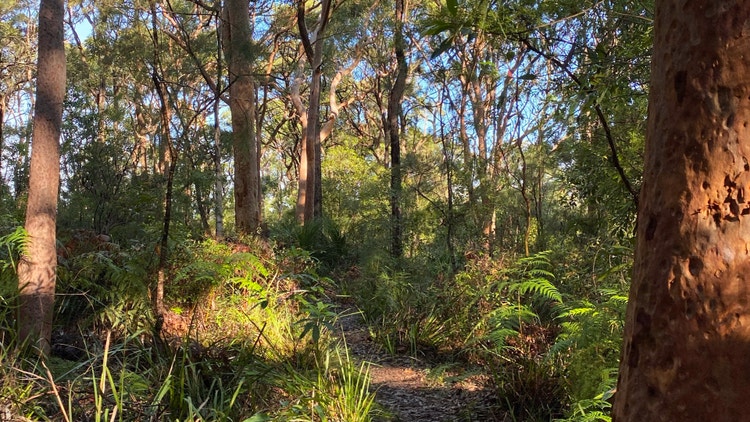
Field of Mars Reserve
Main location – including risk assessment and risk management advice, bus map and track overview.

Buffalo Creek Reserve
Alternative location – including risk assessment and risk management advice, bus map and track overview.
Essential information
Cost and details
Cost 2026 |
DoE $27 per student – GST free Non-gov $37 per student – GST free, min charge $750 per class Term 1 – Non-gov weeks 3 to 6 cost = DoE cost – GST free, min charge $750 |
Classes |
Maximum 6 classes at Field of Mars Reserve with up to 30 students per class. More than 6 classes will run across two sites – Field of Mars Reserve and Buffalo Creek Reserve. Please contact us. |
Activities |
Activities may change to suit student needs, the selected site and weather conditions. |
Bring |
Sports uniform, backpack, medication, low-waste food, water bottle, sunblock, raincoat, hat, sturdy shoes, reusable name tag. |
View |
|
Welfare |
Rugged bushwalking, limited wheelchair accessibility. May not suit recently unwell participants. For medical or special needs notify staff prior to program. |
Extreme or wet weather |
Program may be modified, postponed or cancelled due to predicted extreme temperatures, bush fire danger, heavy rainfall, high winds or dust storms. |
Booking policy |
Confirm student numbers and classes 7 days in advance. |
Cancellation fee |
Less than 30 working school days – $600 Less than 7 working school days notice – full cost Weather or fire danger cancellation – $0 |
Suggested timetable
Time |
Class A, B, C |
Class D, E, F |
| 9.45 - 10.30 |
Introduction - Ranger HQ Recess and toilets |
Introduction - Ranger HQ Recess and toilets |
| 10.30 - 12.00 | Bushwalk |
Habitat development Insect hotel |
| 12.00 - 12.30 | Lunch and toilets | Lunch and toilets |
| 12.30 - 2.00 |
Habitat development Insect hotel |
Bushwalk |
| 2.00 - 2.15 | Pack up, toilets and depart | Pack up, toilets and depart |
Tier 2 and 3 vocabulary
Syllabus outcomes and content
English K-6 Syllabus (2022)
Outcome
- Understands and effectively uses Tier 1, taught Tier 2 and Tier 3 vocabulary to extend and elaborate ideas EN1-VOCAB-01
- Communicates effectively by using interpersonal conventions and language to extend and elaborate ideas for social and learning interactions EN1-OLC-01
- Plans, creates and revises texts written for different purposes, including paragraphs, using knowledge of vocabulary, text features and sentence structure EN1-CWT-01
Content focus (Vocabulary)
Students will be supported to:
- use taught morphemic knowledge to build word families
- understand and use words with different meanings in different contexts
- use vocabulary to express cause and effect
- intentionally choose subject-specific vocabulary to enhance precision and effect
Other syllabus links
Learning experiences will also support (but not explicitly teach) Stage 1 HSIE Geography content about caring for places and active citizenship.
English K-6 Syllabus © NSW Education Standards Authority (NESA) for and on behalf of the Crown in right of the State of New South Wales, 2022

Book now
Book your primary Ranger for a day excursion using our online booking form.

Social stories
View social stories that explain what to expect on an incursion or excursion.

Learning resources
View online lessons that support primary incursion and excursion programs.

Flora and fauna fact sheets
View our curriculum-aligned fact sheets on Australian animals, plants, ecosystems and environments for NSW primary and secondary students, ideal for research, projects and classroom learning.