Eastern snake-necked turtle fact sheet – kutukulung | Field of Mars EEC
What are eastern snake-necked turtles?
Eastern snake-necked turtles, also called eastern long-necked turtles, are freshwater reptiles found across eastern and south-eastern Australia. Their scientific name is Chelodina longicollis. These turtles are easy to recognise because of their very long neck, which can be about half the length of their shell. Unlike many other turtles, they bend their neck sideways under the edge of their shell rather than pulling it straight back.
Eastern snake-necked turtles live in wetlands, ponds, creeks, dams and slow-moving rivers. They spend most of their time swimming, resting underwater or basking in the sun on logs and rocks. Students may also spot them walking across roads, paths or grass after rain as they travel between waterholes looking for food, nesting sites or new habitats.
These turtles are important predators in freshwater ecosystems. They help control populations of insects, tadpoles and small aquatic animals. When threatened, eastern snake-necked turtles can release a strong-smelling liquid from glands near their shell, which helps scare away predators. The Darug name for the eastern snake-necked turtle is kutukulung.
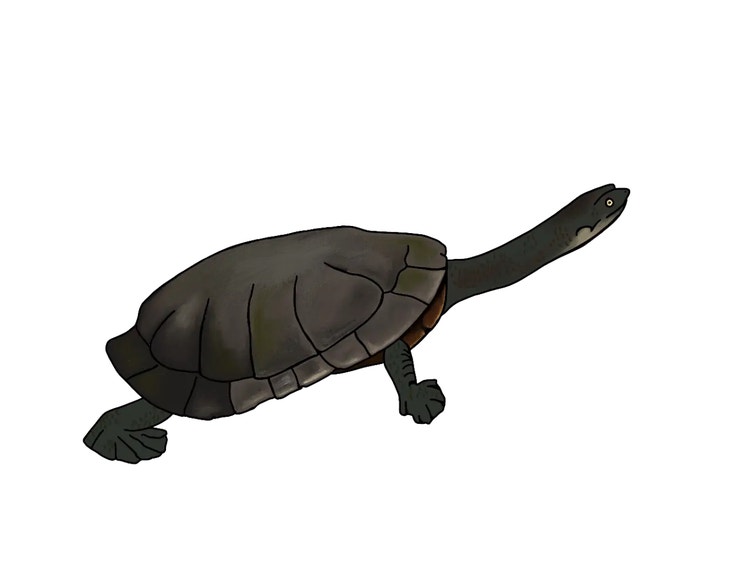
Fast facts – Eastern snake-necked turtle
Scientific name – Chelodina longicollis
Scientific group – Eastern snake-necked turtles are freshwater reptiles in the side-necked turtle family.
Appearance – They have a broad oval shell, webbed feet, strong claws and a long neck that bends sideways into the shell.
Size – Adult shells usually grow up to about 25 centimetres long.
Diet – They eat aquatic insects, tadpoles, yabbies, worms, frogs and small fish.
Habitat – They live in freshwater wetlands, creeks, dams, ponds and slow-moving rivers.
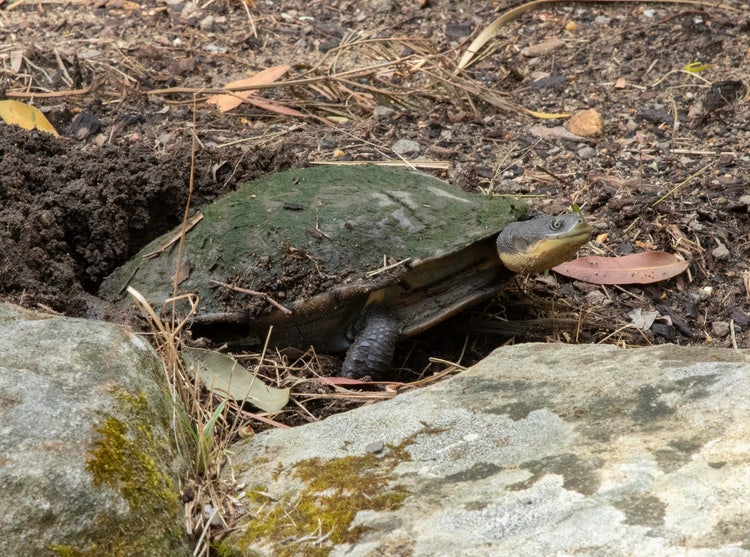
Life cycle – Females lay soft-shelled eggs in nests dug into soil near water during summer, and hatchlings emerge about 3–5 months later. Eastern snake-necked turtles can live for several decades.
Special behaviour – They may walk long distances across land after rain to find new wetlands and can release a strong-smelling liquid when disturbed.

Where do eastern snake-necked turtles live?
Eastern snake-necked turtles are found in Queensland, New South Wales, Victoria and South Australia. They live in freshwater habitats such as wetlands, creeks, farm dams, ponds, lakes and slow-moving rivers. They prefer places with soft muddy bottoms, aquatic plants and logs or rocks where they can bask in the sun.
These turtles are common in many parts of Sydney, including wetlands and waterways connected to Field of Mars Reserve and Lane Cove National Park. Students may spot them swimming near the water surface, resting on logs or travelling across land after heavy rain. They sometimes move surprising distances between wetlands when searching for food, mates or new water sources during dry conditions.

What do eastern snake-necked turtles eat?
Eastern snake-necked turtles are carnivores that hunt small animals in freshwater habitats. Their diet includes aquatic insects, worms, crustaceans, tadpoles, frogs, carrion and small fish. Young turtles usually feed on smaller prey such as insect larvae and tiny aquatic animals.
These turtles are ambush predators. They stretch out their long neck very quickly to grab prey underwater, similar to the strike of a snake. Their strong claws help tear apart larger food items. Eastern snake-necked turtles play an important role in freshwater food webs by helping control populations of aquatic animals and cleaning up dead animals in waterways.

What is the life cycle of eastern snake-necked turtles?
Eastern snake-necked turtles usually breed during the warmer months. In summer, females leave the water and dig a nest in soft soil near wetlands, creeks or ponds. They lay between about 4 and 20 soft-shelled eggs before covering the nest and returning to the water.
After several months, the hatchlings emerge and instinctively head towards water. Young turtles are vulnerable to predators such as birds, fish and foxes. Eastern snake-necked turtles grow slowly and may take many years to reach breeding age, but adults can live for decades if they survive threats such as drought, road crossings and habitat loss.
What adaptations do eastern snake-necked turtles have to help them survive?
Eastern snake-necked turtles have many adaptations that help them survive in freshwater environments. Their webbed feet make them strong swimmers, while their sharp claws help them climb riverbanks, dig nests and tear food apart. Their streamlined shell helps them move through water more easily.
Their long neck allows them to strike quickly at prey and breathe at the water surface while the rest of their body stays hidden underwater. When threatened, they bend their neck sideways beneath their shell for protection. They can also release a foul-smelling liquid from glands near their shell to discourage predators, which has earned them the nickname “stinker”.
Eastern snake-necked turtles can survive dry conditions by moving across land to find new wetlands. During drought, they may bury themselves in mud or damp soil until conditions improve.

Why are eastern snake-necked turtles important?
Eastern snake-necked turtles are important predators and scavengers in freshwater ecosystems. They help keep waterways healthy by eating insects, tadpoles, small animals and carrion. This helps recycle nutrients and maintain balanced food webs.
These turtles are also part of the diet of larger predators such as birds of prey and foxes. Healthy turtle populations are often a sign of healthy wetlands and waterways. Freshwater turtles are culturally important to many Aboriginal peoples across Australia, including communities connected to the waterways of Sydney.

How can you help eastern snake-necked turtles?
People can help eastern snake-necked turtles by protecting wetlands, creeks and ponds from pollution. Rubbish, chemicals, fertilisers and stormwater pollution can damage turtle habitats and reduce water quality. Keeping waterways healthy also protects the insects, frogs and fish that turtles rely on for food.
Drivers should slow down near wetlands and waterways after rain because turtles sometimes cross roads while searching for nesting sites or new waterholes. Students can also help by protecting bushland habitats, keeping pets away from wetlands and learning more about local freshwater ecosystems.

Related fact sheets
More reptile fact sheets
- Reptiles fact sheet – Learn about reptiles and their adaptations.
- Eastern water dragon fact sheet – Discover another reptile often seen near waterways.
- Eastern water skink fact sheet – Learn about a smaller reptile that uses wetland edges and nearby shelter.
- Red-bellied black snake fact sheet – Explore a reptile predator that lives near creeks and wetlands.
Habitats and ecosystems
- Water habitats fact sheet – Discover freshwater habitats where turtles live, feed and breed.
- Habitat fact sheet – Learn how habitats provide food, water, shelter and space for animals.
- Field of Mars Reserve fact sheet – Explore the local bushland, wetlands and waterways near Field of Mars EEC.
Animals that share this habitat
- Striped marsh frog fact sheet – Find out about a frog that lives near ponds, creeks and wetlands.
- Common eastern froglet fact sheet – Learn about a small frog found in damp places around Sydney.
- Dragonfly fact sheet – Explore insects that depend on freshwater habitats for part of their life cycle.
Attributions
References
Australian Museum. Eastern snake-necked turtle. [online] Available at: https://australian.museum/learn/animals/reptiles/eastern-snake-necked-turtle/
NSW National Parks and Wildlife Service. Eastern snake-necked turtle. [online] Available at: https://www.nationalparks.nsw.gov.au/plants-and-animals/eastern-snake-necked-turtle
NSW Department of Climate Change, Energy, the Environment and Water. Freshwater turtles. [online] Available at: https://www.environment.nsw.gov.au/topics/animals-and-plants/native-animals/native-animal-facts/reptiles/freshwater-turtles
Museums Victoria Collections. Chelodina longicollis (Shaw, 1794), Eastern Snake-necked Turtle. [online] Available at: https://collections.museumsvictoria.com.au/species/8818
Northern Beaches Council. Eastern Long-necked Turtle. [online] Available at: https://www.northernbeaches.nsw.gov.au/environment/native-animals/eastern-long-necked-turtle
Dharug and Dharawal Resources. Dharug Dictionary: turtle. [online] Available at: https://dharug.dalang.com.au/language/view_word/1011
Image attributions
An eastern snake-necked turtle. – Field of Mars EEC (original illustration).
Eastern snake-necked turtles often bask on logs beside freshwater creeks and wetlands. – Field of Mars EEC (original image).
Eastern snake-necked turtles live in freshwater wetlands, creeks and ponds across eastern Australia. – Field of Mars EEC (original image).
Eastern snake-necked turtles can move across land when travelling between freshwater habitats. – ‘Common snakeneck turtle (Chelodina longicollis) 2.jpg’ by Bidgee. Creative Commons Attribution 3.0 Unported licence. Available at: https://commons.wikimedia.org/wiki/File:Common_snakeneck_turtle_(Chelodina_longicollis)_2.jpg
_2.jpg)
Female eastern snake-necked turtles dig nests in soft soil beside freshwater habitats. – Field of Mars EEC (original image).
Webbed feet and a streamlined shell help eastern snake-necked turtles swim through freshwater habitats. – Field of Mars EEC (original image).
Eastern snake-necked turtles help keep freshwater ecosystems healthy. – ‘Eastern Long-neck-Turtle-with-algae,-Vic,-3.1.2008.jpg’ by Jjron. Creative Commons licence. Available at: https://commons.wikimedia.org/wiki/File:Eastern_Long-neck-Turtle-with-algae,-Vic,-3.1.2008.jpg

Eastern snake-necked turtles may need help crossing roads safely after rain. – ‘Long-necked tortoise Chelodina longicollis, New England Highway, Wallangarra IMGP3725.jpg’ by Kgbo. Creative Commons licence. Available at: https://commons.wikimedia.org/wiki/File:Long-necked_tortoise_Chelodina_longicollis,_New_England_Highway,_Wallangarra_IMGP3725.jpg

Learn with us

Book now
Book a water environment, science or geography program where students investigate freshwater habitats, turtles, adaptations and waterway food webs.

Learning programs
Explore Field of Mars EEC programs that support learning about turtles, wetlands, creeks, water habitats, life cycles and human impacts on waterways.

Learning resources
Use the eastern snake-necked turtle fact sheet to support classroom learning about freshwater turtles, long necks, swimming adaptations, eggs and aquatic food webs.

Flora and fauna fact sheets
Explore related fact sheets about reptiles, water habitats, freshwater wetlands, rivers, creeks, frogs, invertebrates and wetland ecosystems.