Grass tree fact sheet – gulgadya | Field of Mars EEC
What are grass trees?
Grass trees are slow-growing Australian plants in the genus Xanthorrhoea. They are not true grasses or trees, but flowering plants with a crown of long, narrow, stiff leaves growing from a central point. Some species develop a dark trunk made from old leaf bases held together by resin.
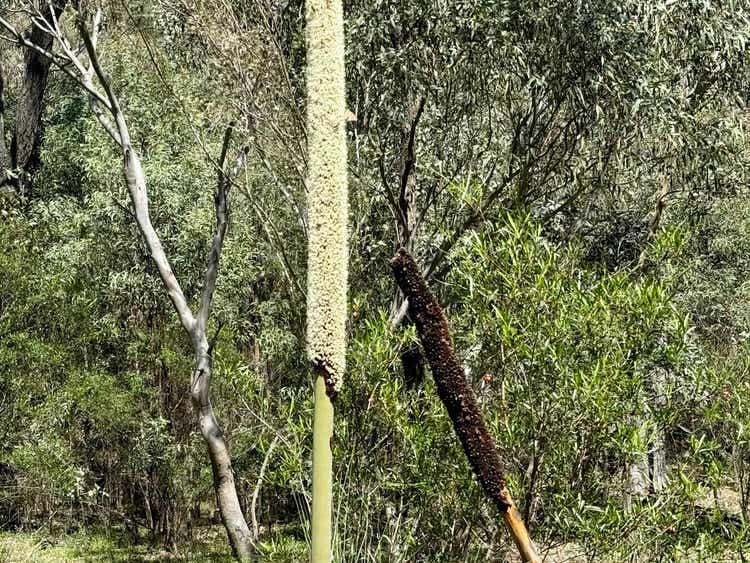
The grass tree found in Field of Mars Reserve is Xanthorrhoea media. It grows in dry eucalypt forest and heathland, often on nutrient-poor soils. When conditions are right, grass trees can produce a tall spear-like flower spike covered in many tiny cream flowers that provide nectar for animals.

A grass tree.
Fast facts – Grass tree
Scientific name – Xanthorrhoea media
Scientific group – Grass trees are flowering monocots in the Asphodelaceae family.
Appearance – Grass trees have long, narrow, stiff leaves that grow from a central crown, and some species develop a dark trunk made from old leaf bases.
Size – Grass tree species can range from about 1 to 6 metres tall, but Xanthorrhoea media usually has no trunk or only a short trunk.
Habitat – Grass trees grow in Australian eucalypt forests, heathlands and other well-drained habitats with low-nutrient soils.
Flowers and seeds – Tiny cream flowers grow along a tall spike and, after pollination, form tough seed capsules.
Life cycle – Grass trees grow slowly, flower after suitable conditions or fire, produce seeds and can live for many years.
Adaptations – Grass trees have narrow leaves, protected growth points, fire responses and helpful root fungi that help them survive in dry, nutrient-poor bushland.
Ecological role – Grass trees provide nectar, pollen, seeds, shelter and structure for insects, birds, mammals and other small animals.

Where do grass trees grow?
Grass trees are found across Australia, especially in dry forests, woodlands and heathlands. They often grow in well-drained, sandy or poor soils where many other plants find it difficult to survive.
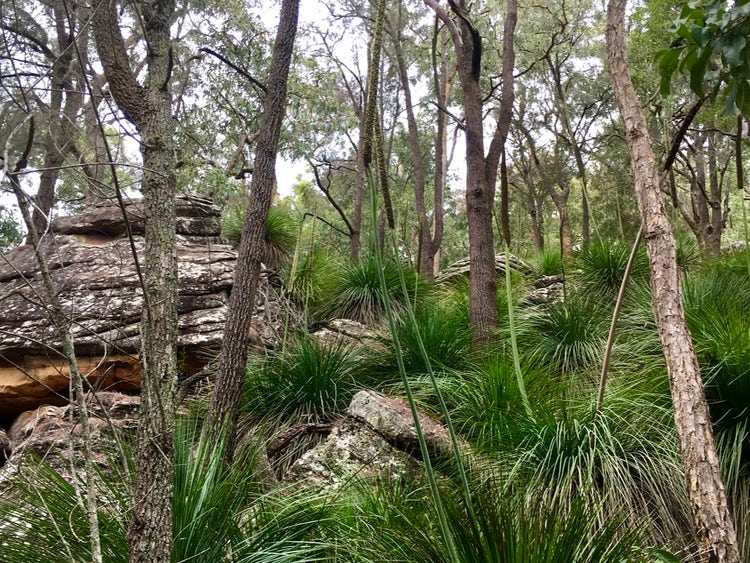
In the Sydney region, grass trees are part of sandstone bushland vegetation. At Field of Mars Reserve, Xanthorrhoea media grows in eucalypt forest understorey, where it forms part of the layered bushland habitat.

How are grass trees used by Aboriginal Peoples?
In Sydney language records, grass tree is recorded as gulgadya or gadi. The Dharug Dalang dictionary records gulgadya for grass tree and galun for grass tree stems used to make spears.
Some Aboriginal Peoples used grass trees in many practical ways. The resin from grass trees was used as a strong waterproof glue for fastening barbs to spears and stone axe heads, and for repairing water containers. Long dry flower stems could be used for spear shafts and fire-making.
Some parts of grass trees were also used as food in some areas. Nectar from the flowers could be collected or soaked in water to make a sweet drink, and the soft bases of young leaves were eaten by some Aboriginal Peoples.

What animals use grass trees?
Grass tree flower spikes produce nectar and pollen that attract insects, birds and mammals. Bees and other insects visit the many small flowers, while nectar-feeding birds may use the flower spikes as a food source when they are in bloom.
The dense leaves and old leaf skirt around some grass trees can provide shelter for small animals. Reptiles, invertebrates and small mammals such as bandicoots may use the cover around grass trees for hiding, nesting or foraging.

What is the life cycle of grass trees?
Grass trees are perennial plants, which means they can live for many years. They grow slowly from seed into young plants with narrow leaves. Over time, some species build a trunk from old leaf bases and resin.
Mature grass trees can produce a tall flower spike. The spike carries many small flowers that are pollinated by insects, birds and mammals. After pollination, the flowers form seed capsules. When seeds fall into suitable soil, some germinate and grow into new grass trees.
What adaptations do grass trees have to help them survive?
Many grass trees are adapted to survive fire. Their living growth point is protected by tightly packed leaf bases, and old dead leaves can form an insulating skirt around the stem. After fire, some grass trees respond by producing new green leaves and flower spikes.
Grass trees also survive in poor soils with help from mycorrhizal fungi around their roots. These fungi help the plant take up water and nutrients, while the grass tree supplies sugars to the fungi. Their long, tough, narrow leaves also help them cope with dry, exposed conditions.

Why are grass trees important?
Grass trees are important understorey plants in Australian bushland. Their flowers provide nectar and pollen, their seeds provide food, and their leaves and old skirts can give shelter to small animals.
Grass trees also add structure to forests and heathlands. They help create a diverse plant layer beneath taller trees and support food webs by providing resources for pollinators, birds, mammals and invertebrates.

How can you help grass trees?
You can help grass trees by staying on tracks, leaving leaves and flower spikes in place, and observing plants without damaging them. Grass trees grow slowly, so broken leaves, damaged trunks or removed plants can take a long time to recover.
Help protect bushland by cleaning soil from shoes and equipment before visiting natural areas, as soil can spread plant diseases such as cinnamon fungus. Joining bushcare, removing weeds with trained adults and learning to identify local native plants can also help protect grass trees and the habitats they support.
Related fact sheets
More plant fact sheets
- Plant fact sheets – Explore more native shrubs, trees, grasses and ground covers of Sydney and NSW.
- Hairpin banksia fact sheet – Learn about another nectar-rich plant that supports birds, mammals and insects.
- Bracken fern fact sheet – Compare grass trees with another understorey plant found in forest habitats.
- Kunzea fact sheet – Explore another dry-forest plant that provides shelter and food for animals.
- Scribbly gum fact sheet – Discover a eucalypt that grows in Sydney sandstone bushland.
Habitats and ecosystems
- Field of Mars Reserve fact sheet – Learn about the local bushland where grass trees and many native animals live.
- Eucalypt forest fact sheet – Explore the forest habitat where grass trees can grow in the understorey.
- Habitat fact sheet – Learn how plants and animals use different parts of a habitat.
- Ground cover habitats fact sheet – Explore low plant layers that shelter small animals and protect soil.
- Shrub habitats fact sheet – Learn how understorey plants provide food and protection for wildlife.
Animals that use this habitat
- Insects fact sheet – Discover insects that visit flowers, pollinate plants and use bushland vegetation.
- Rainbow lorikeet fact sheet – Learn about a nectar-feeding bird that visits flowering native plants.
- Red wattlebird fact sheet – Explore another nectar-feeding bird found in forests, heathlands and gardens.
- Long-nosed bandicoot fact sheet – Learn about a ground-dwelling mammal that uses dense understorey habitat.
Attributions
References
Australian National Botanic Gardens. Aboriginal plant use in south-eastern Australia. [online] Available at: https://assets.schools.nsw.gov.au/content/dam/doe/sws/schools/r/rumbalara-e/Aboriginal%20Education/Aboriginal%20Plant%20Use%20in%20South-Eastern%20Australia.pdf
Bush Heritage Australia. Grass trees. [online] Available at: https://www.bushheritage.org.au/species/grass-trees
Dharug and Dharawal Resources. Dharug dictionary: G words. [online] Available at: https://dharug.dalang.com.au/language/dictionary?dialect=All&numeric=G&query=None&type=English
Dictionary of Sydney. Xanthorrhoea media (gadi). [online] Available at: https://dictionaryofsydney.org/natural_feature/xanthorrhoea_media_gadi
NSW National Parks and Wildlife Service. Fighting invasive Phytophthora root rot. [online] Available at: https://www.nationalparks.nsw.gov.au/conservation-programs/fighting-invasive-phytophthora
PlantNET (The NSW Plant Information Network System). Xanthorrhoea media R.Br. Royal Botanic Gardens and Domain Trust. [online] Available at: https://plantnet.rbgsyd.nsw.gov.au/cgi-bin/NSWfl.pl?lvl=sp&name=Xanthorrhoea~media&page=nswfl
PlantNET (The NSW Plant Information Network System). Xanthorrhoea R.Br. Royal Botanic Gardens and Domain Trust. [online] Available at: https://plantnet.rbgsyd.nsw.gov.au/cgi-bin/NSWfl.pl?lvl=gn&name=Xanthorrhoea&page=nswfl
Image attributions
A grass tree. – Field of Mars EEC (original illustration).
Xanthorrhoea media grows in Field of Mars Reserve. – Field of Mars EEC (original image).
The stem of a grass tree is made from tightly packed old leaf bases. – Field of Mars EEC (original image).
Some Aboriginal Peoples used different parts of grass trees for food, tools and materials. – Field of Mars EEC (original image).
Grass tree flowers provide nectar for insects such as bees. – Field of Mars EEC (original image).
Grass tree flower spikes are covered in many tiny nectar-rich flowers. – Field of Mars EEC (original image).
Grass trees can resprout after bushfire. – Field of Mars EEC (original image).
Tall grass trees form part of the structure of eucalypt forest habitat. – Field of Mars EEC (original image).
Observe grass trees from the track without damaging leaves, trunks or flower spikes. – Field of Mars EEC (original image).
Learn with us

Book now
Book a bushland or Aboriginal connections excursion where students investigate native plants, Country, habitats and sustainable care for places.

Learning programs
Explore Field of Mars EEC programs that support learning about grass trees, plant adaptations, nectar, fire, Aboriginal knowledge and local ecosystems.

Learning resources
Use the grass tree fact sheet to support classroom learning about slow-growing plants, flower spikes, resin, nectar and bushland habitats.

Flora and fauna fact sheets
Explore related fact sheets about native plants, insects, birds, mammals, heath ecosystems, eucalypt forests and habitat connections.
Related programs
Adaptations excursion
Investigate plant structures and adaptations that help native species survive poor soils, dry conditions, fire and other environmental pressures.
National parks excursion
Explore native vegetation, natural features and management strategies that protect plants and biodiversity in national parks.