Golden-tailed spiny ant fact sheet | Field of Mars EEC
What are golden-tailed spiny ants?
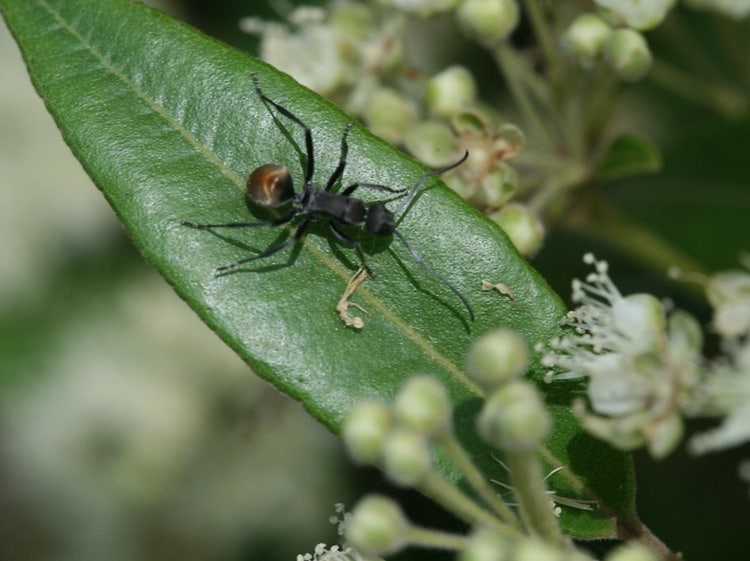
Golden-tailed spiny ants are native Australian ants with dark bodies and a shiny golden covering of fine hairs on the rear part of their body. They are called spiny ants because they have thorn-like spines on their thorax and waist.
The scientific name for the golden-tailed spiny ant is Polyrhachis ammon. Like all ants, they are insects. They have six legs, three main body parts, elbowed antennae and strong jaws.
Golden-tailed spiny ants live in colonies. A colony may include one or more queens, many female workers and winged males and females that help start the next generation. The local Darug people of the Sydney Basin refer to ants as mung.

Fast facts – Golden-tailed spiny ant
Scientific name – Polyrhachis ammon
Scientific group – Golden-tailed spiny ants are insects in the ant family Formicidae.
Darug name – Mung is a Darug word for ant.
Appearance – Golden-tailed spiny ants have dark bodies, elbowed antennae, shiny golden hairs and sharp-looking spines on their thorax and waist.
Size – Workers are usually about 6–10 mm long.
Diet – Golden-tailed spiny ants feed on nectar, pollen, honeydew from sap-sucking insects and small pieces of animal matter.
Habitat – Golden-tailed spiny ants live in open forest, woodland and eucalypt forest along coastal eastern Australia.
Life cycle – Golden-tailed spiny ants hatch from eggs into larvae, change into pupae and then emerge as adult ants.
Adaptations – Their spines, chemical defence, golden body hairs and sensitive antennae help them survive, communicate and find food.

Where do golden-tailed spiny ants live?
Golden-tailed spiny ants are found in open forest and woodland along the east coast of Australia, from northern Queensland to Victoria. They are often seen in eucalypt forests where there are trees, shrubs, leaf litter, fallen logs and rocks.
At Field of Mars Reserve, habitats such as eucalypt forest, leaf litter and rock and log areas provide shelter and food for many ants and other invertebrates.
Golden-tailed spiny ants are ground-nesting ants. Their colonies may be built in soil under rocks, logs or tree roots. Workers often forage on the ground, on leaves and on tree trunks during the day.

What do golden-tailed spiny ants eat?
Golden-tailed spiny ants are omnivores, which means they eat both plant and animal material. They feed on nectar and pollen from flowers, small insects and other animal matter.
They also collect honeydew from sap-sucking insects such as leafhoppers and scale insects. Honeydew is a sweet liquid made when these insects feed on plant sap. The ants may tap the sap-sucking insects with their antennae and collect the honeydew that is released.
In return, the ants may protect the sap-sucking insects from predators. This relationship helps the ants gain a regular sugar-rich food source.
What is the life cycle of a golden-tailed spiny ant?
Golden-tailed spiny ants go through complete metamorphosis. This means their life cycle has four main stages: egg, larva, pupa and adult.
The queen lays tiny eggs inside the nest. Larvae hatch from the eggs and are cared for by adult ants in the colony. As the larvae grow, they shed their skin several times.
The larvae then change into pupae. During this stage, their bodies develop into the adult ant form. Some ant pupae are protected inside a silk cocoon.
Adult ants emerge from the pupae. Most adults in the colony are workers. Winged males and females are produced when it is time for mating and starting new colonies.


What adaptations do golden-tailed spiny ants have to help them survive?
Golden-tailed spiny ants have several adaptations that help them survive in bushland habitats. Their spines may make them harder for predators to grab or swallow. When threatened, they may curl their body to display their spines.
Golden-tailed spiny ants do not have a venomous sting like some other ants. Instead, they can use chemical defence. Formicine ants have a small opening called an acidopore at the tip of the gaster, or rear body section. This opening can release formic acid, which helps defend the ant.
Their shiny golden and black colouring may also help protect them. Bright or contrasting colours can make some animals look less safe to eat.
Their antennae help them touch, smell and communicate. This is important when they are finding food, following trails, recognising nestmates and collecting honeydew from sap-sucking insects.

Why are golden-tailed spiny ants important?
Golden-tailed spiny ants are part of the bushland food web. They provide food for animals such as birds, lizards, spiders and echidnas.
They also help recycle nutrients by feeding on small dead animals and other organic material. Their nests and foraging activity can help move tiny pieces of soil and leaf litter.
Golden-tailed spiny ants also show how connected bushland habitats are. They use flowering plants for food, interact with sap-sucking insects and provide food for larger animals. A small ant colony can be connected to many parts of the ecosystem.

How can you help golden-tailed spiny ants?
You can help golden-tailed spiny ants by protecting bushland habitat. Leaf litter, rocks, fallen branches, logs and tree bases all provide shelter for ants and other small animals.
Where it is safe to do so, leave logs, rocks and natural ground cover in place. These materials may already be homes for insects, spiders, worms and other invertebrates.
Planting local native plants can also help. Flowering wattles, eucalypts and other native plants provide nectar, pollen and habitat for many insects.
Avoid unnecessary pesticide use, especially around flowering plants, leaf litter and garden edges. Pesticides can harm ants and other invertebrates that are important parts of local food webs.
If you find a golden-tailed spiny ant nest, observe it carefully without disturbing it. Do not dig into the nest or leave rocks and logs overturned.

Related fact sheets
More invertebrate fact sheets
- Invertebrate fact sheets – explore more animals without backbones that live in bushland, soil, leaf litter and water.
- Insects fact sheet – learn about the insect group that includes ants, bees, wasps, beetles and flies.
- Ant fact sheet – compare golden-tailed spiny ants with other ants and their colony behaviours.
- Termite fact sheet – learn about another social insect that lives in colonies and recycles dead plant material.
- Springtail fact sheet – discover tiny leaf-litter animals that share damp ground habitats with ants.
Habitats and ecosystems
- Leaf litter habitats fact sheet – explains the damp ground habitat where many ants and other invertebrates live.
- Rock and log habitats fact sheet – explores hidden shelters used by ants, insects, reptiles and other small animals.
- Eucalypt forest fact sheet – explains the local bushland ecosystem that provides leaf litter, logs, trees and shrubs.
- Field of Mars Reserve fact sheet – learn about the local reserve habitats that support ants and other native wildlife.
Animals that share this habitat
- Short-beaked echidna fact sheet – learn about a native mammal that feeds on ants and termites.
Food webs and ecological relationships
- True bug fact sheet – compare ants with sap-feeding insects such as leafhoppers that can provide honeydew.
Attributions
References
AEPMA. n.d. Pest profile: Golden Tailed Spiny Ant. [online] Available at: https://aepma.com.au/PestDetail/7/inftrees
Australian Museum. 2018. Ant colonies. [online] Available at: https://australian.museum/learn/animals/insects/ant-colonies/
Australian Museum. 2018. Ants: Family Formicidae. [online] Available at: https://australian.museum/learn/animals/insects/ants-family-formicidae/
Brisbane Insects. 2010. Golden-tailed Spiny Ant - Polyrhachis ammon. [online] Available at: https://www.brisbaneinsects.com/brisbane_ants/golden_ant.htm
Dharug and Dharawal Resources. n.d. Dictionary. [online] Available at: https://dharug.dalang.com.au/language/dictionary
Pest Nett. n.d. Golden Tailed Spiny Ant. [online] Available at: https://pestnett.com.au/pest-id-guide/golden-tailed-spiny-ant/
Tragust, S. et al. 2020. Formicine ants swallow their highly acidic poison for gut microbial selection and control. eLife. [online] Available at: https://elifesciences.org/articles/60287
Field of Mars EEC. n.d. Insects fact sheet. [online] Available at: https://fieldofmar-e.schools.nsw.gov.au/fact-sheets/invertebrates/insects-fact-sheet
Field of Mars EEC. n.d. Leaf litter habitat fact sheet. [online] Available at: https://fieldofmar-e.schools.nsw.gov.au/fact-sheets/habitats/leaf-litter-habitat-fact-sheet
Field of Mars EEC. n.d. Rock and log habitats fact sheet. [online] Available at: https://fieldofmar-e.schools.nsw.gov.au/fact-sheets/habitats/rock-and-log-habitats-fact-sheet
Field of Mars EEC. n.d. Eucalypt forest fact sheet. [online] Available at: https://fieldofmar-e.schools.nsw.gov.au/fact-sheets/environments/eucalypt-forest-fact-sheet
Field of Mars EEC. n.d. Field of Mars Reserve fact sheet. [online] Available at: https://fieldofmar-e.schools.nsw.gov.au/fact-sheets/environments/field-of-mars-reserve-fact-sheet
Image attributions
A golden-tailed spiny ant – Field of Mars EEC (original illustration).
Golden-tailed spiny ants have an eye-catching golden sheen on the rear part of their body – “Golden-tailed Spiny Ant” by John Tann. Creative Commons Attribution 2.0 Generic. Available at: https://www.flickr.com/photos/31031835@N08/6017256569
Golden-tailed spiny ants often nest in soil under rocks, logs, tree roots or shrubs – “File:Polyrhachis ammon Golden-tailed spiny ant nest at base of Eucalyptus tereticornis 7th Brigade Park Chermside P1130508.jpg” by John Robert McPherson. Creative Commons Attribution-Share Alike 4.0 International. Available at: https://commons.wikimedia.org/wiki/File:Polyrhachis_ammon_Golden-tailed_spiny_ant_nest_at_base_of_Eucalyptus_tereticornis_7th_Brigade_Park_Chermside_P1130508.jpg

Golden-tailed spiny ants forage for nectar, pollen, honeydew and small pieces of animal matter – “Polyrhachis ammon (Golden-tailed Spiny Ant)” by Arthur Chapman. Creative Commons Attribution-NonCommercial 2.0 Generic. Available at: https://www.flickr.com/photos/32005048@N06/3233477332
Golden-tailed spiny ant life cycle – Field of Mars EEC (original illustration).
Winged golden-tailed spiny ants help start the next generation of colonies – “Golden-tailed spiny ant 7829” by Malcolm Tattersall. Creative Commons Attribution-NonCommercial-ShareAlike 2.0 Generic. Available at: https://www.flickr.com/photos/49117104@N05/8540723912
The gold and black colouring of golden-tailed spiny ants may help deter predators – “Polyrhachis ammon (Golden-tailed Spiny Ant)” by Arthur Chapman. Creative Commons Attribution 2.0 Generic. Available at: https://www.flickr.com/photos/32005048@N06/3639591063
Echidnas use their long sticky tongue to catch ants and termites – “Echidna says I smell something…” by paweesit. Creative Commons Attribution-NoDerivs 2.0 Generic. Available at: https://www.flickr.com/photos/105314487@N06/40326275012
You can help golden-tailed spiny ants and other native animals by protecting bushland habitats – Field of Mars EEC (original image).
Learn with us

Book now
Book a science or invertebrate program where students investigate ants, social behaviour, defensive features, nests and habitats.

Learning programs
Explore Field of Mars EEC programs that support learning about golden-tailed spiny ants, insect adaptations, colonies, soil and ecosystem roles.

Learning resources
Use the golden-tailed spiny ant fact sheet to support classroom learning about spines, golden body segments, stings, foraging and ant colonies.

Flora and fauna fact sheets
Explore related fact sheets about ants, bull ants, insects, leaf litter habitats, ground cover, soil and eucalypt forests.
Related programs
Entomologist HPGE enrichment program
Investigate invertebrate anatomy, classification, adaptations and ecological relationships through fieldwork and live specimens.
Ecosystem explorers excursion
Investigate food chains, habitat use and relationships between ants, plants and other organisms in a bushland ecosystem.