Butcherbird fact sheet | Field of Mars EEC
What are butcherbirds?
Butcherbirds are large songbirds that belong to the genus Cracticus. They are closely related to Australian magpies and currawongs. Australia has several butcherbird species, but the pied butcherbird (Cracticus nigrogularis) and grey butcherbird (Cracticus torquatus) are the species most often seen and heard around Sydney bushland, parks and gardens.
Butcherbirds are known for their beautiful flute-like calls, strong hooked beaks and clever hunting behaviour. They are named after their habit of holding or wedging prey against branches, bark or thorns while tearing food into smaller pieces. Students exploring bushland around Sydney may hear a butcherbird singing before they see one perched high in a tree.
These birds are skilled predators that help control insects, small reptiles and rodents. They adapt well to both natural bushland and urban environments, including parts of Field of Mars Reserve and Lane Cove National Park where open woodland and grassy areas provide good hunting habitat.
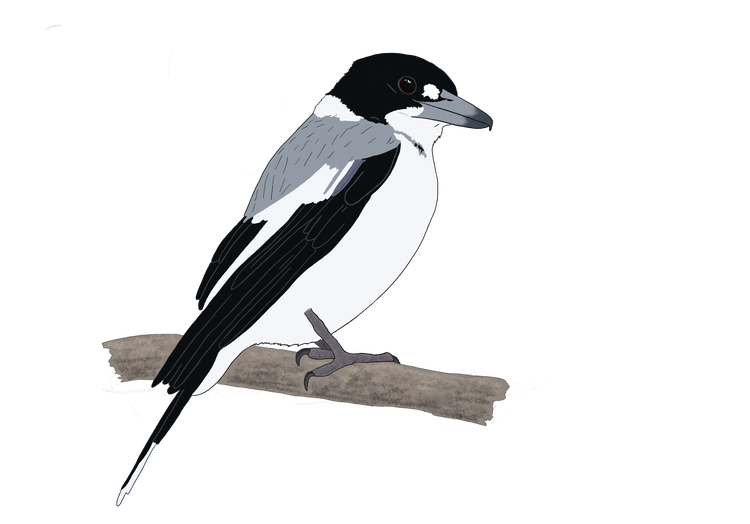
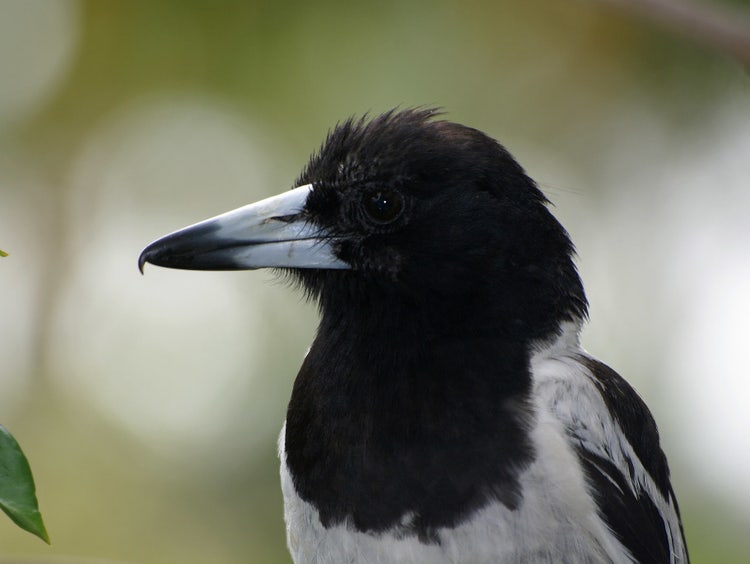
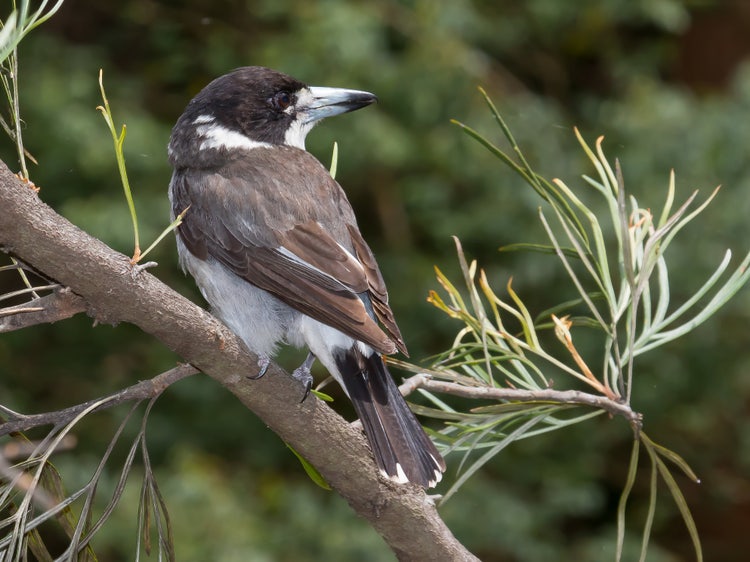
A grey butcherbird.

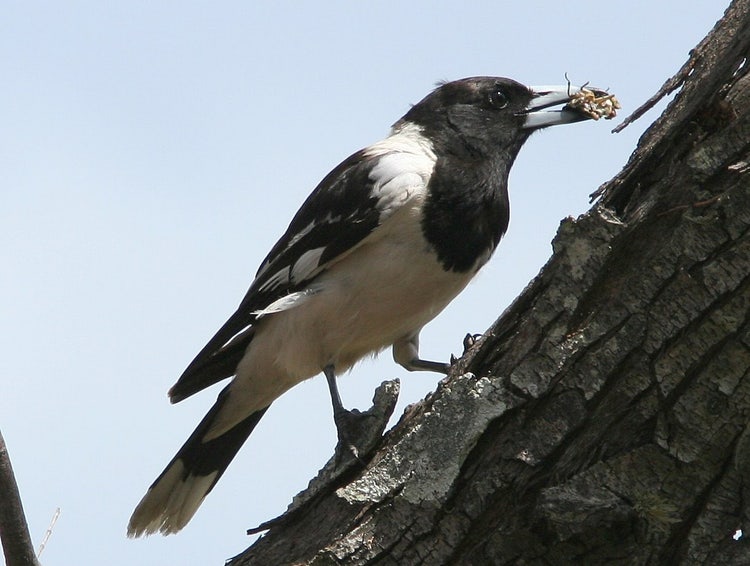
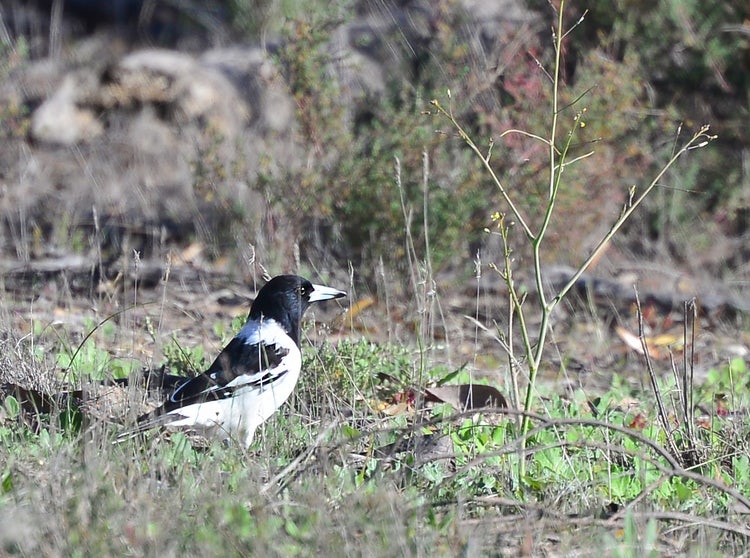
A pied butcherbird.
Fast facts – Butcherbird
Scientific name – Cracticus species
Scientific group – Butcherbirds are native Australian songbirds related to magpies and currawongs.
Appearance – Butcherbirds have black, white and grey feathers, strong hooked beaks and pale eyes.
Size – Most butcherbirds grow between 25 and 35 centimetres long.
Diet – Butcherbirds eat insects, spiders, small reptiles, frogs, birds and small mammals.
Habitat – Butcherbirds live in woodlands, forests, parks, gardens and open bushland across Australia.
Life cycle – Butcherbirds hatch from eggs laid in a nest during spring and summer, and young birds remain with their parents for several months while learning to hunt.
Special behaviour – Butcherbirds often wedge prey into bark or branches before tearing it apart with their beaks.

Where do butcherbirds live?
Butcherbirds live across much of Australia in forests, woodlands, coastal scrub, grasslands, parks and suburban gardens. They prefer places with scattered trees and open spaces underneath where they can easily spot prey on the ground. Some species are more common in dry inland areas, while others live along the coast and in wetter forests.
In Sydney, butcherbirds are often found in bushland reserves, school grounds and suburban parks. Students visiting Field of Mars Reserve or Lane Cove National Park may hear their rich musical calls early in the morning or late in the afternoon. They usually perch quietly on branches, fences or powerlines while searching for movement below.

What do butcherbirds eat?
Butcherbirds are carnivores and hunt a wide range of prey. They feed on insects, spiders, worms, frogs, lizards, mice and small birds. They usually hunt by sitting quietly on a perch and watching the ground carefully before swooping down to catch prey with their strong hooked beaks.
Their name comes from their unusual feeding behaviour. A butcherbird may wedge food into tree bark, forks in branches or sharp twigs while tearing it into smaller pieces. This helps the bird hold struggling prey while eating. By hunting many insects and small animals, butcherbirds help keep ecosystems balanced.

What do butcherbirds sound like?
Butcherbirds are famous for their rich musical calls. Their songs include whistles, fluting notes and complex melodies that can carry long distances through bushland. Some birds sing alone while others perform duets or group songs with nearby family members.
The pied butcherbird is especially well known for its beautiful dawn and dusk songs. These calls help birds defend territory, communicate with family members and attract mates. Many people consider butcherbirds to be among Australia’s most talented songbirds.
What is the life cycle of butcherbirds?
Butcherbirds usually breed during spring and summer when food is plentiful. Pairs build bowl-shaped nests from sticks, bark, grass and roots high in trees. Females lay several eggs and both parents help care for the chicks after they hatch.
Young butcherbirds stay in the nest for several weeks before learning to fly. Even after leaving the nest, juvenile birds often remain with their parents while learning how to hunt and survive. Some family groups stay together for long periods and help defend feeding territories.


What adaptations do butcherbirds have to help them survive?
Butcherbirds have several adaptations that make them successful hunters. Their sharp hooked beaks help them catch and tear apart prey, while their strong eyesight allows them to detect movement from high perches. Their black, white and grey feathers also help camouflage them among branches and shadows.
Behavioural adaptations are also important. Butcherbirds often hunt by waiting silently and conserving energy before making a quick attack. Their strong territorial calls help keep other birds away from feeding areas. Some birds even store food in bark or branches to eat later.
Why are butcherbirds important?
Butcherbirds play an important role in Australian ecosystems because they help control populations of insects and small animals. By hunting species such as grasshoppers, beetles and rodents, they help maintain balance in food webs.
They are also important indicators of healthy bushland habitats. Areas with mature trees, open ground and diverse animal life are more likely to support butcherbirds. Their songs are a familiar part of many Australian environments and contribute to people’s connection with nature.
How can you help butcherbirds?
People can help butcherbirds by protecting native bushland, planting local native plants and keeping large trees where possible. Healthy habitats provide nesting sites, shelter and food for butcherbirds and many other native animals.
Cats should be kept indoors or supervised, especially during the early morning and evening when birds are active. People can also avoid using harmful pesticides that reduce insect populations and may poison wildlife through the food chain.

Related fact sheets
More bird fact sheets
- Birds fact sheet – Learn about the features, life cycles and adaptations of birds.
- Australian magpie fact sheet – Discover another large native songbird related to butcherbirds.
- Pied currawong fact sheet – Compare another black-and-white bird that hunts small animals.
- Australian raven fact sheet – Explore another intelligent bird found in Sydney bushland.
Habitats and ecosystems
- Eucalypt forest fact sheet – Discover forest habitats where butcherbirds perch, nest and hunt.
- Tree habitats fact sheet – Learn how trees provide lookout posts, nesting sites and shelter for birds.
- Shrub habitats fact sheet – Explore the middle layer of bushland used by insects, small birds and prey animals.
Animals that share this habitat
- Eastern water skink fact sheet – Find out about a small reptile that lives in Sydney bushland.
- Red-browed finch fact sheet – Learn about a small seed-eating bird that uses shrubs and grasses for shelter.
Food webs and ecological relationships
- Ants fact sheet – Explore small invertebrates that are part of many bushland food webs.
- Fly fact sheet – Learn about insects that help recycle nutrients and provide food for predators.
Field of Mars habitats and wildlife
- Field of Mars Reserve fact sheet – Learn more about local bushland habitats that support native birds and other wildlife.
Attributions
References
Australian Museum. Grey butcherbird. [online] Available at: https://australian.museum/learn/animals/birds/grey-butcherbird/
Australian Museum. Pied butcherbird. [online] Available at: https://australian.museum/learn/animals/birds/pied-butcherbird/
BirdLife Australia. Pied butcherbird. [online] Available at: https://birdlife.org.au/bird-profiles/pied-butcherbird/
Birds in Backyards. Grey butcherbird. [online] Available at: https://www.birdsinbackyards.net/species/Cracticus-torquatus
Birds in Backyards. Pied butcherbird. [online] Available at: https://www.birdsinbackyards.net/species/Cracticus-nigrogularis
NSW National Parks and Wildlife Service. Lane Cove National Park. [online] Available at: https://www.nationalparks.nsw.gov.au/visit-a-park/parks/lane-cove-national-park
Image attributions
A grey butcherbird. – Field of Mars EEC (original illustration).
A pied butcherbird. – Field of Mars EEC (original illustration).
A grey butcherbird watching for prey from a tree branch. – ‘Grey butcherbird’ by Tatiana Gerus. Creative Commons Attribution 2.0 Generic. Available at: https://commons.wikimedia.org/wiki/File:Grey_butcherbird.jpg

Pied butcherbirds often live in open woodland with scattered trees and grassy hunting areas. – ‘Pied Butcherbird (Cracticus nigrogularis)’ by patrickkavanagh. Creative Commons Attribution 2.0 Generic. Available at: https://commons.wikimedia.org/wiki/File:Pied_Butcherbird_(Cracticus_nigrogularis)_(14640105234).jpg
_(14640105234).jpg)
A pied butcherbird holding prey in its hooked beak. – ‘Pied butcherbird’ by Glen Fergus. Creative Commons Attribution-ShareAlike 2.5 Generic. Available at: https://commons.wikimedia.org/wiki/File:Pied_butcherbird.jpg

A grey butcherbird carrying a small lizard to a tree branch. – ‘Grey butcherbird’ by Jean and Fred Hort. Creative Commons Attribution 2.0 Generic. Available at: https://www.flickr.com/photos/jean_hort/12715253774
A grey butcherbird on her nest. – ‘Grey Butcherbird. Cracticus torquatus on nest’ by gailhampshire. Creative Commons Attribution 2.0 Generic. Available at: https://commons.wikimedia.org/wiki/File:Grey_Butcherbird._Cracticus_torquatus_on_nest.jpg

A clutch of grey butcherbird eggs in a nest. – ‘Variations of grey butcher bird eggs’ by Laurie Boyle. Creative Commons Attribution-ShareAlike 2.0 Generic. Available at: https://www.flickr.com/photos/96849723@N00/53503574570
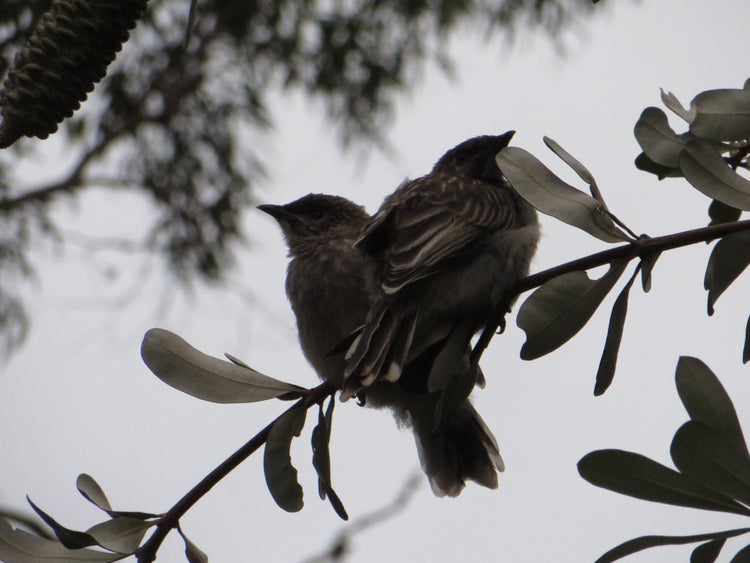
Two fledgling butcherbirds raised near Field of Mars Environmental Education Centre. – Field of Mars EEC (original image).
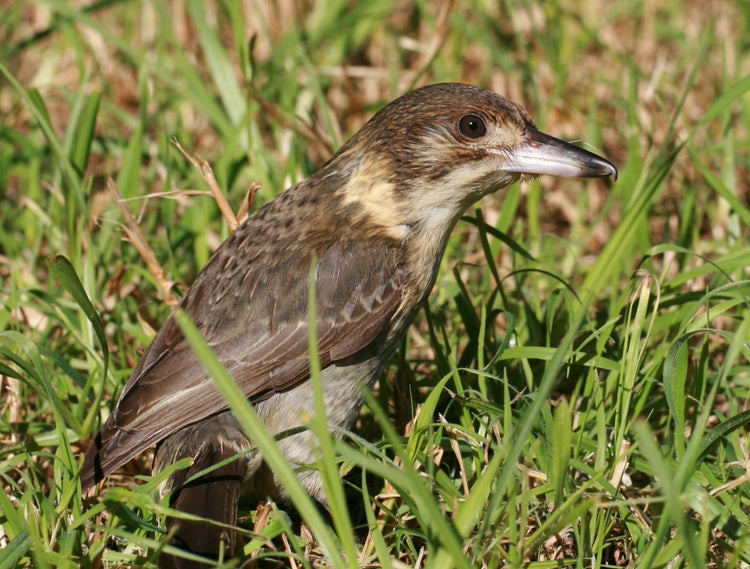
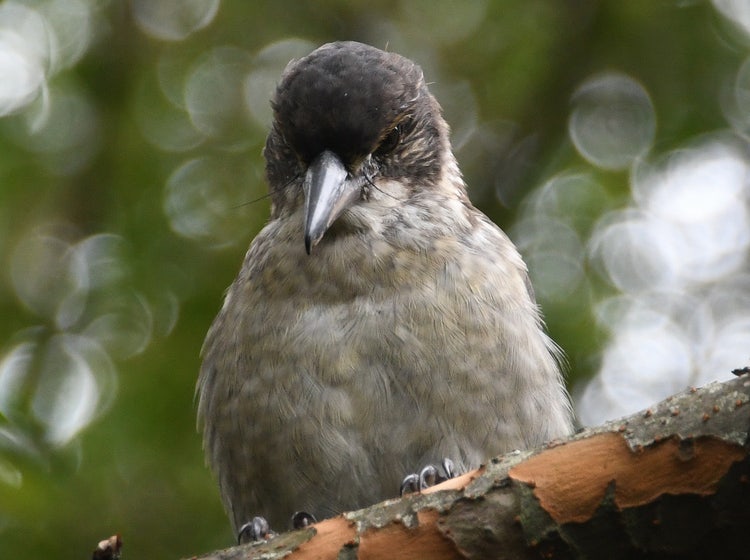
A juvenile grey butcherbird. – ‘Grey butcherbird juvenile in grass’ by Toby Hudson. Creative Commons Attribution-ShareAlike 3.0 Unported. Available at: https://commons.wikimedia.org/wiki/File:Grey_butcherbird_juvenile_in_grass.jpg

A butcherbird’s hooked beak helps it catch and tear prey. – ‘Pied Butcherbird (Cracticus nigrogularis)’ by David Cook. Creative Commons Attribution-NonCommercial 2.0 Generic. Available at: https://www.flickr.com/photos/kookr/49202735052
Butcherbirds use sharp eyesight to spot prey from perches. – ‘Butcherbird Randwick’ by Sardaka. Creative Commons Attribution-ShareAlike 4.0 International. Available at: https://commons.wikimedia.org/wiki/File:Butcherbird_Randwick.jpg

Butcherbirds help control insect and small animal populations in Australian ecosystems. – ‘Grey Butcherbird’ by patrickkavanagh. Creative Commons Attribution 2.0 Generic. Available at: https://www.flickr.com/photos/12429142@N00/14542037182
Native plants and healthy bushland provide food and shelter for butcherbirds. – ‘Huntington State Park’ by Jeff P. Creative Commons Attribution 2.0 Generic. Available at: https://www.flickr.com/photos/27708639@N08/14790649597
A grey butcherbird drinking from a bird bath at Field of Mars Environmental Education Centre. – Field of Mars EEC (original image).
Learn with us

Book now
Book a birdwatching or curriculum-aligned excursion where students investigate songbirds, hooked beaks, hunting behaviour and food webs.

Learning programs
Explore Field of Mars EEC programs that support learning about butcherbirds, bird calls, predator-prey relationships, feeding adaptations and local ecosystems.

Learning resources
Use the butcherbird fact sheet to support classroom learning about strong hooked beaks, songs, insects, small animals, branches and hunting behaviour.

Flora and fauna fact sheets
Explore related fact sheets about birds, insects, reptiles, tree habitats, shrub habitats, eucalypt forests and food webs.
Related programs
Classification and adaptations excursion
Investigate how living things are classified and how structural and behavioural adaptations support survival
Mystery HPGE enrichment program
Analyse wildlife evidence and predator-prey relationships to construct and present an evidence-based scientific explanation.