Mole crickets fact sheet | Field of Mars EEC
What are mole crickets?
Mole crickets are unusual insects with bodies shaped for life underground. They are related to grasshoppers, locusts and other crickets, but their wide front legs make them look a little like tiny digging mammals.
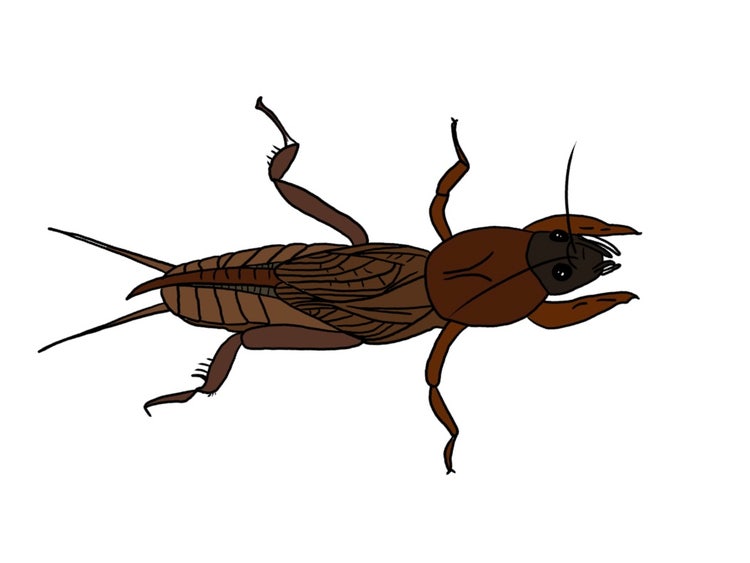
Mole crickets have brown bodies, long antennae, short forewings and a soft abdomen. Their strong front legs are flattened like shovels, with claws and spines that help them dig through soil. Many adult mole crickets grow to about 30–40 mm long.
Mole crickets spend most of their lives in underground tunnels. They are often heard more than seen, especially when males call from their burrows during warm, wet evenings.
Fast facts – Mole crickets
Scientific name – Gryllotalpidae
Scientific group – Mole crickets are insects in the order Orthoptera, the same group as grasshoppers, locusts and other crickets.
Appearance – Mole crickets have brown bodies, long antennae, short forewings, soft abdomens and wide shovel-like front legs for digging.
Size – Many adult mole crickets are about 30–40 mm long.
Diet – Mole crickets may eat plant roots, seeds, worms, beetle larvae and other small soil animals. Diet varies between species.
Habitat – Mole crickets live in soil in grassy woodland, gardens, parklands, lawns and other well-watered vegetated areas.
Life cycle – Mole crickets hatch from eggs into nymphs and grow into adults through incomplete metamorphosis. Some species may live for more than two years.
Adaptations – Shovel-like front legs help mole crickets dig, while underground burrows provide shelter and can amplify male calls.

Where do mole crickets live?
Mole crickets are found throughout Australia and are most common in well-watered places with soil and vegetation. They may live in grassy woodland, gardens, parklands, lawns, vegetable gardens and other damp soil habitats.
In eastern Australia, Gryllotalpa pluvialis is a native mole cricket species known from areas including Sydney and Brisbane. Some mole cricket species have also been moved outside their natural range and can become pests when they damage lawns or gardens.
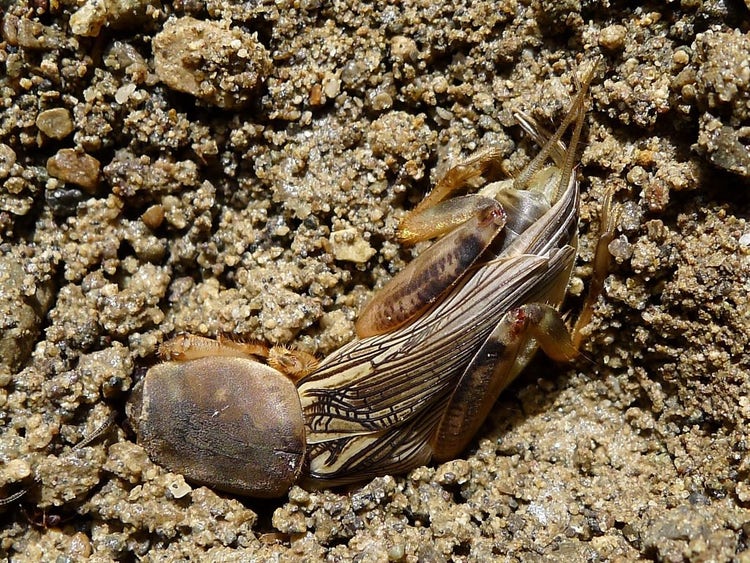
Mole crickets dig tunnels just below the soil surface and also make deeper burrows. Small mounds, raised trails or openings in the soil can show where they have been moving underground.
At Field of Mars Reserve, moist soil, leaf litter, ground cover and vegetated areas provide habitat for many soil invertebrates. Animals such as mole crickets are often easier to hear than see because they spend so much time underground.
What do mole crickets eat?
Mole crickets may be herbivores, carnivores or omnivores, depending on the species. Some feed mainly on plant roots, seeds and underground plant parts. Others eat worms, beetle larvae and small invertebrates that live in soil.
Some mole crickets can damage lawns, seedlings or garden plants when they feed on roots or disturb the soil while tunnelling. They are also part of the soil food web and provide food for other animals.
Mole crickets usually feed underground, but they may sometimes come to the surface at night.

What is the life cycle of a mole cricket?
Mole crickets go through incomplete metamorphosis. This means their life cycle has three main stages: egg, nymph and adult.
Mating usually happens underground. Males call from specially shaped burrows that make their songs louder. Females can fly and may be attracted to suitable calling sites, especially damp places where eggs are more likely to survive.
After mating, the female lays eggs in an underground chamber. In many mole crickets, the female stays in the burrow and guards the eggs and young nymphs. The nymphs look like small, pale adults without fully developed wings. They moult several times as they grow.


Mole crickets go through incomplete metamorphosis.
What adaptations do mole crickets have to help them survive?
Mole crickets have strong, shovel-like front legs that help them dig through soil. Their claws and leg spines help them push soil aside and move quickly through tunnels.
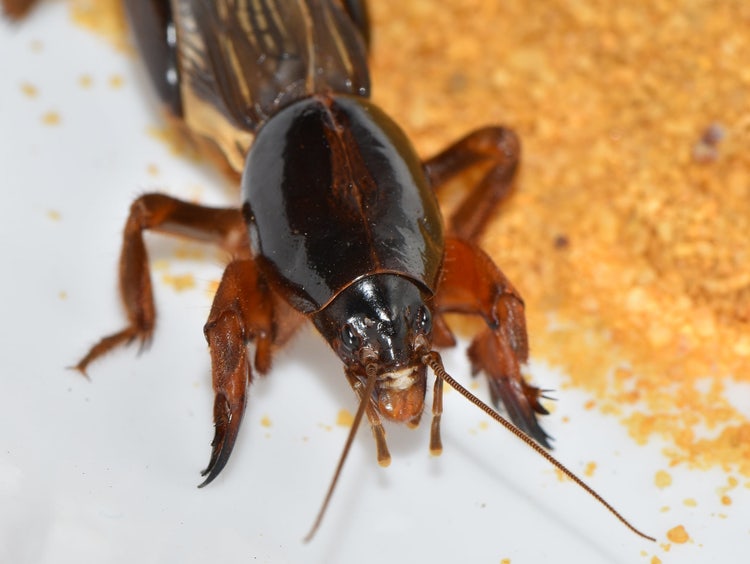
The front part of a mole cricket’s body is hardened and rounded. This helps protect the head and body as it pushes through soil. Their soft abdomen helps them move through narrow underground spaces.
Living underground helps mole crickets hide from many predators and avoid drying out. Their tunnels provide places to feed, shelter, call, mate and lay eggs.
Some mole crickets can also release a foul-smelling liquid from the end of their body when disturbed. This may help discourage predators.
Why are mole crickets important?
Mole crickets are part of the soil food web. They feed on plants, seeds and small soil animals, and they are eaten by larger animals such as birds, lizards, frogs, spiders and other predators.
They are also important to blue ants. Despite their name, blue ants are not ants. They are native Australian wasps. Female blue ants hunt mole crickets, paralyse them and lay eggs on them. When the wasp larvae hatch, they feed on the mole cricket.
Mole crickets also show how much life can be hidden under the soil. Even when an animal is rarely seen, it can still be part of a busy underground ecosystem.

How can you help mole crickets?
You can help mole crickets and other soil invertebrates by protecting healthy soil habitat. Leave leaf litter, fallen bark and natural ground cover in garden and bushland areas where it is safe to do so.
Avoid unnecessary pesticide use, especially in places where insects, spiders and other invertebrates live. Many chemicals can harm animals that are part of the soil food web.
If mole crickets are damaging a lawn or garden, try to identify the problem before using control methods. Some mole crickets are native animals, and not all species cause serious damage.
If you find a mole cricket, observe it carefully and let it return to the soil. Do not handle it roughly or disturb its burrow.

Related fact sheets
More invertebrate fact sheets
- Invertebrate fact sheets – Explore insects, spiders, crustaceans, molluscs, worms and other small animals found across Sydney and NSW.
- Insects fact sheet – Learn about insect body parts, life cycles and the roles insects play in ecosystems.
- Cricket fact sheet – Compare true crickets with burrowing mole crickets.
- Grasshopper fact sheet – Compare another Orthopteran insect with strong legs and incomplete metamorphosis.
Habitats and ecosystems
- Leaf litter habitats fact sheet – Learn how fallen leaves, bark and soil create shelter for small animals.
- Ground cover habitats fact sheet – Explore how grasses and low plants protect soil and shelter invertebrates.
- Rock and log habitats fact sheet – Find out how cool, sheltered places support many ground-dwelling animals.
- Eucalypt forest fact sheet – Learn about the bushland ecosystem that supports soil, leaf litter and invertebrate food webs.
- Field of Mars Reserve fact sheet – Explore local bushland habitats that support insects and other small animals.
Food webs and ecological relationships
- Wasp fact sheet – Learn about wasps, including species that hunt other invertebrates for their larvae.
- Spider fact sheet – Explore predators that feed on insects and other small invertebrates.
- Birds fact sheet – Learn about birds, including species that feed on insects and other small animals.
- Reptiles fact sheet – Explore reptiles such as lizards that may feed on ground-dwelling invertebrates.
- Amphibians fact sheet – Learn about frogs and other amphibians that can feed on small invertebrates.
Attributions
References
Australian Geographic. n.d. Mole cricket. [online] Available at: https://www.australiangeographic.com.au/fact-file/fact-file-mole-cricket
Australian Museum. 2024. Mole Cricket. [online] Available at: https://australian.museum/learn/animals/insects/mole-cricket/
Australian Museum. 2020. Blue Ant. [online] Available at: https://australian.museum/learn/animals/insects/blue-ant/
Atlas of Living Australia. n.d. Gryllotalpa pluvialis. [online] Available at: https://bie.ala.org.au/species/Gryllotalpa%2Bpluvialis
Museums Victoria. n.d. Gryllotalpa, Mole Cricket. [online] Available at: https://collections.museumsvictoria.com.au/species/8570
Western Australian Museum. 2011. Mole Crickets (Gryllotalpidae). [online] Available at: https://museum.wa.gov.au/sites/default/files/Mole%20crickets.pdf
Field of Mars EEC. n.d. Insects fact sheet. [online] Available at: https://fieldofmar-e.schools.nsw.gov.au/fact-sheets/invertebrates/insects-fact-sheet
Field of Mars EEC. n.d. Cricket fact sheet. [online] Available at: https://fieldofmar-e.schools.nsw.gov.au/fact-sheets/invertebrates/cricket-fact-sheet
Field of Mars EEC. n.d. Leaf litter habitats fact sheet. [online] Available at: https://fieldofmar-e.schools.nsw.gov.au/fact-sheets/habitats/leaf-litter-habitats-fact-sheet
Field of Mars EEC. n.d. Ground cover habitats fact sheet. [online] Available at: https://fieldofmar-e.schools.nsw.gov.au/fact-sheets/habitats/ground-cover-habitats-fact-sheet
Field of Mars EEC. n.d. Rock and log habitats fact sheet. [online] Available at: https://fieldofmar-e.schools.nsw.gov.au/fact-sheets/habitats/rock-and-log-habitats-fact-sheet
Field of Mars EEC. n.d. Field of Mars Reserve fact sheet. [online] Available at: https://fieldofmar-e.schools.nsw.gov.au/fact-sheets/environments/field-of-mars-reserve-fact-sheet
Image attributions
A mole cricket – Field of Mars EEC (original illustration).
A mole cricket shows the strong shovel-like front legs it uses for digging through soil – “Mole cricket.jpg” by Fir0002/Flagstaffotos. GNU Free Documentation License 1.2. Available at: https://commons.wikimedia.org/wiki/File:Mole_cricket.jpg

A mole cricket uses its strong front legs to dig through loose soil – “Mole cricket. Grylloptalpa gryllotalpa.” by gailhampshire. Creative Commons Attribution 2.0 Generic licence. Available at: https://www.flickr.com/photos/43272765@N04/8109300284
A mole cricket may come to the surface at night but spends most of its life underground – “Mole cricket” by Eugene Romanenko. Creative Commons Attribution-NonCommercial 2.0 Generic licence. Available at: https://www.flickr.com/photos/59219224@N05/17099224896
A mole cricket moving through loose soil and leaf litter – “Mole Cricket” by Boobook48. Creative Commons Attribution-NonCommercial-ShareAlike 2.0 Generic licence. Available at: https://www.flickr.com/photos/31400835@N03/16916996033
Mole crickets go through incomplete metamorphosis – Field of Mars EEC (original illustration).
The smooth, hardened front of a mole cricket helps protect it while it pushes through soil – “Mole Cricket in the garden” by Jean and Fred Hort. Creative Commons Attribution 2.0 Generic licence. Available at: https://www.flickr.com/photos/jean_hort/33708906888
A blue ant is a native wasp that uses mole crickets as food for its larvae – “Diamma bicolor_6161” by Linda Rogan. Creative Commons Attribution-NonCommercial-NoDerivs 2.0 Generic licence. Available at: https://www.flickr.com/photos/71223605@N03/8445784413
Leaf litter helps to create healthy soil habitats – Field of Mars EEC (original image).
Learn with us

Book now
Book a soil, schoolyard or invertebrate program where students investigate mole crickets, digging adaptations, underground habitats and food webs.

Learning programs
Explore Field of Mars EEC programs that support learning about mole crickets, soil habitats, insect adaptations, sound and ecosystem relationships.

Learning resources
Use the mole cricket fact sheet to support classroom learning about shovel-like front legs, burrows, soil, sound, roots and underground movement.

Flora and fauna fact sheets
Explore related fact sheets about insects, crickets, soil, ground cover habitats, leaf litter habitats, worms and birds.
Related programs
Entomologist HPGE enrichment program
Investigate invertebrate anatomy, habitats and adaptations through fieldwork, live specimens and scientific modelling.
Adaptations excursion
Investigate specialised structural and behavioural features and explain how adaptations help animals survive in particular habitats.