Huntsman spider fact sheet | Field of Mars EEC
What are huntsman spiders?
Huntsman spiders are large, fast-moving spiders with long legs that spread out sideways. They are arachnids, not insects, and belong to a group of spiders called Sparassidae.
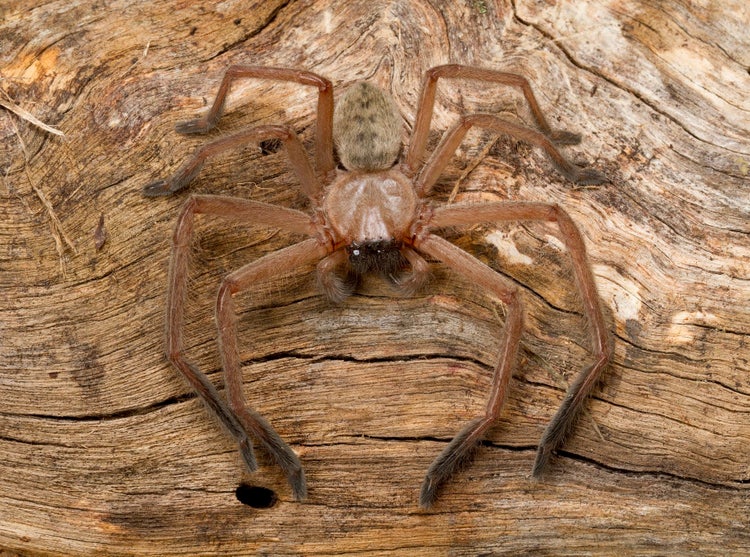
Huntsman spiders are often seen on tree trunks, under loose bark, beneath rocks and sometimes inside houses. Their flat bodies help many species squeeze into narrow spaces during the day.
Unlike orb-weaving spiders, huntsman spiders do not build sticky webs to catch their prey. They are active hunters that use speed, sensitive hairs and venom to catch insects and other small animals.

Fast facts – Huntsman spiders
Scientific name – Sparassidae
Scientific group – Huntsman spiders are arachnids in the spider order Araneae.
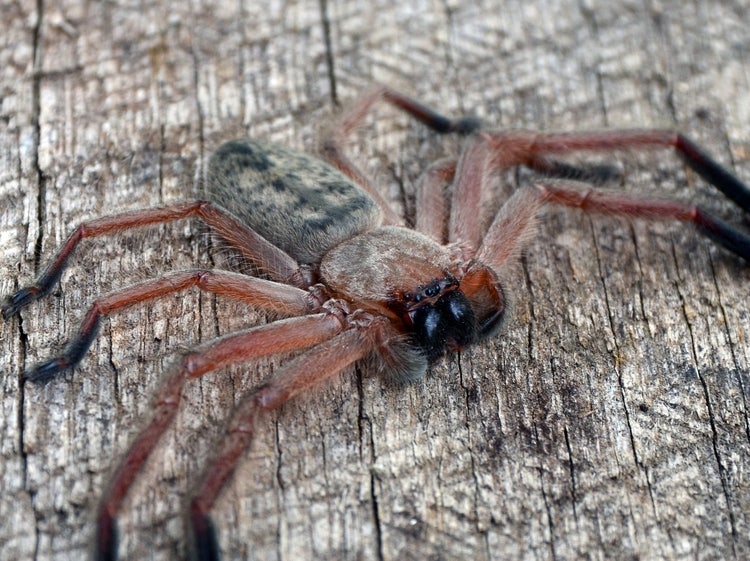
Appearance – Huntsman spiders have two main body parts, eight legs, long sideways-facing legs, pedipalps, chelicerae with fangs, and spinnerets for making silk.
Size – Some huntsman spiders can reach a leg span of about 15–16 cm, making them one of Australia’s largest spider groups.
Diet – Huntsman spiders eat insects and other invertebrates. Large individuals may also catch small lizards or frogs.
Habitat – Huntsman spiders live on tree trunks, under bark, in logs, beneath rocks, in foliage and sometimes on walls inside houses.
Life cycle – Female huntsman spiders make silk egg sacs. Spiderlings hatch, moult as they grow and eventually become adults. Most huntsman spiders live for about two years or more.
Adaptations – Huntsman spiders use flat bodies, long sideways-facing legs, speed, venom, sensitive hairs and silk to help them hunt, hide and protect their eggs.
Where do huntsman spiders live?
Huntsman spiders occur across Australia in many different habitats. In bushland they can be found on tree trunks, under loose bark, in rock crevices, beneath stones and among vegetation. Many huntsman spiders shelter during the day and become more active at night. Their flat bodies help them hide in tight spaces where predators may find it harder to reach them.
Some huntsman spiders also enter houses, sheds and cars. They are usually looking for shelter or prey such as cockroaches and other insects.
What do huntsman spiders eat?
Huntsman spiders are carnivores. They mostly eat insects and other invertebrates, including cockroaches, moths, crickets and other small animals they can overpower.
They do not use a web to trap prey. Instead, they stalk, chase and grab their prey using their long legs. Their fangs inject venom that helps immobilise the animal before the spider feeds.
Large huntsman spiders may also eat small lizards or frogs if they can catch them.

What is the life cycle of a huntsman spider?
Huntsman spiders hatch from eggs. After mating, a female makes a flat silk egg sac and places it in a protected place such as under bark, beneath a rock or inside a silken retreat.
The female often guards the egg sac. This helps protect the eggs from predators and damage. Some female huntsman spiders can become more defensive while guarding their eggs.
When the spiderlings hatch, they are small and pale. They moult several times as they grow. After each moult their new outer covering hardens and they become larger. Most huntsman spiders live for about two years or more.

What adaptations do huntsman spiders have to help them survive?
Huntsman spiders have flat bodies that help them squeeze under bark, into rock crevices and other narrow hiding places. This provides shelter from predators, weather and drying out.
Their long sideways-facing legs help them move quickly forwards and sideways. This speed helps them chase prey and escape danger.
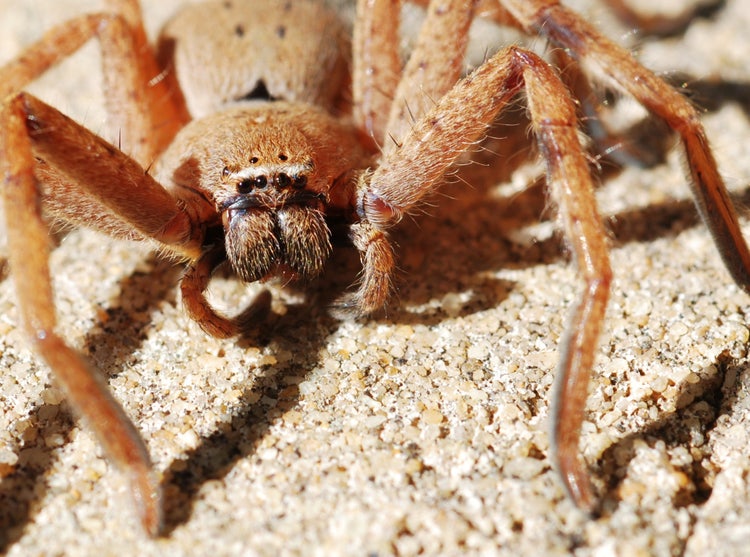
Huntsman spiders have sensitive hairs on their legs and body. These hairs help them detect movement, vibrations and air currents made by nearby prey or predators.
Their fangs and venom help them catch and immobilise prey. Their pedipalps help them touch, sense and handle food. Their spinnerets produce silk, which is used for egg sacs, retreats and movement, rather than for building large prey-catching webs.
Why are huntsman spiders important?
Huntsman spiders are important predators. They help control populations of insects and other invertebrates, including some animals that people may consider pests.
They are also part of the food web. Huntsman spiders may be eaten by birds, reptiles, mammals, larger spiders and spider wasps.
In bushland, huntsman spiders show why bark, logs, rocks and tree trunks are important habitats. These places provide shelter for many small animals, not just spiders.

How can you help huntsman spiders?
You can help huntsman spiders by protecting bushland habitat. Fallen logs, loose bark, rocks, leaf litter and old trees provide shelter for spiders and many other invertebrates.
Avoid unnecessary pesticide use, especially around gardens and outdoor areas where spiders and other small animals live. Pesticides can harm predators as well as the insects they eat.
If you see a huntsman spider, observe it from a safe distance and do not try to handle it. If a huntsman spider enters a building, observe it from a safe distance and ask an adult to move it outside safely.

Related fact sheets
More invertebrate fact sheets
- Invertebrate fact sheets – Explore more insects, spiders and other small animals.
- Arachnids fact sheet – Learn about spiders, mites and other eight-legged arachnids.
- Spider fact sheet – Learn about spider features, safety and different spider groups.
- Black house spider fact sheet – Compare huntsman spiders with common web-building spiders found on bark, rocks and buildings.
- Net-casting spider fact sheet – Compare huntsman spiders with spiders that hunt using a small silk net.
- Wolf spider fact sheet – Compare huntsman spiders with fast ground-hunting spiders.
- Trapdoor spider fact sheet – Compare huntsman spiders with burrow-dwelling ambush hunters.
Habitats and ecosystems
- Tree habitats fact sheet – Learn how bark, trunks and branches provide shelter for spiders and other animals.
- Rock and log habitats fact sheet – Learn how rocks, logs and loose bark create shelter for invertebrates.
- Leaf litter habitats fact sheet – Learn about the forest-floor habitat used by many small animals.
- Eucalypt forest fact sheet – Learn about the local bushland ecosystem that supports many spiders.
- Field of Mars Reserve fact sheet – Learn about the local habitats where huntsman spiders and other animals may be found.
Food webs and ecological relationships
- Wasp fact sheet – Learn about wasps, including spider wasps that hunt spiders to feed their young.
Attributions
References
Australian Museum. Huntsman Spiders. [online] Available at: https://australian.museum/learn/animals/spiders/huntsman-spiders/
Australian Museum. Spider facts. [online] Available at: https://australian.museum/learn/animals/spiders/spider-facts/
Australian Museum. Spider structure. [online] Available at: https://australian.museum/learn/animals/spiders/spider-structure/
Australian Reptile Park. Huntsman Spider. [online] Available at: https://www.reptilepark.com.au/about/meet-our-animals/huntsman-spider
Museums Victoria. Neosparassus diana (Koch, 1875), Badge Huntsman. [online] Available at: https://collections.museumsvictoria.com.au/species/12356
Field of Mars EEC. Arachnids fact sheet. [online] Available at: https://fieldofmar-e.schools.nsw.gov.au/fact-sheets/invertebrates/arachnids-fact-sheet
Field of Mars EEC. Spider fact sheet. [online] Available at: https://fieldofmar-e.schools.nsw.gov.au/fact-sheets/invertebrates/spider-fact-sheet
Field of Mars EEC. Tree habitats fact sheet. [online] Available at: https://fieldofmar-e.schools.nsw.gov.au/fact-sheets/habitats/tree-habitats-fact-sheet
Field of Mars EEC. Rock and log habitats fact sheet. [online] Available at: https://fieldofmar-e.schools.nsw.gov.au/fact-sheets/habitats/rock-and-log-habitats-fact-sheet
Field of Mars EEC. Eucalypt forest fact sheet. [online] Available at: https://fieldofmar-e.schools.nsw.gov.au/fact-sheets/environments/eucalypt-forest-fact-sheet
Field of Mars EEC. Field of Mars Reserve fact sheet. [online] Available at: https://fieldofmar-e.schools.nsw.gov.au/fact-sheets/environments/field-of-mars-reserve-fact-sheet
Image attributions
A huntsman spider – Field of Mars EEC (original illustration).
Huntsman spiders live on tree trunks and under loose bark – “Sparassidae, Delena cancerides, Social Huntsman Spider” by Catching The Eye. Creative Commons Attribution 2.0 Generic. Available at: https://www.flickr.com/photos/160417453@N04/26078020077
Huntsman spiders hunt insects and other small animals at night. This huntsman spider was found at Field of Mars Reserve – Field of Mars EEC (original image).
A female huntsman spider guards her egg sac as spiderlings hatch – “Huntsman Spider egg sac hatching 23 Jan 11.JPG” by Elliekay. Creative Commons CC0 1.0 Universal Public Domain Dedication. Available at: https://commons.wikimedia.org/wiki/File:Huntsman_Spider_egg_sac_hatching_23_Jan_11.JPG

Huntsman spiders usually have eight eyes, fang-bearing chelicerae and sensitive leg hairs that detect movement – “Huntsman” by Jean and Fred Hort. Creative Commons Attribution 2.0 Generic. Available at: https://www.flickr.com/photos/jean_hort/5345234785/
The abdomen, or back body part, has no legs and carries the spinnerets used to make silk – “Eight, count ’em” by JC Merriman / Merryjack. Creative Commons Attribution 4.0 International. Available at: https://www.flickr.com/photos/merryjack/22368551826
Huntsman spiders are part of the food web. Some spider wasps hunt spiders to feed their young – “Cryptocheilus bicolor spider wasp Sparassidae Huntsman spider DSCF4183” by Bill & Mark Bell. Creative Commons Attribution-NonCommercial-ShareAlike 2.0 Generic. Available at: https://www.flickr.com/photos/48991563@N06/15395120480/
Protecting eucalypt forest helps keep the bark, trunks, leaf litter and shelter used by huntsman spiders and other small animals – “Blue Gum Walk eucalypt forest.jpg” by Bembacorolla. Creative Commons Attribution-ShareAlike 4.0 International. Available at: https://commons.wikimedia.org/wiki/File:Blue_Gum_Walk_eucalypt_forest.jpg

Learn with us

Book now
Book a schoolyard or invertebrate program where students investigate huntsman spiders, camouflage, fast movement, tree bark and food webs.

Learning programs
Explore Field of Mars EEC programs that support learning about huntsman spiders, arachnid features, hunting behaviour, shelter and ecosystem roles.

Learning resources
Use the huntsman spider fact sheet to support classroom learning about flat bodies, long legs, speed, bark camouflage, egg sacs and insect prey.

Flora and fauna fact sheets
Explore related fact sheets about spiders, insects, tree habitats, rock and log habitats, leaf litter and urban environments.
Related programs
Entomologist HPGE enrichment program
Investigate spider anatomy, classification, hunting behaviours and habitats through fieldwork and close observation.
Augmented reality studio HPGE enrichment program
Explore body shape, camouflage, movement and habitat use and create a digital augmented reality science explanation.