St Andrew's Cross spider fact sheet | Field of Mars EEC
What are St Andrew's Cross spiders?
St Andrew’s Cross spiders are native Australian orb-weaving spiders. Their scientific name is Argiope keyserlingi.
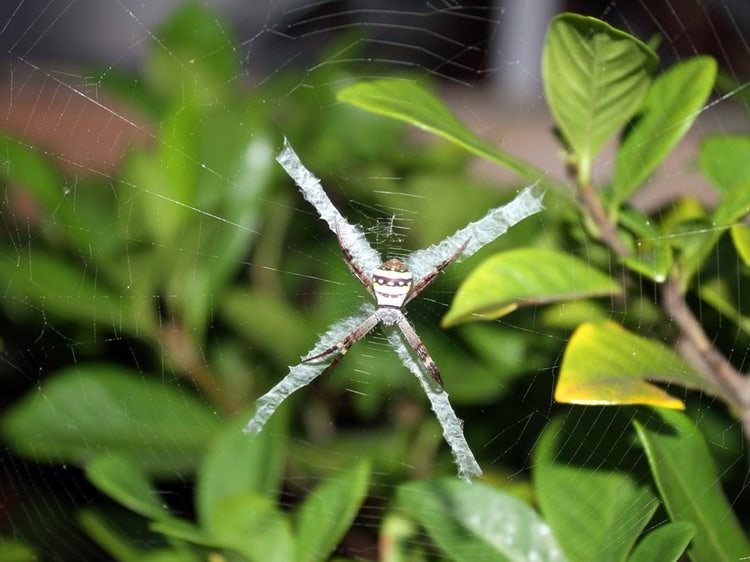
They are named after the bright white silk cross that is often found in the centre of their web. This cross is called a stabilimentum. The spider often sits in the middle of the web with its legs held together in pairs, making its body look like part of the cross.
Females are much larger and more colourful than males. Females have banded legs and a silver, yellow, red, black and white abdomen. Males are much smaller and are usually brown or cream.

Fast facts – St Andrew's Cross spiders
Scientific name – Argiope keyserlingi.
Scientific group – St Andrew’s Cross spiders are arachnids in the orb-weaving spider family Araneidae.
Appearance – Females have banded legs and a silver, yellow, red, black and white patterned abdomen. Males are much smaller and are usually brown or cream.
Size – Females grow to about 10–16 mm long. Males are much smaller, usually about 3–5 mm long.
Diet – St Andrew’s Cross spiders eat insects such as flies, moths, butterflies, bugs and bees.
Habitat – They live in gardens, open forest, heathland, shrubby bushland and rainforest edges.
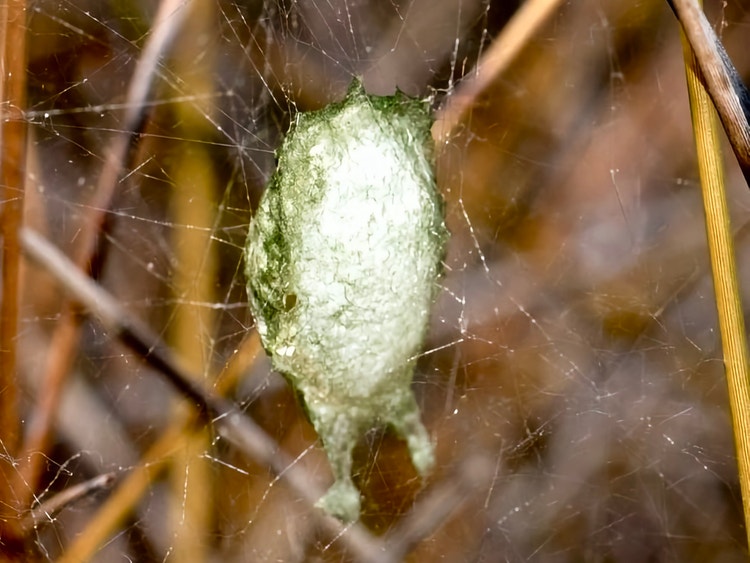
Life cycle – Females make greenish egg sacs among leaves and silk. Spiderlings hatch, grow by moulting and later disperse to new places.
Adaptations – Sticky orb webs, sensitive hairs, silk safety lines and web shaking help them catch prey and avoid predators.

Where do St Andrew's Cross spiders live?
St Andrew’s Cross spiders are found in eastern Australia, including Queensland, New South Wales and Victoria. They live in habitats with low shrubs, grasses and other plants that can support their webs.
They may be found in gardens, open forest, heathland, shrubby bushland and rainforest edges. Females build medium-sized orb webs on low vegetation and usually stay in the web during the day and night.
At Field of Mars Reserve, shrubby bushland and garden edges provide habitat for many web-building spiders. These areas support insects for spiders to eat and plants that can hold their webs.
What do St Andrew's Cross spiders eat?
St Andrew’s Cross spiders eat insects that become trapped in their sticky orb webs. Their prey can include flies, moths, butterflies, bugs and bees.
When an insect lands in the web, the spider senses the movement through the silk. It moves towards the prey, wraps it in silk and then bites it. Smaller prey may be bitten before being wrapped.
Spiders are important predators in bushland and gardens because they help control insect populations.

What is the life cycle of a St Andrew’s Cross spider?
St Andrew’s Cross spiders hatch from eggs as tiny spiderlings. They grow by moulting, which means shedding their hard outer skeleton so their bodies can become larger.
Mating usually occurs from summer to autumn. A much smaller male approaches the female carefully and may vibrate a silk thread to attract her attention. After mating, the female makes a greenish, pear-shaped egg sac and hangs it in silk, often among leaves near the web.
The spiderlings stay close together for a short time before dispersing. Some climb to a high point and release silk into the air so the breeze can carry them to a new habitat. Young St Andrew’s Cross spiders may build a circular silk pattern in the centre of their web before making the adult X-shaped cross.


What adaptations do St Andrew’s Cross spiders have to help them survive?
St Andrew’s Cross spiders have several adaptations that help them survive. Their large orb web is a sticky trap for catching flying insects. Fine sensory hairs on their legs help them detect vibrations when prey lands in the web.
The white silk cross is called a stabilimentum. It may help attract prey, camouflage the spider, or make the web more visible to larger animals that might otherwise fly or run through it.
If threatened, a St Andrew’s Cross spider may drop from the web on a silk line. It may also shake the web rapidly so the spider and silk cross become a blur. This can confuse predators and give the spider time to escape.

Why are St Andrew’s Cross spiders important?
St Andrew’s Cross spiders are important predators. They catch insects in their webs and help keep insect populations balanced in bushland, parks and gardens.
They are also part of the food web. Birds, wasps and other predators may eat spiders, while some wasps use spiders as food for their larvae.
St Andrew’s Cross spiders also show why shrubs and layered vegetation are important habitat. Low plants provide web-building places, shelter and feeding areas for many small animals. In healthy bushland, even small spaces between leaves and stems can become important habitat.

How can you help St Andrew’s Cross spiders?
You can help St Andrew’s Cross spiders by protecting habitat. Keep a variety of native plants, shrubs and grasses in gardens and bushland so spiders have places to build webs.
Avoid breaking spider webs when you see them. If a web is across a path, walk around it if it is safe to do so. Spiders use energy and silk to build their webs, and the web helps them catch food.
Avoid unnecessary pesticide use, especially around flowering plants and garden edges. Pesticides can reduce the insects that spiders eat and may also harm spiders directly.
If you find a St Andrew’s Cross spider, observe it from a safe distance. Watch how it sits in the web, responds to movement and uses silk to survive.

Related fact sheets
More invertebrate fact sheets
- Arachnids fact sheet – learn about spiders, mites, ticks and other eight-legged invertebrates.
- Spider fact sheet – learn how spiders use silk, venom, webs and different hunting methods.
- Garden orb weaving spider fact sheet – compare another orb-weaving spider that builds circular webs.
- Golden orb weaving spider fact sheet – compare another large web-building spider found around Sydney bushland and gardens.
- Leaf-curling spider fact sheet – learn about another orb-weaving spider that uses silk and leaves for shelter.
Habitats and ecosystems
- Shrub habitats fact sheet – shrubs provide web supports, shelter and insect prey.
- Tree habitats fact sheet – trees provide bark, branches and leaves where spiders and insects live.
- Eucalypt forest fact sheet – eucalypt forests support shrubs, insects, spiders and other food-web links.
- Field of Mars Reserve fact sheet – explore the local reserve habitats where spiders and other small animals live.
Food webs and ecological relationships
- Insects fact sheet – learn about the main group of animals caught by many web-building spiders.
- Fly fact sheet – learn about common flying insects that may become prey in spider webs.
- Moth fact sheet – learn about flying insects that may be caught by orb-weaving spiders.
- Butterfly fact sheet – learn about insects that may sometimes become trapped in orb webs.
- Wasp fact sheet – learn about wasps, including species that hunt spiders or use spiders as food for their larvae.
Attributions
References
Australian Museum. St Andrew’s Cross Spider. [online] Available at: https://australian.museum/learn/animals/spiders/st-andrews-cross-spider/
Australian Museum. Spider webs. [online] Available at: https://australian.museum/learn/animals/spiders/spider-webs/
Arachne.org.au. Argiope keyserlingi Karsch, 1878 St Andrews Cross. [online] Available at: https://www.arachne.org.au/01_cms/details.asp?ID=1022
Field of Mars EEC. Arachnids fact sheet. [online] Available at: https://fieldofmar-e.schools.nsw.gov.au/fact-sheets/invertebrates/arachnids-fact-sheet
Field of Mars EEC. Spider fact sheet. [online] Available at: https://fieldofmar-e.schools.nsw.gov.au/fact-sheets/invertebrates/spider-fact-sheet
Field of Mars EEC. Shrub habitats fact sheet. [online] Available at: https://fieldofmar-e.schools.nsw.gov.au/fact-sheets/habitats/shrub-habitats-fact-sheet
Field of Mars EEC. Field of Mars Reserve fact sheet. [online] Available at: https://fieldofmar-e.schools.nsw.gov.au/fact-sheets/environments/field-of-mars-reserve-fact-sheet
Image attributions
A St Andrew’s Cross spider – Field of Mars EEC (original illustration).
Male St Andrew’s Cross spiders are much smaller than females – “St Andrew’s Cross (Argiope keyserlingi)” by Graham Winterflood. Creative Commons Attribution-ShareAlike 2.0 Generic licence. Available at: https://www.flickr.com/photos/126953422@N04/43865136385
Females are often found in low vegetation where they can build orb webs between stems and leaves – “IMG_2750-web” by Jacqueline Wales. Creative Commons Attribution-NonCommercial-ShareAlike 2.0 Generic licence. Available at: https://www.flickr.com/photos/69432220@N02/14417553665
St Andrew’s Cross spiders wrap prey in silk before feeding – “Moth v spider Part 3. The end” by John Tann. Creative Commons Attribution 2.0 Generic licence. Available at: https://www.flickr.com/photos/31031835@N08/5545882915
Females make greenish egg sacs that are hung in silk near the web – “Green eggs” by Jean and Fred Hort / jeans_Photos. Creative Commons Attribution 2.0 Generic licence. Available at: https://www.flickr.com/photos/63479603@N00/5579130397
Many tiny spiderlings can hatch from one egg sac – “Spiderlings 4381” by Malcolm Tattersall / Malcolm NQ. Creative Commons Attribution-NonCommercial-ShareAlike 2.0 Generic licence. Available at: https://www.flickr.com/photos/49117104@N05/5000366125
Young St Andrew’s Cross spiders may build circular silk decorations before making the adult X-shaped cross – “Argiope keyserlingi” by Graham Winterflood. Creative Commons Attribution-ShareAlike 2.0 Generic licence. Available at: https://www.flickr.com/photos/126953422@N04/27231559218
The bright silk cross may help attract prey or protect the spider from predators – “St Andrew’s Cross (Argiope keyserlingi)” by Graham Winterflood. Creative Commons Attribution-ShareAlike 2.0 Generic licence. Available at: https://www.flickr.com/photos/126953422@N04/30633634997
Mud dauber wasps can collect spiders as food for their developing larvae – “the inside of mud dauber nests” by ap2il. Creative Commons Attribution-NonCommercial 2.0 Generic. Available at: https://www.flickr.com/photos/ap2il/2682017861
Protected areas provide safe places for spiders and native animals – Field of Mars EEC (original image).
Learn with us

Book now
Book a schoolyard or invertebrate program where students investigate St Andrew’s cross spiders, web patterns, camouflage and food webs.

Learning programs
Explore Field of Mars EEC programs that support learning about St Andrew’s cross spiders, orb webs, silk patterns, predator adaptations and insect prey.

Learning resources
Use the St Andrew’s cross spider fact sheet to support classroom learning about cross-shaped web decorations, egg sacs, camouflage and flying insects.

Flora and fauna fact sheets
Explore related fact sheets about spiders, garden orb-weaving spiders, insects, shrub habitats, gardens and eucalypt forests.
Related programs
Entomologist HPGE enrichment program
Investigate spider anatomy, web-building, classification and ecological relationships through close observation and fieldwork.
Augmented reality studio HPGE enrichment program
Explore structural features, silk use and behaviour and create a detailed augmented reality science explanation.