Earwigs fact sheet | Field of Mars EEC
What are earwigs?
Earwigs are insects in the order Dermaptera. The name Dermaptera comes from Greek words meaning skin wings, because many earwigs have short, leathery forewings. Not all earwigs have wings.
Earwigs are sometimes called pincer bugs because they have a pair of hard forceps, or pincers, at the end of their abdomen. These pincers are used for defence, catching prey and sometimes during courtship.
Earwigs do not crawl into people’s ears to lay eggs. Their English name may have come from old words meaning soil insect, or from the shape of their folded hind wings.

Fast facts – Earwigs
Scientific group – Earwigs are insects in the order Dermaptera.
Australian species – Australia has about 85 described earwig species, including native and introduced species.
Appearance – Earwigs have six legs, long antennae, chewing mouthparts, a flexible abdomen and hard pincers called forceps.
Size – Earwigs can range from about 5 mm to 50 mm long, depending on the species.
Diet – Earwigs are mostly omnivores. They eat living and decaying plant and animal material. Some species are predators.
Habitat – Earwigs live in dark, sheltered places such as leaf litter, under bark, under logs, under rocks and in soil crevices.
Life cycle – Earwigs have incomplete metamorphosis. They hatch from eggs into nymphs, moult several times and become adults. Lifespan varies between species.
Adaptations – Earwigs use their pincers for defence, catching prey and sometimes during courtship.
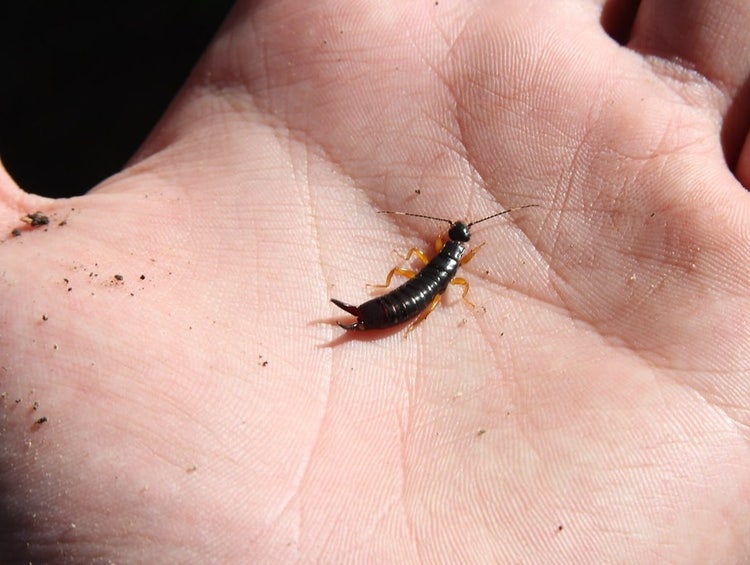
Where do earwigs live?
Earwigs are found across Australia, with the greatest diversity in warmer tropical and subtropical areas. They live in protected, moist places where they can hide from predators and avoid drying out.
In bushland and gardens, earwigs may be found under leaf litter, bark, logs, rocks, fallen plant material and other natural debris. These small shelters help earwigs stay damp and hidden during the day.
At Field of Mars Reserve, leaf litter, fallen branches, logs and bark provide habitat for many small invertebrates, including earwigs.

What do earwigs eat?
Earwigs are mostly omnivores. They feed on a wide range of plant and animal material, including dead leaves, decaying plant matter, fungi, dead insects and other small animals.
Some earwigs are predators. They may use their pincers to catch and hold small prey such as soft-bodied insects and caterpillars. Other species can feed on flowers, fruit or seedlings, especially when their populations become large.
This means earwigs can be helpful decomposers and predators, but some introduced species can also become garden or crop pests.

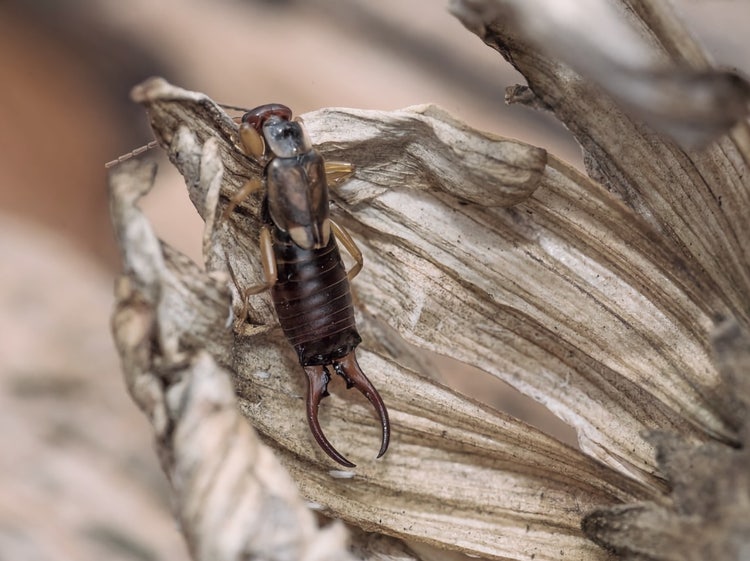
What adaptations do earwigs have to help them survive?
Earwigs have long, flattened bodies that help them squeeze into narrow cracks, crevices and spaces under bark. This helps them hide from predators and stay protected during the day.
Their pincers are an important adaptation. Earwigs use them for defence, catching and carrying prey, and sometimes for gripping during mating. Male earwigs usually have more curved pincers, while females usually have straighter pincers.
Many earwigs are nocturnal, which means they are active at night. Moving and feeding in the dark helps them avoid some predators and reduces the risk of drying out. Some species can also produce a strong-smelling defensive fluid when disturbed.

What is the life cycle of an earwig?
Earwigs have incomplete metamorphosis. This means their life cycle has three main stages: egg, nymph and adult.
Female earwigs lay their eggs in a sheltered place, such as a small burrow in the soil, under leaf litter or beneath debris. Unlike many insects, female earwigs care for their eggs. They guard them, gather them if they are scattered and clean them to help protect them from fungus.
When the eggs hatch, the young earwigs are called nymphs. Nymphs look like small, pale adults but do not yet have fully developed wings or pincers. They moult several times before becoming adults. In many species, the mother continues to protect the young nymphs until they are ready to leave the nest.


Do male and female earwigs look different?
Male and female earwigs can often be told apart by their pincers and abdomen. Males usually have more strongly curved pincers, while females usually have straighter pincers.
Males also usually have 10 visible abdominal segments. Females usually have 8 visible abdominal segments. These differences are easier to see in adult earwigs than in young nymphs.
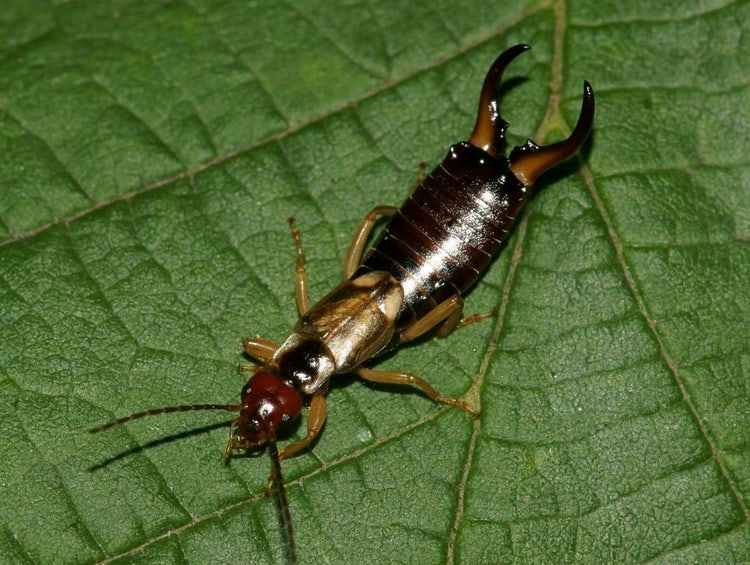
Why are earwigs important?
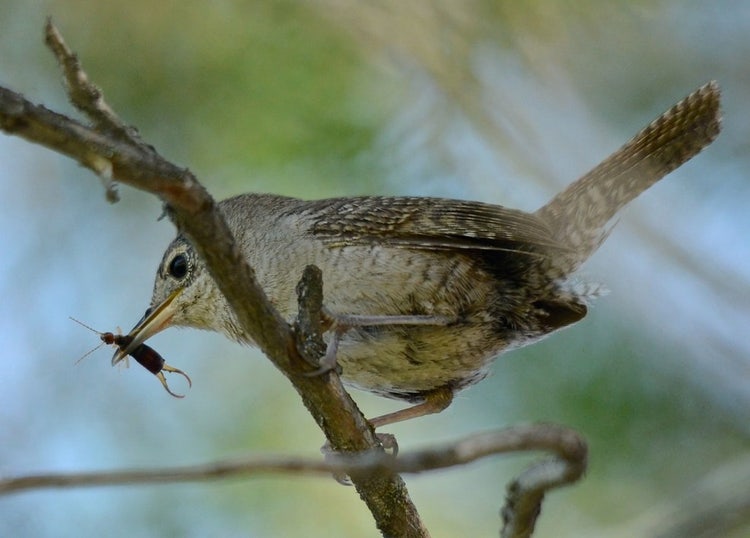
Earwigs are part of the bushland food web. They are eaten by birds, frogs, lizards, spiders, centipedes, assassin bugs and other predators.
Many earwigs also help break down dead plants and animals. By feeding on decaying material, they help recycle nutrients back into the soil.
Some native earwigs can be useful predators because they eat other insects. However, some introduced earwigs, such as the European earwig, can become pests when they damage seedlings, flowers, fruit or crops.
How can you help earwigs?
You can help earwigs and other leaf-litter animals by protecting natural habitat. Leave leaf litter, fallen bark, small branches and logs in gardens and bushland where it is safe to do so.
Avoid unnecessary pesticide use, especially in places where invertebrates live and feed. Pesticides can harm many small animals, including helpful decomposers and predators.
If you lift a log, rock or piece of bark to look for insects, put it back carefully. This helps protect the damp, dark shelter that earwigs and other small animals need to survive.

Related fact sheets
More invertebrate fact sheets
- Invertebrate fact sheets – explore more animals without backbones.
- Insects fact sheet – learn about the insect group that includes earwigs.
- Crustaceans fact sheet – learn about slaters and other animals that share damp leaf-litter habitats.
- Myriapods fact sheet – learn about centipedes and millipedes found in soil, leaf litter and under logs.
- Arachnids fact sheet – learn about spiders, mites and other predators that may feed on insects.
Habitats and ecosystems
- Leaf litter habitat fact sheet – learn about the damp ground habitat where many earwigs shelter and feed.
- Rock and log habitats fact sheet – learn how rocks, logs and bark provide shelter for small animals.
- Ground cover habitats fact sheet – learn about low plants and sheltered spaces used by invertebrates.
- Field of Mars Reserve fact sheet – learn about the bushland habitats that support earwigs and other invertebrates.
Food webs and ecological relationships
- Centipede fact sheet – learn about predators that hunt small animals in leaf litter and under logs.
- Birds fact sheet – learn how birds fit into food webs and feed on many small animals.
- Amphibians fact sheet – learn about frogs and other amphibians that feed on small invertebrates.
Attributions
References
Australian Museum. 2024. Earwigs. [online] Available at: https://australian.museum/learn/animals/insects/earwigs/
CSIRO. n.d. Dermaptera: earwigs. [online] Available at: https://www.ento.csiro.au/education/insects/dermaptera.html
CSIRO. n.d. Dermaptera Families. [online] Available at: https://www.ento.csiro.au/education/insects/dermaptera_families/dermaptera_families.html
Binns, M., Hoffmann, A., van Helden, M., Heddle, T., Kirkland, L. and Umina, P. 2020. Earwigs – an appetite for destruction or are they beneficial? GRDC. [online] Available at: https://grdc.com.au/resources-and-publications/grdc-update-papers/tab-content/grdc-update-papers/2020/02/earwigs-an-appetite-for-destruction-or-are-they-beneficial
Fattore, A. 2024. European earwig fact sheet. NSW Department of Primary Industries. [online] Available at: https://www.dpi.nsw.gov.au/__data/assets/pdf_file/0007/1559923/European-earwigs.pdf
Image attributions
An earwig. – Field of Mars EEC (original illustration).
Earwigs are usually small insects that hide during the day – “Earwig in the photographer’s hand (Euborellia arcanum)” by stevenw12339. Creative Commons Attribution-NonCommercial 2.0 Generic licence. Cropped from original. Available at: https://www.flickr.com/photos/100620478@N03/11139632694
European earwigs are introduced insects found in many parts of Australia – “European earwig” by hedera.baltica. Creative Commons Attribution-ShareAlike 2.0 Generic licence. Cropped from original. Available at: https://www.flickr.com/photos/125741467@N05/45132658571
Earwigs can feed on decaying plant material such as rotting wood – “European Earwigs (Forficula auricularia)” by Dann Thombs / Goshzilla - Dann. Creative Commons Attribution-NonCommercial-NoDerivs 2.0 Generic licence. Available at: https://www.flickr.com/photos/8381689@N06/3894219733
Earwigs help recycle nutrients by feeding on dead and decaying material – “Is there beauty in an earwig?” by Nedra / NedraI. Creative Commons Attribution-NonCommercial-ShareAlike 2.0 Generic licence. Cropped from original. Available at: https://www.flickr.com/photos/7855946@N08/42483930940
Earwigs have flexible bodies that help them squeeze into small spaces – “Tisores - Tijereta - Earwig (Forficula auricularia)” by Ferran Turmo Gort / fturmog. Creative Commons Attribution-NonCommercial-ShareAlike 2.0 Generic licence. Available at: https://www.flickr.com/photos/9016747@N03/2494993352
Female earwig with eggs and newly hatched juvenile earwigs – “File:Nesting Earwig Chester UK 2.jpg” by Tom Oates / Nabokov. Creative Commons Attribution-ShareAlike 3.0 Unported licence. Available at: https://commons.wikimedia.org/wiki/File:Nesting_Earwig_Chester_UK_2.jpg

Earwig life cycle – “File:Earwig life cycle Sideways.svg” by Bugboy52.40. Creative Commons Attribution-ShareAlike 3.0 Unported licence. Cropped from original. Available at: https://commons.wikimedia.org/wiki/File:Earwig_life_cycle_Sideways.svg

A male earwig with curved pincers – “Earwig (Forficula auricularia), m” by bramblejungle. Creative Commons Attribution-NonCommercial 2.0 Generic licence. Cropped from original. Available at: https://www.flickr.com/photos/10728961@N02/7798129758
Earwigs are part of the food web and provide food for other animals – “Glad you’re not an Earwig?” by eugene beckes / corvidaceous. Creative Commons Attribution-NonCommercial-ShareAlike 2.0 Generic licence. Cropped from original. Available at: https://www.flickr.com/photos/61210501@N04/7603040302
By protecting natural areas you can help earwigs and other leaf-litter animals – Field of Mars EEC (original image).
Learn with us

Book now
Book a schoolyard, bushland or invertebrate program where students investigate earwigs, leaf litter, logs, shelter and food webs.

Learning programs
Explore Field of Mars EEC programs that support learning about earwigs, insect features, decomposition, shelter habitats and ecosystem recycling.

Learning resources
Use the earwig fact sheet to support classroom learning about pincers, hiding places, bark, leaves, logs, eggs and nocturnal activity.

Flora and fauna fact sheets
Explore related fact sheets about insects, leaf litter habitats, rock and log habitats, decomposers, spiders and eucalypt forests.
Related programs
Entomologist HPGE enrichment program
Investigate invertebrates in leaf litter and other habitats and examine their anatomy, classification and ecological roles.
Ecosystem explorers excursion
Investigate leaf litter habitats, decomposers, food chains and interactions between organisms and their surroundings.