
Digital woodlands incursion | Stage 3 Creative Arts
Program overview
Digital woodlands is a Stage 3 Creative Arts incursion where students use iPads to explore nature photography in their school grounds or a suitable nearby natural area. They learn how photographers use composition, focus, light, perspective and macro photography to represent the natural world and communicate ideas to an audience.
Working in pairs, students capture a portfolio of natural images, select and edit their strongest photographs, and create a collaborative digital photo book. Each student also chooses one image to be printed, framed and delivered to school.
We have been advised that this program is exempt from the screen use limits under the new screen use guidelines for schools, as the use of technology in this program is purposeful, intensive and curriculum aligned.
This program is also available for Stage 2 and as a Digital woodlands excursion.
Learning intention
- We are learning to use digital photography techniques to represent the natural world and communicate ideas to an audience.
Jump to: Program and curriculum | Essential information | Plan and prepare | Location | Related programs


Program and curriculum information
Program activities
Activities may change to suit student needs, timing and school arrangements.
Nature photography workshop
Students examine examples of nature photography and discuss how images can tell stories, influence audiences and encourage people to value the natural world. They learn techniques including subject focus, macro photography, light, leading lines, framing, perspective and the rule of thirds.
Field photography
Working in pairs, students photograph plants, animals, textures, patterns and other natural features in the school grounds or a suitable nearby natural area. They experiment with angles and viewpoints, apply composition techniques and explain the choices they make when creating each image.
Students may also complete creative photography challenges involving forced perspective, natural alphabets, patterns and carefully arranged natural materials.
Publishing
Students use selection criteria to identify and justify their strongest photographs before using digital editing tools to refine their images. Each student selects one photograph to be printed, framed and delivered to school.
Students collaborate in Book Creator to produce a digital photo book showcasing different photographic techniques. They organise and sequence images, design a cover and reflect on how their photography developed throughout the day. Time permitting, students share selected photographs and discuss the techniques used.
Suggested timetable
Time |
Activities |
| 9.15–11.00 |
Nature photography workshop Field photography |
| Recess | |
| 11.30–1.00 |
Field photography Publishing |
| Lunch | |
| 1.30–2.15 | Publishing continued (if required) |
Times and session durations may vary depending on the school timetable, location choice and number of participating classes.
Include your school’s bell times in the notes section of the booking form.
Syllabus outcomes and content
Students will learn to
- analyse how photographers use composition, focus, framing, perspective, light and macro photography to communicate ideas to audiences
- intentionally select natural subjects, viewpoints and photographic techniques to represent the natural world
- apply digital photography and editing processes to refine and enhance images
- evaluate and justify the selection and sequencing of photographs
- make curatorial choices when presenting photographs in a collaborative digital photo book
- collaborate safely and reflect on how artistic choices influence the ways audiences interpret artworks
The incursion directly supports the Creative Arts K–6 Syllabus (2024) through intentional nature photography, digital artmaking, appreciation, refinement and the curation of artworks for an audience.
Creative Arts K–6 Syllabus (2024)
Visual Arts
Outcome
- Makes artworks in intentional ways to represent ideas about their world, and explains ways artists are influenced by contexts and how artworks are interpreted by audiences – CA3-VIS-01
Content addressed
Making – Artists represent their world in intentional ways through their artmaking practice
- Apply understandings of materials, digital technologies and processes to represent intended ideas in artworks
- Explore artistic conventions and ways to represent subject matter and ideas in compositions
- Explain how artists, artworks, the world and audiences influence own artmaking practice
- Make artworks in collaboration with others to represent an intended meaning
- Demonstrate safe artmaking practices with respect for physical, social, digital and cultural safety
Appreciating – Artists are influenced by contexts and make artworks that audiences can critique and interpret in various ways
- Make associations between artworks and own personal, social or cultural contexts
- Explain structural features of an artwork and how artists use the elements of art and design to communicate meaning to audiences through art forms, using Tier 2 and Tier 3 vocabulary
- Infer ideas about an artist’s intentions and recognise that artworks may be critiqued and interpreted in various ways by audiences
Exhibiting – Artworks are displayed and curated to communicate intentional ideas to audiences
- Enhance an artwork by refining, editing, resolving or mounting an artwork
- Make choices about ways to display or curate own artworks to engage audiences and convey ideas and meaning
- Reflect on personal experiences and contributions as an artist, explaining how choices and decisions influenced the artwork and the ways it is understood by audiences
Creative Arts K–6 Syllabus © NSW Education Standards Authority for and on behalf of the Crown in right of the State of New South Wales, 2024
Tier 2 and 3 vocabulary
Essential information
Cost, class numbers and booking
Cost
DoE school – $27 per student, GST free
Non-government school – $37 per student, GST free, minimum charge $750 per class
A minimum charge of $750 per class applies to non-metropolitan schools.
Classes
A recommended maximum of four classes can participate each day, with up to 30 students per class. The indoor learning space must comfortably accommodate all participating classes.
Program costs
Program costs may change. If program costs change after you book, you will be charged at the original cost.
Booking policy
Confirm final student numbers and classes 7 working school days before the program.
Risk assessment and accessibility
View incursion risk assessments
Notify Field of Mars EEC before the incursion about medical, mobility, sensory, communication or other support needs so reasonable adjustments can be considered.
The school should ensure the selected indoor and outdoor learning spaces, furniture arrangements and movement routes are accessible and appropriate for participating students.
Classroom teachers are expected to attend and actively supervise students throughout the incursion.
Students who are unwell should not attend.
Weather, cancellations and rescheduling
The incursion may be modified, postponed or cancelled if travel or program delivery is unsafe because of extreme weather or fire danger.
Cancellation or rescheduling with less than 30 school days’ notice before the booking date – $650
Cancellation with less than 14 school days’ notice before the booking date – full program cost
Cancellation due to unsafe weather or fire danger – $0
Plan and prepare
Learning space and access
Provide one extra-large indoor learning space, with a screen or projector, for all participating classes. The space must comfortably accommodate all participating students and remain available for the duration of the program day.
Ensure the room, outdoor learning areas, gates and movement routes are unlocked and available when Field of Mars EEC staff arrive.
Provide clear school-entry, visitor sign-in and parking instructions before the incursion. Where possible, arrange parking or an unloading area close to the main learning space.
Ensure the school office and participating teachers know when Field of Mars EEC staff will arrive and where the program will be delivered.
Natural areas and class organisation
The program requires access to significant natural environments in or near the school. Access to a suitable nature reserve near the school provides the richest learning experience.
Reserve suitable and accessible gardens, planted areas, bushland or other natural areas where students can photograph plants, animals, textures, patterns and other natural features. Inspect the selected areas before the incursion and remove or manage temporary hazards.
When using bushland or another natural area outside the school grounds, ensure all participating class teachers have visited the site and are familiar with the walking route between the school and the site. Maintain a supervision ratio of at least one adult to 15 students while away from the school grounds.
Organise students into pairs before the program begins. Ensure participating teachers understand the boundaries of the outdoor learning areas and the required supervision arrangements.
Include the school’s bell times and details of the proposed natural areas in the notes section of the booking form.
Location

School incursions
Planning information for incursions delivered at your school, including learning spaces, accessibility, risk management and staff access.
Extend student learning
Use these student-friendly fact sheets before or after the Digital woodlands incursion to introduce natural subjects, habitats, textures and patterns that can inspire students’ photography.
Ecosystems and environments fact sheet – Explore natural environments, habitats, living things and non-living features that can inspire digital photography.
Eucalypt forest ecosystem fact sheet – Learn about gum-tree forests with trees, shrubs, leaf litter, animals and connected food webs.
Plant fact sheets – Explore native plants with leaves, flowers, bark, colours, shapes and patterns suitable for close observation.
Tree habitat fact sheet – Discover bark, branches, flowers, hollows and canopy features that can become photographic subjects.
Leaf litter habitat fact sheet – Explore small ground-level details suited to macro photography and close observation.
Habitat fact sheet – Learn how living and non-living features create places where organisms can survive.
Learn with us

Book this incursion
Book this Stage 3 Creative Arts incursion using our online booking form.
Learning resources
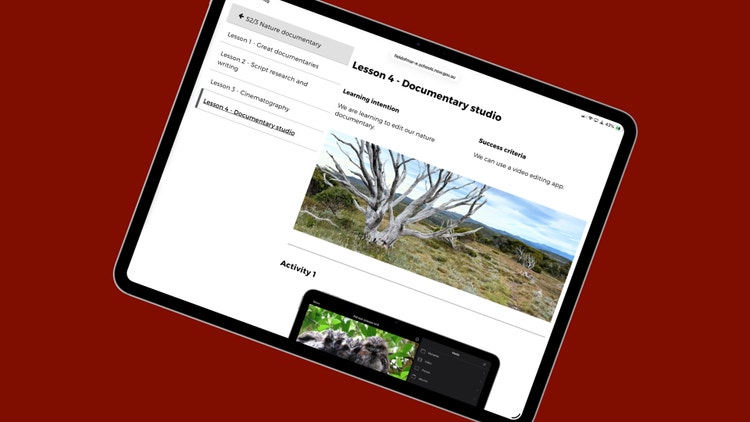
Explore digital activities, lesson ideas and classroom resources that support creative arts, nature observation and environmental learning.
Related Stage 3 programs
Nature’s gift incursion
Use natural materials, photography and digital drawing tools to create a layered nature-inspired artwork.
Documentary in a day incursion
Plan, script, film and review a short nature documentary while developing speaking, listening and multimodal storytelling skills.