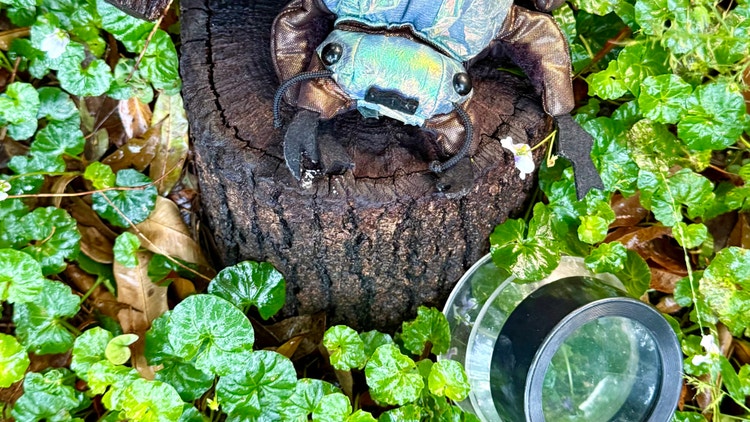
Entomologist HPGE | Stage 2–3 Science and Technology
Program overview
Entomologist is a one-day Stage 2 and Stage 3 Science and Technology HPGE enrichment program where students investigate invertebrate ecology, anatomy, classification and adaptations. Students work with an entomologist to conduct field investigations, collect and record evidence, examine live specimens and classify invertebrates using observable anatomical features.
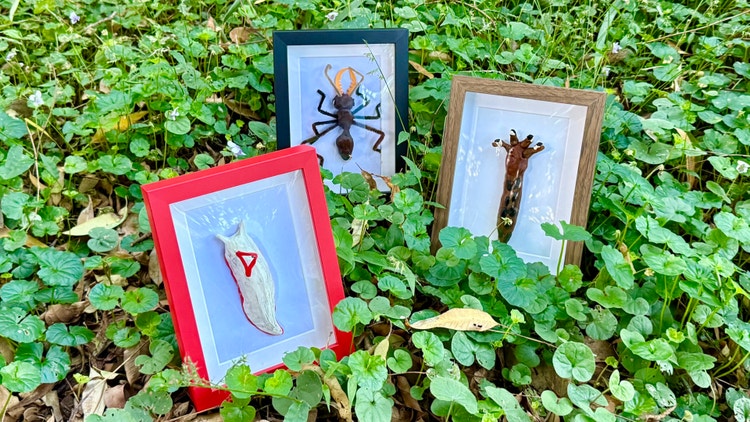
Students compare structures such as legs, antennae, wings, mouthparts, body segments and exoskeletons before applying their scientific understanding to construct a detailed invertebrate model. Each student mounts their completed model in a box frame to take home. HPGE domains: creative, intellectual.
Book this Stage 2–3 Science and Technology enrichment program
Learning intentions
- We are learning to conduct an invertebrate investigation and record field observations and evidence.
- We are learning to classify and justify invertebrate identifications using anatomical evidence and scientific vocabulary.
- We are learning to communicate findings through recorded observations and a detailed model that shows accurate structural adaptations.
Jump to: Program and curriculum | Essential information | Plan and prepare | Location | Extend student learning | Related HPGE programs
Program and curriculum information
Program activities
Activities may change to suit student needs, specimen availability, timing and weather conditions.
Invertebrate walk
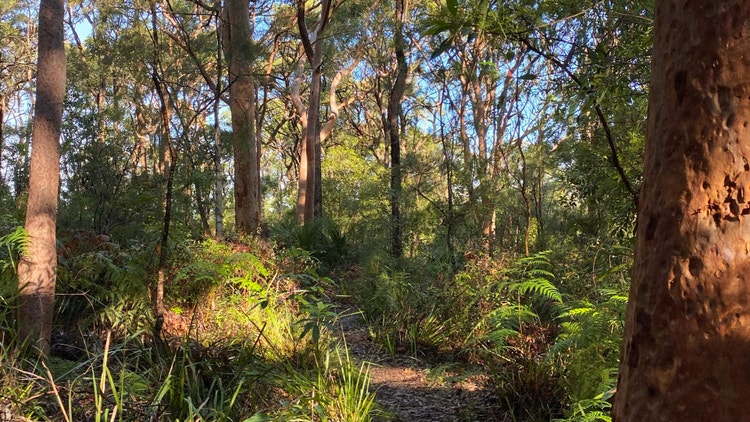
Students search bushland habitats for invertebrates and evidence of their activity. They use magnifiers to observe living and non-living habitat features and identify examples of how invertebrates depend on plants, other animals and environmental materials for food, shelter and survival.
Invertebrate investigation with an entomologist
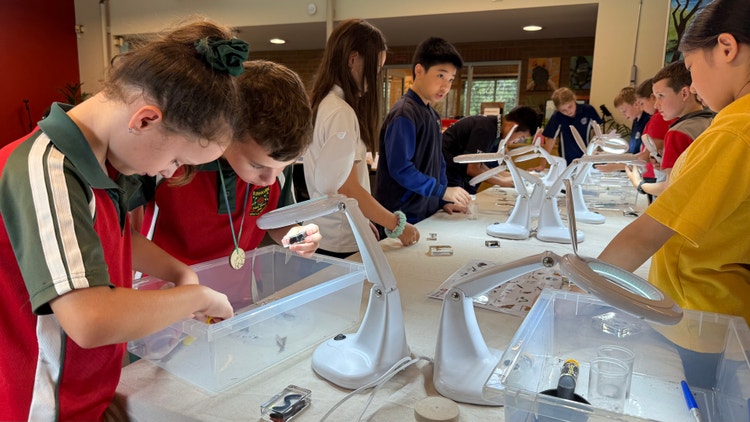
Students examine live and preserved specimens using magnifying equipment. Specimens may include stick insects, beetle larvae, spiders, centipedes, isopods and crayfish.
Students compare anatomical features and learn how specimens are prepared for biodiversity collections and scientific study.
Invertebrate anatomy and classification
Students classify insects, arachnids, crustaceans, myriapods and other invertebrates using features such as legs, body segments, antennae, wings and mouthparts.
They distinguish observations from inferences and record evidence in a take-home nature journal.
Scientific model construction
Students design and construct an anatomically informed model of a real or imagined invertebrate. They explain how its structures support movement, feeding, sensing, defence or survival.
Each completed model is mounted in a box frame to take home.
Timetable
Time |
Activities |
|
| 9.15 | Arrival | |
| 9.30–10.15 | Invertebrate walk | |
| 10.15–10.30 | Recess | |
| 10.30–12.00 | Group 1 – Invertebrate investigation with an entomologist | Group 2 – Invertebrate anatomy, classification and model construction |
| 12.00–12.30 | Lunch | |
| 12.30–2.00 | Group 1 – Invertebrate anatomy, classification and model construction | Group 2 – Invertebrate investigation with an entomologist |
| 2.15 | Student collection and departure | |
The timetable may be adjusted according to participant numbers, specimen availability, environmental conditions and the needs of participating students.
Syllabus outcomes and content
Students will learn to
- conduct a field investigation using appropriate observation and collection techniques
- observe and describe living and non-living features within invertebrate habitats
- collect, organise and interpret field observations and data
- compare invertebrate body structures and identify patterns
- classify invertebrates using anatomical evidence
- explain how structural and behavioural features may support survival
- communicate scientific understanding through written observations, diagrams, discussion and model construction.
The program supports the Science and Technology K–6 Syllabus (2024) through field investigations, observation, evidence, data interpretation, living systems, adaptations and scientific communication.
Science and Technology K–6 Syllabus (2024) – Stage 2
Physical and living systems depend on energy
Outcomes
- Uses information to investigate the solar system and the effects of energy on living, physical and geological systems – ST2-SCI-01
- Uses and interprets data to describe patterns and relationships – ST2-DAT-01
Content addressed
Living things depend on energy and materials to survive
- Observe and describe living and non-living things in a habitat
- Describe ways in which plants and animals depend on each other for survival
Science and Technology K–6 Syllabus (2024) – Stage 3
Knowledge of our world and beyond inspires sustainable solutions
Outcomes
- Uses evidence to explain how scientific knowledge can be used to develop sustainable practices – ST3-SCI-01
- Interprets data to support explanations and arguments – ST3-DAT-01
Content addressed
Living things may change over millions of years, in response to their environments
- Observe behavioural and structural adaptations of plants and animals, and suggest how these may help them survive in their environments
- Interpret evidence collected during investigations to support explanations about living things and their environments
Science and Technology K–6 Syllabus (2024) © NSW Education Standards Authority for and on behalf of the Crown in right of the State of New South Wales, 2024
Tier 2 and 3 vocabulary
Essential information
Program costs, eligibility and booking
Cost
$60 per student – GST free
Program costs are processed through each student’s home school.
Program costs may change. If program costs change after you book, you will be charged at the original cost.
Eligibility
This program is available to Stage 2 and Stage 3 students enrolled in NSW Department of Education schools.
Schools should select students who demonstrate strong interest or potential in biological science, field investigation, classification, scientific reasoning or detailed model-making. Selection should consider curiosity and potential, not only prior achievement.
Dates and booking
Entomologist is offered on selected HPGE program dates. Check available dates and remaining places before selecting students.
View HPGE program dates and remaining places
Cancellations
Less than 4 weeks notice – full cost (excluding HPGE programs in Term 1, Weeks 3–5)
Weather or fire danger cancellation – $0
Student numbers, supervision and support
Student numbers
A school may nominate up to twelve students for each HPGE program day.
Places are limited and subject to the remaining program capacity.
Supervision
Classroom teachers are not required to attend but are welcome.
Field of Mars Environmental Education Centre teachers supervise students throughout the program. Schools must provide a teacher or school learning support officer when a student requires additional assistance to participate safely and successfully.
Student information
Schools must provide accurate medical, allergy, medication, emergency contact, collection and support information for every participating student.
Student details must be confirmed at least seven working school days before the program. Changes can be made using the edit-submission link provided with the booking confirmation.
Support and adjustments
Notify Field of Mars Environmental Education Centre before the program about any mobility, sensory, communication, behavioural, medical or learning support requirements. Staff can discuss reasonable adjustments and suitable participation options.
What to bring, arrival and transport
Students should bring
School sports uniform, backpack, medication, low-waste food, water bottle, sunscreen, raincoat, hat and sturdy shoes.
Arrival and departure
Students should be dropped off by 9.15 am and collected at 2.15 pm.
A teacher, parent or responsible adult must supervise students until they have been received by Field of Mars Environmental Education Centre staff.
Transport and parking
Schools and families are responsible for transport to and from Field of Mars Reserve.
Cars must park in the main car park beside Pittwater Road. Students and accompanying adults then walk along the access road to the centre.
Risk management, weather and cancellations
Risk management
The program includes indoor activities, bushland field investigations, walking near natural vegetation and creeks, and observing or handling invertebrate specimens.
Schools should review the Field of Mars Reserve risk management information when planning student participation and transport.
Students who are unwell should not attend.
View the Field of Mars Reserve risk management plan
View Field of Mars Reserve location and access information
Weather
The program may be modified, postponed or cancelled because of predicted extreme temperatures, bush fire danger, heavy rainfall, high winds or dust storms.
Field activities may continue in light rain when conditions are safe. Students must bring a waterproof raincoat.
Families may be directed to the Westminster Road entrance when flooding prevents access through the main entrance.
Plan and prepare for your visit

Field of Mars Reserve social story
Help Stage 2 and 3 students understand where they will go, what they may experience and how to participate safely during their visit.

Preparing for your excursion
Help students and families prepare for the program by checking clothing, food, water, medication, transport and outdoor learning requirements.
Location
Field of Mars Reserve
Main location
Find risk management information, parking details, access information and walking track information for Field of Mars Reserve.
Teachers, parents or responsible adults will need to drop off and collect students.
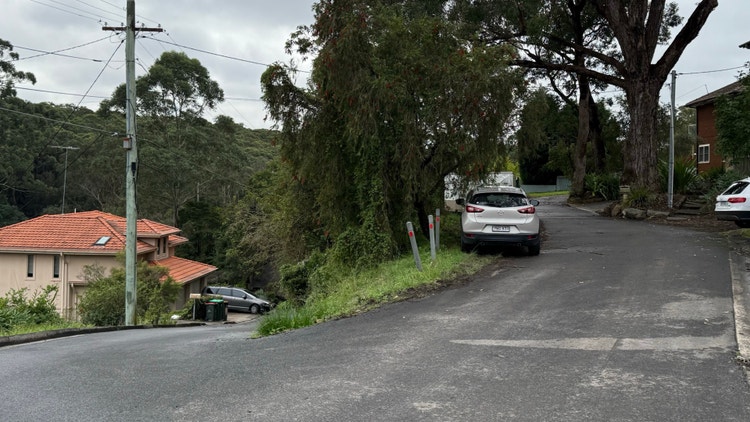
Westminster Road
Alternative entrance
This entrance or exit provides alternative access during severe high tides and heavy rainfall events that cause flooding at the main Pittwater Road entrance.
Extend student learning
Use these student-friendly fact sheets before or after your Entomologist HPGE enrichment program to support invertebrate ecology, classification, adaptations and scientific modelling.
- Invertebrate fact sheets – Explore insects, spiders, worms, molluscs and other small animals found in bushland and schoolyard habitats.
- Insects fact sheet – Learn about insect body parts, life cycles, adaptations and ecological roles.
- Ant fact sheet – Explore social insects that live in colonies, collect food and help recycle nutrients.
- Spider fact sheet – Learn about arachnids, webs, hunting behaviours and habitat use.
- Leaf litter habitats fact sheet – Discover fallen leaves, bark and twigs where many invertebrates shelter, feed and reproduce.
- Ground cover habitats fact sheet – Explore grasses, ferns and low plants that provide shelter and food for small animals.
Learn with us
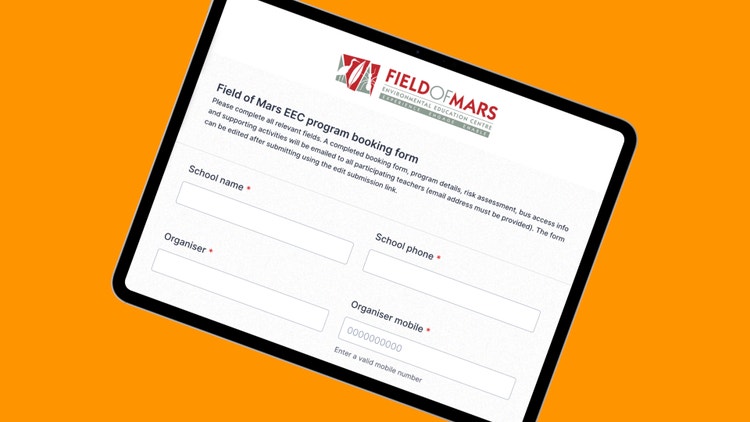
Book this HPGE enrichment program
Check program dates and remaining places, then book places for selected students using the Field of Mars EEC HPGE booking page.
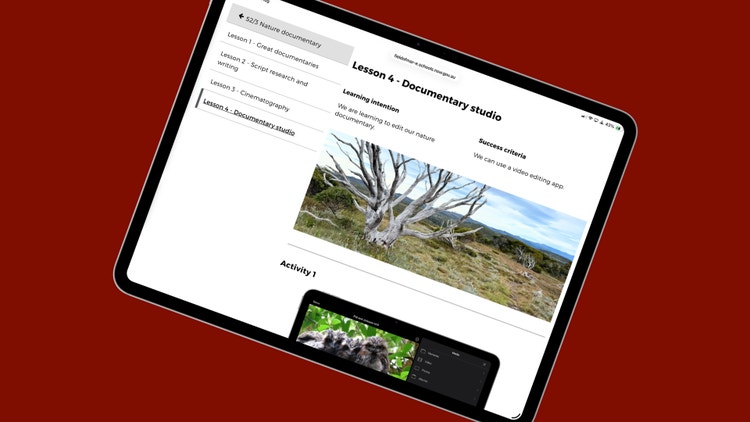
Learning resources
Explore lessons, digital activities, fact sheets and classroom resources that support outdoor and environmental learning before or after the HPGE program.
Related HPGE programs
Augmented Reality Studio HPGE enrichment program
Students investigate invertebrate features, behaviours and habitats before creating a digital specimen and augmented reality science explanation using iPads.
Mystery HPGE enrichment program
Students work in teams to solve a wildlife mystery by following a clue trail, collecting field evidence, interpreting maps and data, and presenting an evidence-based scientific argument.