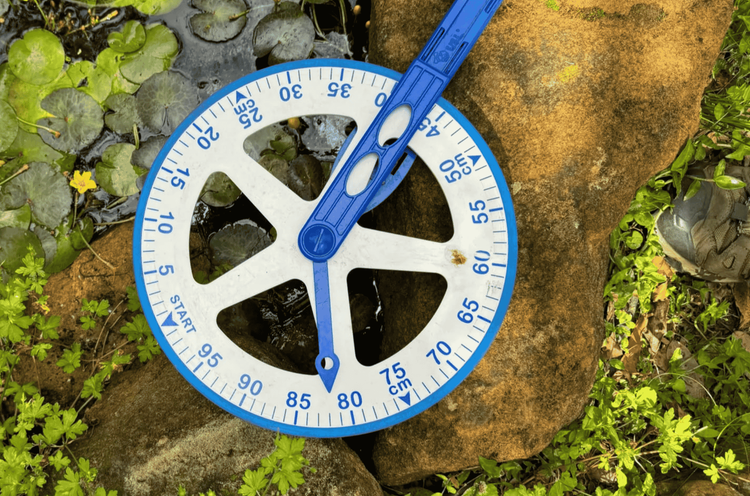
Natural numbers excursion | Stage 4 and 5 Mathematics
Program overview
Natural numbers is a Stage 4–5 Mathematics excursion at Buffalo Creek Reserve in Lane Cove National Park. Students apply mathematical concepts and Working Mathematically processes to authentic challenges involving measurement, mapping, estimation, scale, ratios, trigonometry and environmental data.
Schools select from a range of fieldwork activities suited to students’ stage, prior learning and program priorities. Working in teams, students choose and apply mathematical techniques, record measurements and calculations, evaluate their methods and communicate their reasoning using appropriate mathematical language.
This program will retire at the end of 2026.
Fieldwork inquiry
- How can mathematical techniques be used to solve measurement and navigation problems in an outdoor environment?
- Which methods can provide reliable estimates of distances, heights, river width and abundance?
- How can field data, calculations and mathematical reasoning be communicated clearly?
Jump to: Program and curriculum | Essential information | Prepare for fieldwork | Location | Extend learning | Related programs


Program and curriculum information
Fieldwork activities
Activities may change to suit student needs, timing and weather conditions.
Schools select a combination of activities appropriate to the students’ mathematical knowledge and learning priorities.
Cartography and navigation
Students use a compass and measuring equipment to map sections of Buffalo Creek Reserve and its boardwalk or complete a navigation challenge. They apply distance, direction, scale and spatial reasoning to represent routes and justify their decisions.
River width investigation
Students use compass bearings, markers and measured distances to construct a geometric model and estimate the width of the Lane Cove River. Depending on students’ prior learning and the selected method, they apply Pythagoras’ theorem or trigonometry involving bearings, record their calculations and evaluate assumptions, measurement precision and possible sources of error.
Tree height investigation
Students use a clinometer and tape measure to estimate the height of canopy trees. Depending on students’ prior learning and the selected method, they apply ratios, Pythagoras’ theorem or trigonometric ratios using an angle of elevation. They record their measurements and calculations, compare results and evaluate the precision of their method.
Fauna abundance and mathematical communication
Students use quadrats to collect repeated samples of native fauna abundance. They calculate the total area sampled and use the sample data to estimate abundance across a larger defined area. Students classify the numerical variables, organise and display their results using a suitable representation, and compare the samples using the mean, median and range. They use mathematical vocabulary in a short video-blog to explain their calculations, problem-solving method, assumptions and reasoning.
Worksheet and supporting resources
Student worksheet
Access the Natural numbers student worksheets.
Schools are responsible for printing one worksheet for each student before the excursion.
Teacher and student resources
View the Fieldwork techniques learning resource.
Suggested timetable
Time |
Activities |
| 9.45–10.00 | Introduction, fieldwork preparation, food break and toilets |
| 10.00–11.00 | Fieldwork activity 1 |
| 11.00–12.00 | Fieldwork activity 2 |
| 12.00–12.30 | Food break and toilets |
| 12.30–1.30 | Fieldwork activity 3 |
| 1.30–2.00 | Communicating mathematically |
| 2.00–2.15 | Conclusion and depart |
The timetable may change according to class numbers, student learning needs and weather.
Syllabus outcomes and content
Students will learn to
- select and apply mathematical techniques to solve authentic fieldwork problems
- use measurement, direction, scale, ratios and geometric reasoning to estimate unknown quantities
- apply Pythagoras’ theorem or trigonometry to practical measurement problems where appropriate
- collect, classify, organise, display and interpret primary field data
- evaluate assumptions, measurement precision and possible sources of error
- communicate calculations, strategies and reasoning using mathematical conventions
Mathematics K–10 Syllabus (2022)
The particular outcomes and content addressed depend on the activities selected and the mathematical level of participating students.
Overarching outcome
MAO-WM-01 – develops understanding and fluency in mathematics through exploring and connecting mathematical concepts, choosing and applying mathematical techniques to solve problems, and communicating their thinking and reasoning coherently and clearly
Stage 4 outcomes and content
MA4-RAT-C-01 – solves problems involving ratios and rates, and analyses distance–time graphs
Students:
- use ratios to compare 2 or more quantities measured in the same units
- solve real-life problems involving ratios
MA4-ARE-C-01 – applies knowledge of area and composite area involving triangles, quadrilaterals and circles to solve problems
Students:
- apply the formula to find the area of a rectangle or square
MA4-PYT-C-01 – applies Pythagoras’ theorem to solve problems in various contexts
Students:
- solve practical problems involving Pythagoras’ theorem
MA4-DAT-C-01 – classifies and displays data using a variety of graphical representations
Students:
- classify data as either numerical discrete or continuous variables
- display data using graphical representations relevant to the purpose of the data
- interpret data in graphical representations
MA4-DAT-C-02 – analyses simple datasets using measures of centre, range and shape of the data
Students:
- calculate and compare the mean, median and range for simple datasets
Stage 5 outcomes and content
MA5-TRG-C-01 – applies trigonometric ratios to solve right-angled triangle problems
Students:
- apply trigonometry to solve right-angled triangle problems
MA5-TRG-C-02 – applies trigonometry to solve problems, including bearings and angles of elevation and depression
Students:
- solve right-angled triangle problems involving angles of elevation
- solve right-angled triangle problems involving bearings
Mathematics K-10 Syllabus (2022) © NSW Education Standards Authority for and on behalf of the Crown in right of the State of New South Wales, 2022
Vocabulary
Essential information
Cost, class numbers and booking
Cost
DoE $27 per student – GST free
Non-government school $37 per student – GST free, minimum charge $750 per class
Classes
Maximum 4 classes, with up to 30 students per class.
Program costs
Program costs may change. If program costs change after you book, you will be charged at the original cost.
Booking policy
Confirm final student numbers and classes 7 working school days before the program.
Risk assessment and accessibility
Buffalo Creek Reserve risk assessment and location information – main location
The program includes rugged bushwalking on uneven natural tracks, sandstone steps and boardwalks. Buffalo Creek Reserve is not wheelchair accessible.
Students who are unwell should not attend.
Classroom teachers are expected to attend and actively supervise students throughout the excursion.
Notify Field of Mars EEC before the visit about medical, mobility, sensory, communication or other support needs so reasonable adjustments can be considered.
What to bring and prepare
School preparation
- Print one worksheet for each student
- Organise students into suitable working groups
- Ensure students bring writing materials and a clipboard
- Review relevant mathematical concepts and selected fieldwork challenges
- Preview relevant fieldwork equipment and techniques
- Advise Field of Mars EEC of learning, medical or access requirements
Students should bring
School sports uniform, backpack, medication, low-waste food, water bottle, sunscreen, raincoat, hat, sturdy closed shoes, pencils, clipboard and a reusable name tag.
Weather, cancellations and rescheduling
The program may be modified, postponed or cancelled because of predicted extreme temperatures, bush fire danger, heavy rainfall, high winds or dust storms.
Cancellation or rescheduling with less than 30 school days’ notice before the booking date – $650
Cancellation with less than 14 school days’ notice before the booking date – full program cost
Cancellation due to unsafe weather or fire danger – $0
Prepare for secondary fieldwork

Preparing for your excursion
Find information about clothing, equipment, transport, arrival procedures, safety and preparing students for outdoor fieldwork.
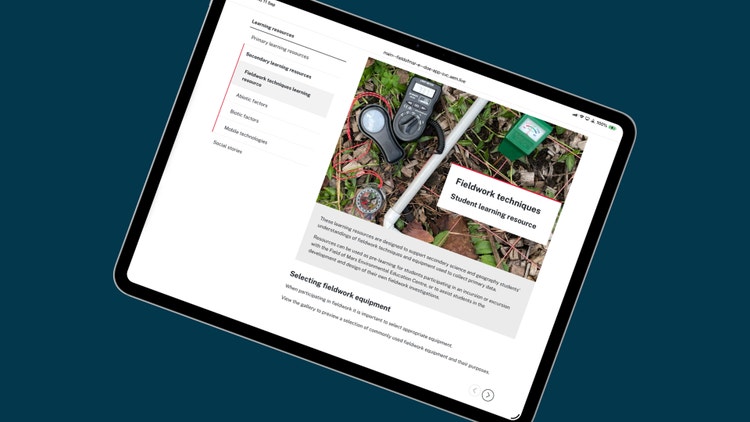
Fieldwork techniques
Preview clinometers, measuring tapes, quadrats and other equipment used for field measurement, sampling and data collection.
Location
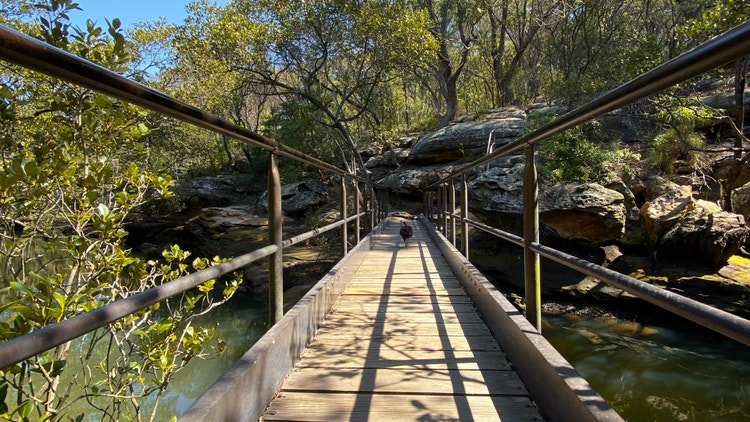
Buffalo Creek Reserve
Main location
Find risk assessment information, risk management advice, bus access details and walking track information for Buffalo Creek Reserve.
Extend student learning
Use these fact sheets before or after the excursion to support fieldwork involving measurement, estimation, sampling and data analysis.
- River and creek environment fact sheet – Explore the waterways, banks and environmental features surrounding Buffalo Creek and the Lane Cove River.
- Mangrove forest fact sheet – Investigate the living and non-living features of mangrove forests and the organisms that can be sampled within them.
- Estuary environments fact sheet – Learn how freshwater, salt water, tides, sediments and living things interact within an estuary.
- Tree habitat fact sheet – Explore tree structure and the habitat features associated with tree-height measurement activities.
- Grey mangrove ecosystem fact sheet – Examine the features, size and habitat of a common tree growing along the Lane Cove River.
- Semaphore crab fact sheet – Discover a mangrove animal that can provide a context for quadrat sampling and abundance estimates.
Learn with us

Book this excursion
Book this Stage 4–5 Mathematics excursion using the online booking form.

Learning resources
Access student worksheets, fieldwork techniques and classroom resources that support measurement, sampling, mapping and data analysis.
Related secondary programs
Landscapes and landforms excursion
Investigate landform features, geomorphic processes and cultural landscapes in a riverine environment.
Forces incursion
Investigate forces, simple machines and Aboriginal technologies through practical experiments and design activities.