
Environmental change and management excursion | Stage 5 Geography
Program overview
Environmental change and management is a Stage 5 Geography excursion where students investigate environmental change in the urban riverine environment of Blackman Park and the Lane Cove River. Students examine how biophysical processes and human activities have changed the environment through field observations, mapping and targeted investigations of three management issues affecting the site - water quality, weed invasion, and microplastic pollution.
Working in small groups, students collect and analyse qualitative and quantitative data using water-testing equipment, quadrats, transects and digital fieldwork tools. They explain the consequences of environmental change, assess the effectiveness of current management strategies and propose evidence-based improvements.
Fieldwork inquiry
- What are the consequences of human-induced environmental change on a riverine environment?
- To what extent are environmental changes being effectively managed at Blackman Park?
Jump to: Program and curriculum | Essential information | Prepare for fieldwork | Location | Extend learning | Related programs


Program and curriculum information
Fieldwork activities
Activities may change to suit student needs, timing and weather conditions.
Site mapping and environmental change
Students interpret a map of Blackman Park and identify natural and built features and the locations of their fieldwork sites. Using the investigation context and site evidence, they examine the change from wetland to landfill and recreational park and identify human activities and biophysical processes affecting the riverine environment.
Water quality and catchment processes
Students measure turbidity, phosphate, dissolved oxygen and aesthetic qualities of the Lane Cove River. They compare results with healthy indicator ranges, explain how surrounding land uses, stormwater and human activities influence water quality, and use their evidence to evaluate observed management strategies and recommend improvements.
Microplastics dispersion
Students use quadrats along a belt transect from synthetic playing surfaces to measure synthetic-turf fragments and/or rubber-crumb cover, then map their distribution and identify hotspots. They analyse how wind and stormwater transport microplastics, explain consequences for soil, bushland, waterways, wildlife and people, and evaluate observed containment and maintenance strategies.
Invasive plants and management evaluation
Students use a transect from a pathway into eucalypt forest to record soil disturbance and weed presence. They analyse the relationship between disturbance and weed distribution, explain how weeds are introduced and dispersed and how they affect native biodiversity, then evaluate biological, chemical and mechanical management strategies and recommend improvements.
Worksheet and supporting resources
Student worksheet
Secondary worksheets are password protected and available to teachers after booking. Contact Field of Mars EEC to request the password.
Download the student worksheet from the Stage 5 Environmental change and management resource folder.
Schools are responsible for printing one worksheet for each student before the excursion.
Teacher and student resources
Access the stimulus booklet from the Stage 5 Environmental change and management resource folder.
View the Fieldwork techniques learning resource.
Suggested timetable
Time |
Activities |
| 9.30–9.45 | Arrival, introduction and fieldwork preparation |
| 9.45–10.45 | Site mapping and fieldwork investigation 1 |
| 10.45–11.15 | Food break and toilets |
| 11.15–12.45 | Fieldwork investigations 2 and 3 |
| 12.45–1.15 | Food break and toilets |
| 1.15–2.00 | Fieldwork investigation 4 and management evaluation |
| 2.00–2.15 | Conclusion and depart |
The timetable may change according to class numbers, student learning needs and weather.
Syllabus outcomes and content
Students will learn to
- identify and map natural and built features of an urban riverine environment
- explain how changed land use and human activities have altered a riverine environment over time
- investigate biophysical processes that transport water, pollutants, invasive plants and microplastics
- collect qualitative and quantitative primary data using water-quality testing, bipolar analysis, transects, quadrats and mapping
- analyse water-quality, vegetation and microplastics data to identify trends, patterns and relationships
- explain why healthy riverine environments and native biodiversity are important
- explain the environmental consequences of reduced water quality, invasive plants and microplastic pollution
- assess the effectiveness of water, weed and microplastic management strategies
- propose evidence-based improvements to environmental management
- create written explanations, evaluations and recommendations using geographical data and terminology
Geography 7–10 Syllabus (2024)
Focus area
Environmental change and management
Outcomes
- GE5-PRI-01 – analyses the processes and interactions that transform people, places and environments
- GE5-MAN-01 – assesses different approaches to the management and protection of places and environments
- GE5-COM-01 – selects and applies concepts and terminology to communicate geographical information for a range of purposes, audiences and contexts
Content
Thinking and working geographically
- Select and apply relevant geographical concepts
- Engage in geographical inquiry using geographical information
- Create written texts to explain the geographical processes that influence change in environments and make arguments about the management of these processes
Environmental change
- The role and importance of Earth’s environments
- Biophysical processes that change Earth’s environments
- Human-induced environmental changes over time
- Consequences of environmental change
Environmental management
- Management strategies to reduce the impacts of environmental change
Geography 7–10 Syllabus (2024) © NSW Education Standards Authority for and on behalf of the Crown in right of the State of New South Wales, 2024
Vocabulary
Essential information
Cost, class numbers and booking
Cost
DoE $27 per student – GST free
Non-government school $37 per student – GST free, minimum charge $750 per class
Classes
Maximum 8 classes, with up to 30 students per class.
Program costs
Program costs may change. If program costs change after you book, you will be charged at the original cost.
Booking policy
Confirm final student numbers and classes 7 working school days before the program.
Risk assessment and accessibility
Blackman Park risk assessment and location information
The program includes walking on paved paths, grassed areas and uneven natural surfaces near the Lane Cove River. Some program areas at Blackman Park may be wheelchair accessible.
Students who are unwell should not attend.
Classroom teachers are expected to attend and actively supervise students throughout the excursion.
Notify Field of Mars EEC before the visit about medical, mobility, sensory, communication or other support needs so reasonable adjustments can be considered.
What to bring and prepare
School preparation
- Print one worksheet for each student
- Organise students into suitable working groups
- Ensure students bring writing materials and a clipboard
- Arrange at least one charged mobile device for each working group to record photographs and field data
- Inform Field of Mars EEC if student mobile devices are not permitted
- Review relevant fieldwork techniques and supporting resources
- Advise Field of Mars EEC of learning, medical or access requirements
Students should bring
School sports uniform, backpack, medication, low-waste food, water bottle, sunscreen, raincoat, hat, sturdy closed shoes, pencils, clipboard and a reusable name tag.
Weather, cancellations and rescheduling
The program may be modified, postponed or cancelled because of predicted extreme temperatures, bush fire danger, heavy rainfall, high winds or dust storms.
Cancellation or rescheduling with less than 30 school days’ notice before the booking date – $650
Cancellation with less than 14 school days’ notice before the booking date – full program cost
Cancellation due to unsafe weather or fire danger – $0
Prepare for secondary fieldwork

Preparing for your excursion
Find information about clothing, equipment, transport, arrival procedures, safety and preparing students for outdoor fieldwork.
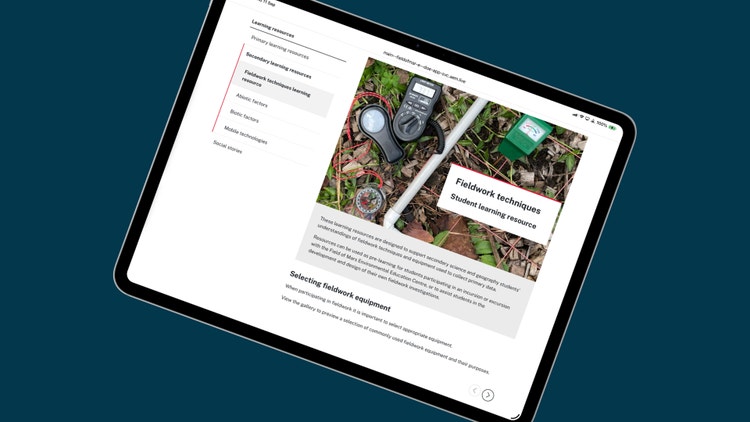
Fieldwork techniques
Help students prepare to use maps, quadrats, transects, water-testing equipment, sampling methods and digital tools to collect and record geographical data.
Location

Blackman Park
Blackman Park is located beside the Lane Cove River in Lane Cove West on Cammeraygal Country.
Find risk assessment information, accessibility advice, bus access details, meeting points, emergency assembly information and a walking track preview.
Extend student learning
Use these student-friendly fact sheets before or after the Environmental change and management excursion to support investigations of riverine environments, human impacts, water quality, invasive plants and environmental management.
- Urban environments fact sheet – Learn how urban places can affect biodiversity, green spaces, waterways and environmental quality.
- River and creek environment fact sheet – Explore how waterways can be affected by erosion, stormwater, pollution and catchment change.
- Estuary environments fact sheet – Learn about environments where freshwater, saltwater, sediment, tides and human impacts interact.
- Water habitats fact sheet – Explore water habitats that support water quality testing and aquatic ecosystem investigations.
- Eucalypt forest ecosystem fact sheet – Learn how forest ecosystems can be affected by weeds, disturbance, changed runoff and management actions.
- Ground cover habitats fact sheet – Learn how grasses, ferns and low plants protect soil, reduce erosion and provide habitat.
Learn with us

Book this excursion
Book this Stage 5 Geography excursion using our online booking form.
Supporting resources
Access fieldwork techniques, fact sheets and digital resources that support secondary Geography fieldwork, inquiry and data analysis.
Related secondary Geography programs
Water in the world excursion
Investigate water resources, waterway health, catchment processes, cultural values and water management through Stage 4 Geography fieldwork.
Landscapes and landforms excursion
Investigate riverine landscapes, geomorphic processes, human impacts and the ways people value, manage and protect environments.